
Why Privy by IDfy's #1 MeitY-NeGD Ranking Matters for India's DPDP Compliance
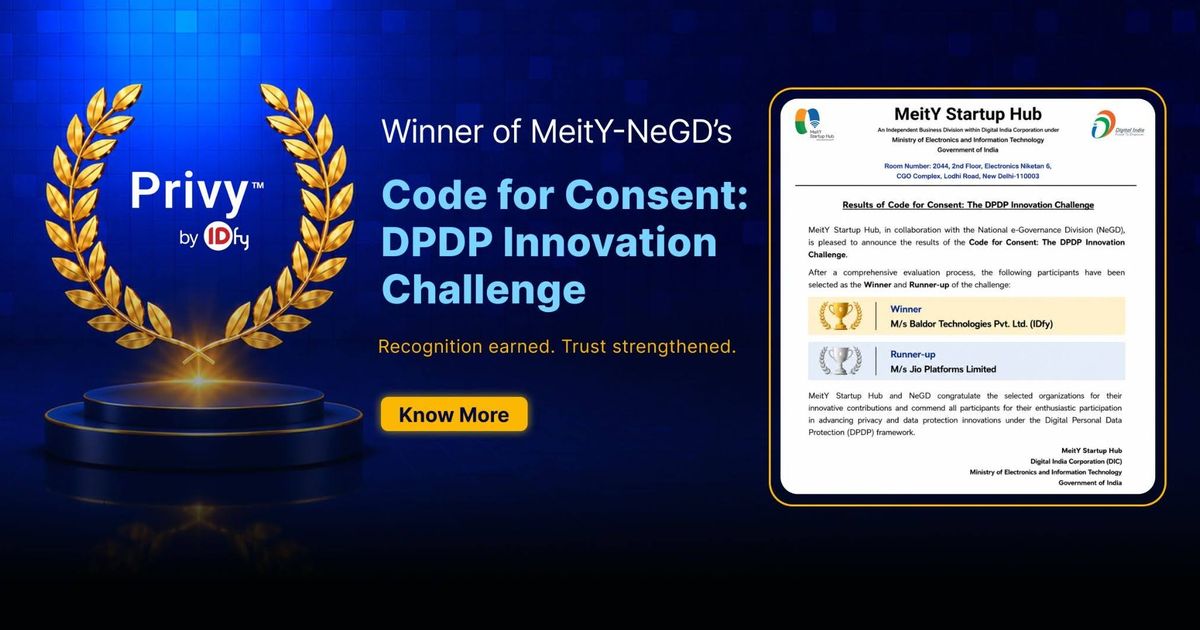
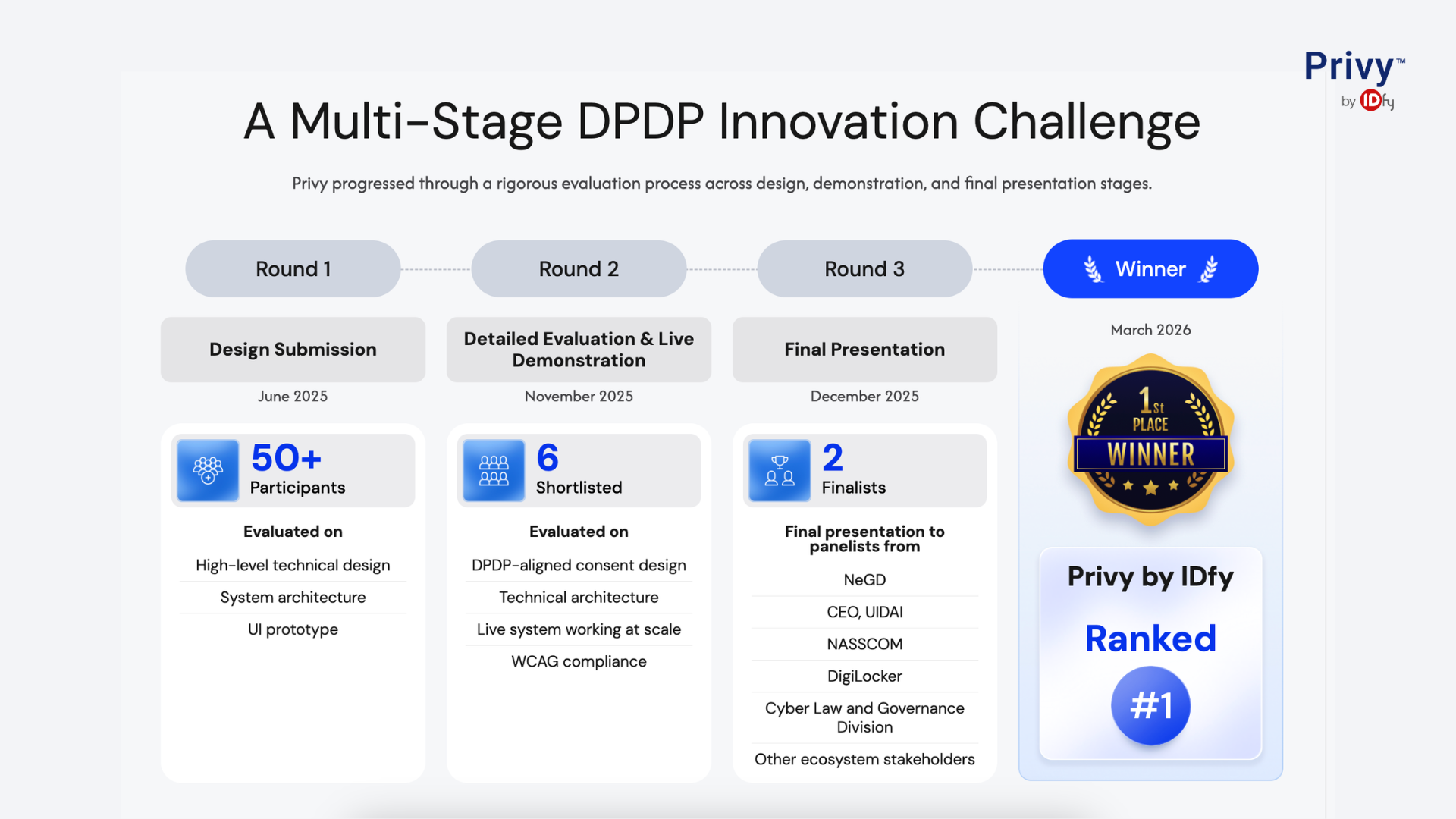
The Ministry of Electronics and Information Technology did not hand out a participation certificate. The "Code for Consent: DPDP Innovation Challenge" was a competitive government evaluation with a Business Requirement Document, a three-month coding sprint, periodic review sprints assessed on functionality, compliance, usability, and scalability, and a ranked outcome. Six entities entered. Privy by IDfy, built by Baldor Technologies (IDfy), was ranked number one. Today, 50+ organisations rely on Privy's privacy governance and DPDPA implementation expertise. That number is backed by the kind of validation that no marketing claim can replicate.
That result matters far beyond a badge on a website. It answers a question that every enterprise evaluating DPDPA compliance infrastructure in India has to ask, and has had no government-backed way to answer until now: which of these platforms has actually been tested against what the DPDP Act requires? Privy's full validation details are documented on the official MeitY Innovation Challenge winner page.
What the MeitY Challenge Actually Was
In June 2025, the National e-Governance Division (NeGD) under MeitY released a Business Requirement Document for building consent management systems under the DPDPA. The BRD defined exactly what a compliant consent manager needs to do: user consent must be specific, revocable, and traceable; the system must support multilingual dashboards; records must be maintained with immutable audit trails; and real-time consent verification via secure APIs must block any data request where consent is missing, expired, or withdrawn.
MeitY then ran a competitive challenge, supervised by the MeitY Startup Hub, to identify which Indian entities could actually build this to specification. Six were shortlisted for the coding round: Jio Platforms, IDfy (Baldor Technologies), Redacto (VertexTech Labs), Zoop (Quagga Tech), Concur Consent Manager, and Aurelion Future Forge. They were evaluated through periodic review sprints over three months, not a single presentation. IDfy's Privy was ranked first. The official result is publicly available in MeitY's announcement and the result PDF.
Why the Ranking Is a Structural Trust Signal, Not a Marketing One
India's DPDPA creates a role that does not exist in GDPR or most other privacy frameworks: the consent manager. Under the Act, a consent manager is a registered entity that acts as a single point of contact between data principals and data fiduciaries, enabling individuals to give, manage, review, and withdraw consent through a single interface, rather than managing it separately with each enterprise they interact with.
This role carries specific eligibility requirements written into the Act itself. A consent manager must be an entity incorporated in India. It must meet a minimum net worth threshold (₹2 crore). It must be registered with the Data Protection Board once registration opens, currently expected around November 2026.
Foreign platforms, regardless of their GDPR credentials, market share, or sales presence in India, are structurally ineligible to operate as consent managers under the Act's terms. OneTrust, TrustArc, and Usercentrics cannot apply for consent manager registration. Privy by IDfy can. And of all the India-incorporated entities that competed in MeitY's challenge to demonstrate readiness for exactly this role, Privy ranked first.
That is the distinction that matters for enterprise procurement decisions. Buying a consent platform that cannot operate as a registered consent manager is buying a tool that may need to be replaced or supplemented as the regulatory architecture matures.
What MeitY's BRD Required and How Privy Delivered It
The evaluation criteria from the BRD are specific enough to be instructive. Each is worth examining against what Privy's platform actually does.
Consent must be specific and traceable. Privy's consent governance platform maps every consent record to a specific processing purpose, a specific data category, and a specific interaction point in the customer journey. The record is not a binary yes. It is a timestamped, purpose-linked artefact that shows exactly what a data principal agreed to, for which data, at which moment.
Consent must be revocable in real time. Withdrawal is one of the most operationally demanding requirements in the Act. A data principal withdrawing consent must be able to do so through the same channel or an equally accessible one, and the enterprise must stop the relevant processing immediately. Privy's platform automates that withdrawal workflow, propagating it to the relevant processing systems rather than leaving it as a manual task for a compliance team.
Multilingual support is mandatory. India's digital population spans dozens of languages. A consent notice that a user cannot read in their language is not a valid notice for purposes of the Act. Privy supports multilingual consent delivery natively, built for India's linguistic diversity rather than added as an afterthought.
Immutable audit trails for records. Consent records under the DPDP Rules must be maintained for a data retention period of seven years by a consent manager. Each record stored in Privy uses hashing and versioning to ensure tamper-proof evidentiary integrity. An auditor or the Data Protection Board can verify that a consent record has not been altered since it was created.
Real-time API verification before data use. Privy's consent infrastructure operates as an API layer that data fiduciaries can query before any personal data is collected or processed. If a valid consent record does not exist for the requested purpose, the transaction is blocked automatically. This is what "real-time consent verification" means in practice, not a batch check at the end of the day.
What 14 Years of Identity Infrastructure Adds to Consent
The MeitY win is partly a product story and partly a lineage story. IDfy has spent 14 years building identity verification infrastructure for India's most regulated enterprises: Axis Bank, HSBC, TrustPaisa, and hundreds of others across BFSI and fintech. That means 14 years of operating at the intersection of Indian regulatory requirements, Indian identity documents (Aadhaar, PAN, Voter ID, NACH mandates), and the Indian digital user journey.
Consent management for DPDPA is not a standalone product. It is an extension of the identity and trust layer that Indian enterprises have been building for years. A consent notice that asks for agreement to process Aadhaar data needs to be delivered to a user who has already been verified against that Aadhaar. The consent record that governs a financial transaction needs to be retrievable alongside the KYC record that underpins it. These are not separate systems. They are the same system.
Privy integrates consent governance with data discovery and mapping and Data Principal rights management in one platform, built on the IDfy identity and RegTech foundation. Privacy impact assessments and incident response run on the same audit trail, not siloed from the consent layer. The consent record does not stand alone. It is the operating surface of a full compliance programme.
What This Means for Enterprises Evaluating DPDPA Compliance Now
The practical implications of the MeitY ranking are three.
For enterprises selecting a DPDPA compliance platform today: the ranking is the closest thing available to an independent, government-conducted evaluation of which India-built compliance infrastructure actually meets the Act's requirements. It is not a regulatory approval (the Data Protection Board has not yet registered any consent managers), but it is an authoritative signal covering the full obligation stack.
For enterprises expecting SDF designation: Significant Data Fiduciaries face annual DPIA requirements, algorithmic due diligence, and DPO appointment obligations in addition to consent requirements. A platform that handles consent but not PIAs or algorithmic assessment creates operational silos. Privy covers both because it was built as a full stack.
For BFSI enterprises specifically: The RBI has separately signalled expectations around unified consent management for customer data. Banks and NBFCs are building toward a world where RBI data governance requirements and DPDPA compliance converge. A consent platform that cannot handle financial sector data flows, Aadhaar-linked KYC, NACH mandates, and dual-regulation contexts is not the right infrastructure for this sector.
Trusted by India's Leading Enterprises
Recognition from MeitY matters. So does the trust of the enterprises that have gone live. Privy by IDfy now has 30+ live implementations ongoing across 6 industry verticals. The client base spans India's most regulated sectors, which is also where DPDPA obligations are most consequential.
Banks and Insurance: Axis Bank, HSBC, Federal Bank, City Union Bank, Aditya Birla Capital Health Insurance, Aditya Birla Capital Life Insurance
NBFCs: Shriram Finance, Aditya Birla Capital, Axis Finance, Flipkart Finance, Finova Capital, Aditya Birla Capital Home Loans, Infina
Investments and Wealth: Axis Capital, Aditya Birla Capital Mutual Funds, Aditya Birla Capital Stocks and Securities, Aditya Birla Capital Pension Fund
Consumer and Ecommerce: Shoppers Stop, Housing.com, Wakefit
Fintechs: Aditya Birla Capital Digital, InvoiceMart, SunCrypto, TrustPaisa
Telco and Services: Airtel, Teleperformance, Aditya Birla Capital Wellness, Khaitan and Co
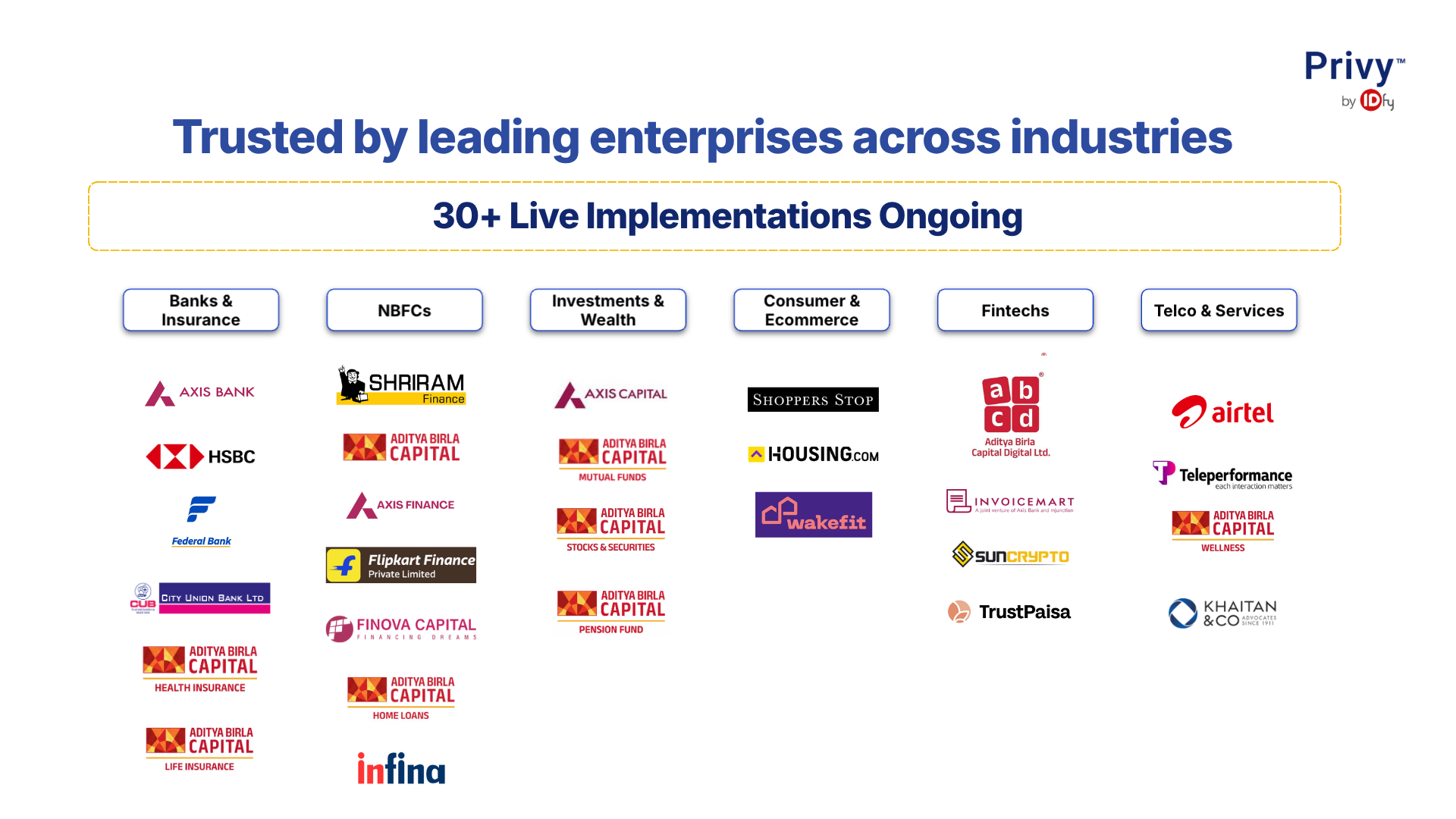
The breadth of this client base, across BFSI, fintech, ecommerce, telco, and professional services, reflects a single underlying point. DPDPA compliance is not a niche requirement. It applies to every enterprise that collects and processes the personal data of Indian residents. The enterprises above have chosen to build their DPDPA programmes on Privy, backed by MeitY's validation and IDfy's 14 years of RegTech infrastructure.
Conclusion
Winning MeitY's DPDP Innovation Challenge means Privy by IDfy has been evaluated by the Indian government against the specific technical, compliance, and usability requirements the Act demands, and came first. Privy is not a consent banner tool. It is a full-stack DPDPA compliance platform covering consent governance, data discovery, Data Principal rights, PIAs, vendor risk, incident management, and audit trails, and it is the only one in India that carries this government ranking.
For enterprises that are still evaluating which DPDPA compliance platform to build their programme on, the answer to "who has the Indian government tested and ranked?" is now public record. To explore what MeitY validated consent infrastructure looks like in practice for your organisation, or to book a demo of Privy's full DPDPA compliance stack, write to shivani@idfy.com.
FAQ's
What was the MeitY DPDP Innovation Challenge?
The "Code for Consent: DPDP Innovation Challenge" was a government competition overseen by the National e-Governance Division (NeGD) under MeitY, designed to identify entities capable of building compliant consent management infrastructure under the DPDPA. Six entities were shortlisted and evaluated over a three-month coding sprint. Privy by IDfy (Baldor Technologies) was ranked number one.
What is a consent manager under the DPDPA?
A consent manager under the DPDPA is a registered entity that acts as a single point of contact between data principals and data fiduciaries, enabling individuals to give, manage, review, and withdraw consent through a unified interface. Consent managers must be India-incorporated entities meeting minimum net worth requirements and will need to register with the Data Protection Board.
Can foreign platforms operate as consent managers under the DPDPA?
No. The DPDPA requires consent managers to be entities incorporated in India. US and EU-incorporated platforms such as OneTrust, TrustArc, or Usercentrics are structurally ineligible to operate as registered consent managers under the Act, regardless of their global market position.
What did the MeitY challenge evaluate consent managers on?
Functionality, compliance with the DPDPA's technical requirements, ease of use, and scalability. Specific requirements included specific and traceable consent, real-time revocation, multilingual support, immutable audit trails, and real-time API verification before data collection.
How does Privy's consent platform differ from a cookie banner tool?
A cookie banner tool manages cookie consent at the browser level. Privy's consent governance platform manages the full DPDPA consent lifecycle: Rule 3 notice delivery across all data collection touchpoints, purpose-linked consent records, multilingual delivery, real-time withdrawal propagation, seven-year record retention with tamper-proof audit trails, and API-level consent verification integrated with data processing workflows.
Search Here
Explore More

Aug 11, 2026
DPDP for Board: A Leadership Framework

Jun 23, 2026
What Does DPDPA Compliance Actually Cost? A CFO's Guide for Indian Enterprises
Share




 shivani@idfy.com
 Unit no. 801, Skyline Icon, 804, Andheri - Kurla Rd, Chimatpada, Marol, Andheri East, Mumbai, Maharashtra 400059
 1800 123 4339