

Encryption in Transit
Definition
Encryption in transit is the process of protecting data while it is being transmitted between devices, applications, networks, or cloud services to prevent unauthorized access or interception.
Encryption in transit, also known as data-in-transit encryption or encryption in motion, protects data as it travels between systems, users, applications, APIs, databases, or cloud environments. It uses cryptographic protocols to ensure that information exchanged over public or private networks cannot be read or altered by unauthorized parties during transmission. Common technologies that enable encryption in transit include Transport Layer Security (TLS), HTTPS, Secure Shell (SSH), IPsec, and Virtual Private Networks (VPNs).
Modern organizations continuously exchange sensitive information across distributed digital ecosystems. Personal data may travel between web browsers and applications, mobile apps and backend servers, cloud services and on-premises systems, or business partners through APIs. Without encryption in transit, attackers may intercept communications through techniques such as packet sniffing, man-in-the-middle (MITM) attacks, or network eavesdropping. Encrypting data during transmission helps preserve confidentiality and integrity while reducing the risk of unauthorized disclosure or tampering.
The Digital Personal Data Protection Act, 2023 (DPDP Act) does not prescribe encryption in transit as a mandatory technical requirement. Instead, it requires Data Fiduciaries to implement reasonable security safeguards to protect personal data from Personal Data Breaches. Depending on the organization's risk profile and the nature of the personal data being processed, encryption in transit is widely recognized as an appropriate safeguard. It also aligns with internationally accepted security frameworks such as ISO/IEC 27001, the NIST Cybersecurity Framework, and secure software development best practices.
In practice, gaps emerge when:
- Web applications transmit personal data over unsecured HTTP connections instead of HTTPS.
- Internal APIs exchange sensitive information without transport layer encryption.
- Legacy systems continue using outdated encryption protocols or weak cipher suites.
- Mobile applications fail to validate digital certificates, increasing the risk of man-in-the-middle attacks.
- Organizations encrypt internet-facing traffic but overlook encryption for internal service-to-service communications.
Organizations strengthen security by enforcing HTTPS across applications, adopting modern TLS versions, securing APIs, implementing certificate lifecycle management, monitoring encrypted communications, and regularly reviewing cryptographic configurations. Within Privy, capabilities such as automated data discovery, data classification, data mapping, governance workflows, and compliance reporting help organizations identify where personal data is transmitted so that appropriate security controls—including encryption in transit—can be implemented as part of a broader privacy and security program.
Questions About Staying in Control?
Here’s everything you need to know about this term and how it fits into your compliance program.
Encryption in transit protects data while it is moving between devices, applications, networks, or cloud services, ensuring that unauthorized parties cannot intercept or read the information.
It helps prevent eavesdropping, man-in-the-middle attacks, and unauthorized interception of sensitive information during transmission, improving data security and privacy.
The DPDP Act does not explicitly mandate encryption in transit. However, organizations are required to implement reasonable security safeguards, and encryption in transit is widely recognized as an effective measure to protect personal data.
Encryption in transit protects data while it is being transmitted across networks, whereas encryption at rest protects data while it is stored in databases, cloud storage, backups, or other storage systems.
Privy helps organizations identify where personal data flows through automated data discovery, data mapping, and governance capabilities, enabling security teams to implement appropriate controls such as secure transmission protocols, encryption, and continuous monitoring.
Still have a question?
Latest Blog

Sep 30, 2026
RBI NBFC Rules Just Banned Dark Patterns and Fake Consent
Sep 29, 2026
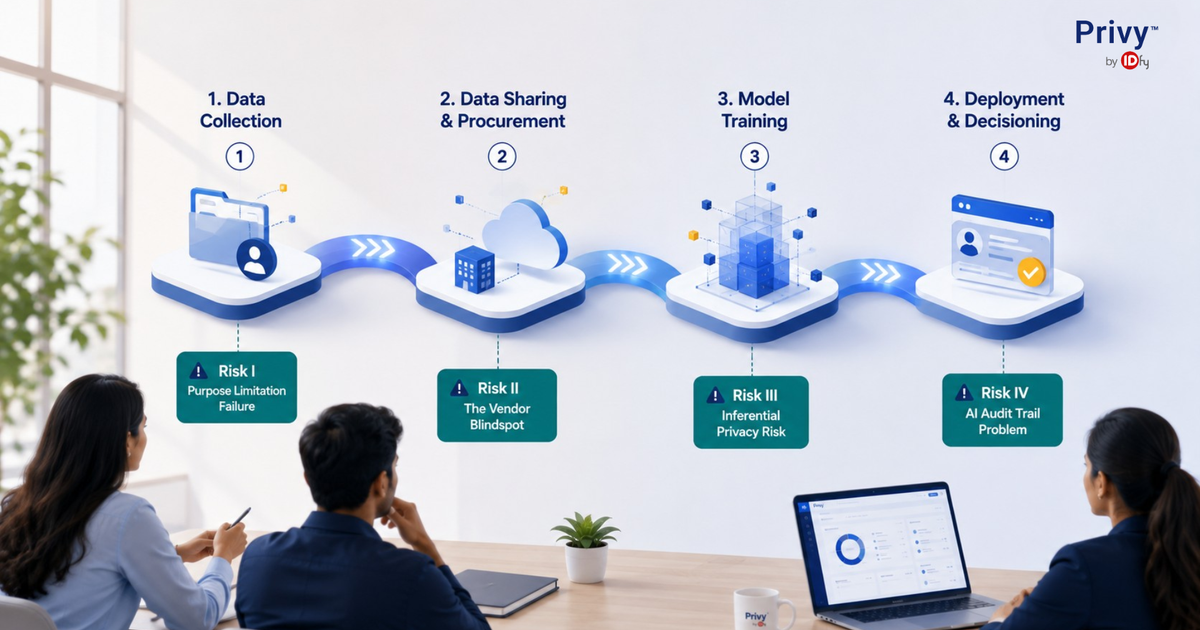
Data Privacy in the AI Era: The Four Risks Indian Corporations Have Already Inherited
Sep 10, 2026




 shivani@idfy.com
 Unit no. 801, Skyline Icon, 804, Andheri - Kurla Rd, Chimatpada, Marol, Andheri East, Mumbai, Maharashtra 400059
 1800 123 4339