
Zero Knowledge Proof
Definition
Zero Knowledge Proof is a cryptographic technique that allows one party to prove the validity of information without revealing the underlying data.
In the context of the DPDP Act, Zero Knowledge Proof (ZKP) is a privacy-enhancing technology that can help organizations verify information while minimizing the exposure of personal data.
Zero Knowledge Proof allows a party to demonstrate that a specific statement is true without sharing the actual information behind that statement. For example, an individual may prove that they meet a certain eligibility requirement without revealing additional personal details.
By reducing the need to share raw personal data, ZKP can support principles such as data minimisation and privacy-by-design approaches. Organizations can explore privacy-enhancing technologies like Zero Knowledge Proof to reduce unnecessary data exposure while enabling secure verification processes.
Although ZKP is not specifically mandated under the DPDP Act, it can support organizations in building stronger privacy practices and reducing risks associated with excessive personal data sharing.
In Practice, Gaps Emerge When:
- Organizations collect more personal data than required for verification.
- Verification processes depend on sharing complete identity information.
- Sensitive data is exposed unnecessarily during authentication.
- Privacy-enhancing technologies are not considered.
- Teams lack visibility into opportunities for data minimisation.
Organizations address these challenges by adopting privacy-enhancing technologies, minimizing data collection, strengthening identity verification processes, and implementing secure data-sharing practices. Within Privy, capabilities such as data minimisation, consent management, data discovery, and privacy workflows help organizations strengthen personal data governance.
Questions About Staying in Control?
Here’s everything you need to know about this term and how it fits into your compliance program.
Zero-knowledge proof is a cryptographic method that allows verification of information without revealing the actual data.
It reduces unnecessary exposure of personal data by allowing organizations to verify information without collecting or sharing complete data sets.
No. Zero Knowledge Proof is not mandated under the DPDP Act but can support privacy-enhancing and data minimisation practices.
It can be used in areas such as identity verification, authentication, eligibility checks, and secure data sharing.
Privy helps organizations improve data visibility, manage consent, support data minimisation, and strengthen privacy governance.
Still have a question?
Latest Blog

Sep 30, 2026
RBI NBFC Rules Just Banned Dark Patterns and Fake Consent

Sep 29, 2026
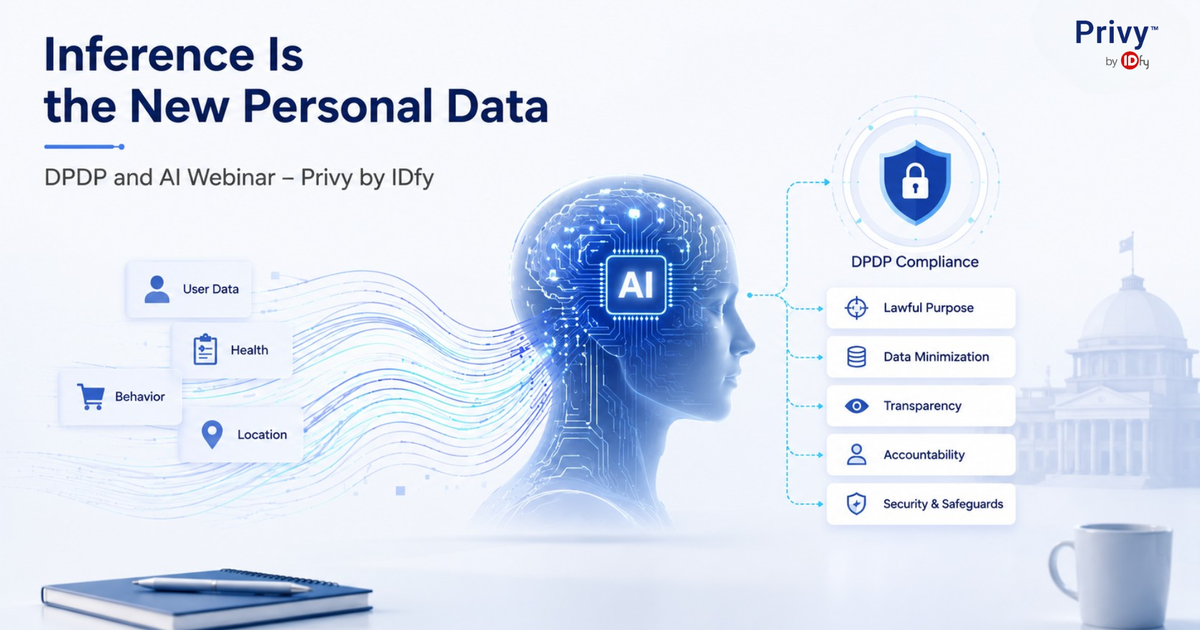
Data Privacy in the AI Era: The Four Risks Indian Corporations Have Already Inherited
Sep 10, 2026




 shivani@idfy.com
 Unit no. 801, Skyline Icon, 804, Andheri - Kurla Rd, Chimatpada, Marol, Andheri East, Mumbai, Maharashtra 400059
 1800 123 4339