

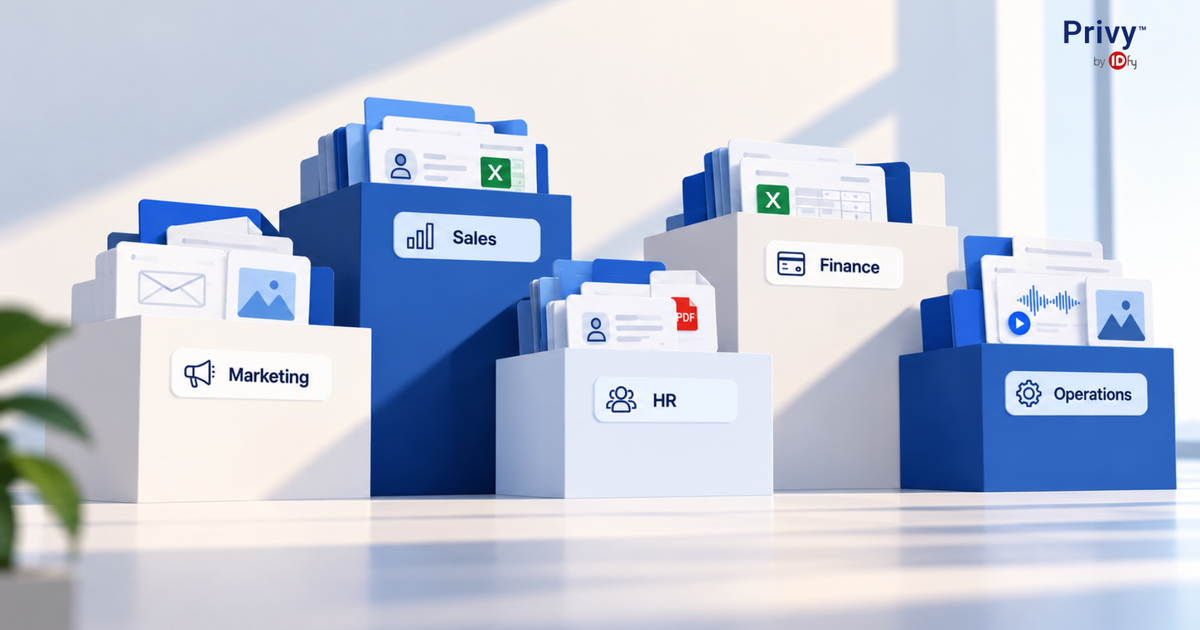
Data Silos and Duplicate Copies: Why You Can't Govern Personal Data You Can't See Across Departments
Every department in a large organisation runs its own systems. Sales has the CRM. Credit has the loan platform. Collections works from spreadsheets. Analytics keeps a reporting database. People usually talk about these data silos as an efficiency problem. Under the DPDP Act, they are also a compliance problem, because personal data does not stay inside department walls. It gets exported, extracted, and sent to vendors, until the same customer exists in more places than any one team can see. When a Data Principal asks you to erase her personal data, how many of those copies can you name?
Example: a customer takes a vehicle loan from a regional NBFC. Her relationship manager enters her PAN and mobile number into the CRM. The credit team pulls her Aadhaar and bank statements into the loan system and sends the file to a verification agency. Every night, analytics copies the loan table into a reporting database. After one missed EMI, collections adds her to the monthly overdue list and forwards it to field agents on WhatsApp. When her loan closes, marketing hands a cross-sell list to an outside telecalling agency.
Every step was routine. Her personal data is now in at least six places, across five departments and two outside companies. No one holds the full list.
Data silos do not stop personal data from moving. They only stop you from seeing where it went.
What Are Data Silos? Meaning and Data Duplication Explained
Large organisations run on data silos, and that is normal. Data silos are stores of data that one team owns and other teams cannot easily see. A CRM, a loan system, and a collections spreadsheet are each a silo. Data duplication is the other half: copies of the same data in more than one place. It is also called data redundancy.
Silos hide the copies. Duplication creates them. In a bank or an NBFC, data silos leak copies in three ways: exports, extracts, and files sent to vendors.
Three Kinds of Data Duplication That Spread Personal Data
Data silos let three kinds of copies spread.
Exports: The Copy Made for One Afternoon
The simplest copy is the export. Someone downloads a spreadsheet for a reconciliation or a call list. The work takes an afternoon. The file stays for years on a shared drive or a laptop, outside the access rules, retention routine, and correction screens that cover the source. A deletion or update on the loan system never reaches it. Data silos keep each team's exports out of everyone else's view.
The overdue list sent to the field agents the month she missed an EMI still names her as overdue, long after she has paid.
An export is a one-off decision with a permanent result.
Extracts: The Copy That Rebuilds Itself
Extracts are scheduled copies, like the nightly feed into the reporting database. Engineers build them, and schedulers run them. Nobody in the business owns them.
An extract copies personal data on every run, not once. If the team deletes her from the reporting database alone, the next full reload copies her back. If the team deletes her at the source instead, an extract that only adds rows keeps her forever.
Nobody decided to keep her data. A scheduler did.
Vendor Shares: The Copy You No Longer Hold
The hardest copy is the one that leaves your systems. Months after her loan closes, she withdraws her consent to marketing calls. The NBFC updates the CRM. The agency calls her again from the list it already holds, because a flag in your CRM has no route to a file on someone else's server.
A signed contract feels like control, but it is only a promise. It does not show you where the file is. From 13 May 2027, Section 8(1) makes the data fiduciary responsible for processing done on its behalf by a data processor, whatever the contract says. That is why sharing data with third-party processors carries risk beyond the contract.
Section 6(6) goes further. Once she withdraws consent, you must stop processing her personal data within a reasonable time. Your data processors must stop too, unless a law requires or allows the processing. You can only make an agency stop if you recorded which agency received which file.
Why DPDP Makes Every Copy Count
The Act defines personal data as any data about an individual who can be identified from it. It counts storage and sharing as processing. It does not ask whether a record is the original or the fourth copy. Data silos hide the copies, and the Act counts every one.
Data duplication multiplies the work behind each duty. These apply from 13 May 2027:
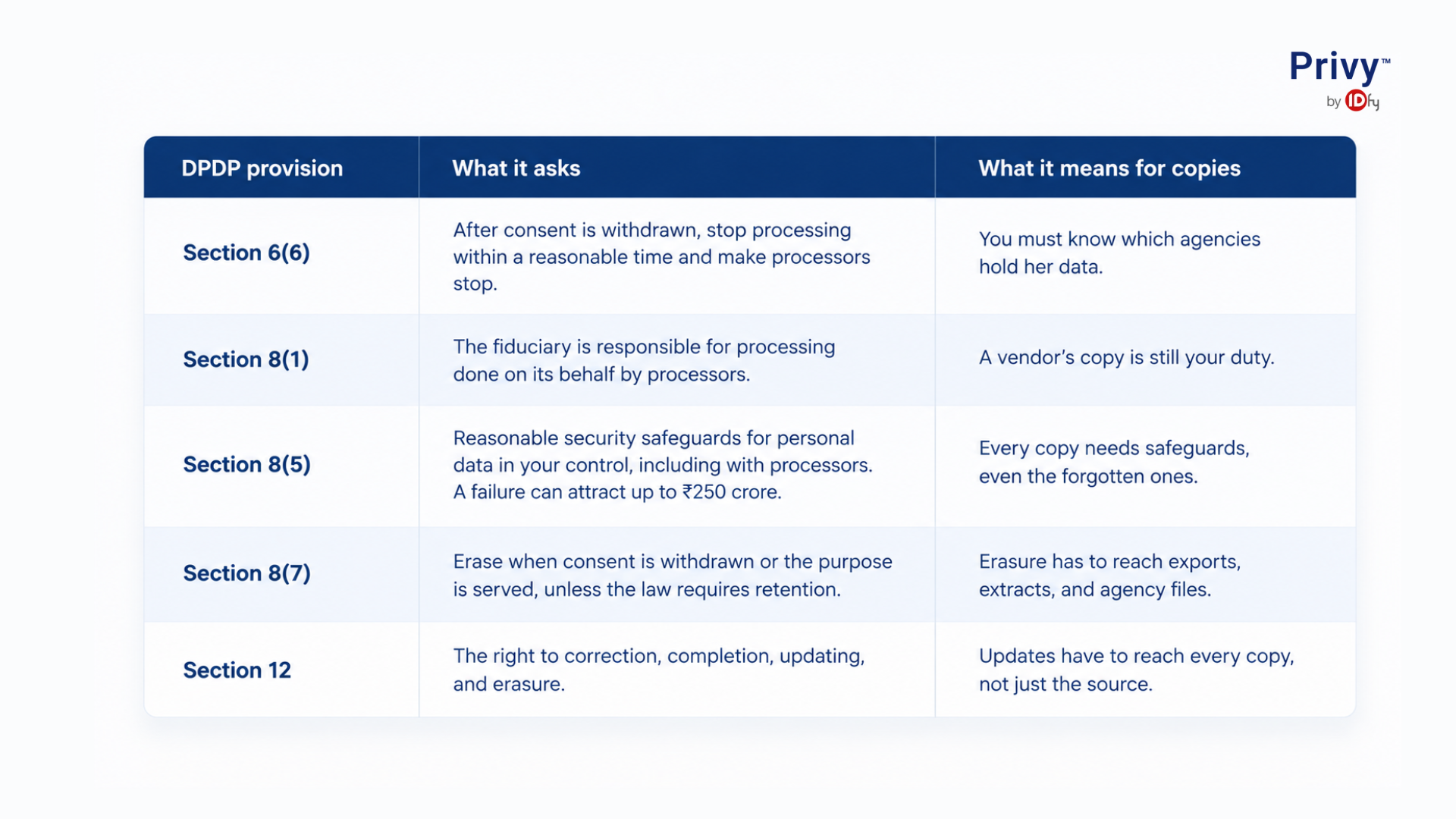
Each duty is only as good as your list of copies, and data silos make that list hard to build. Her CRM record shows a closed loan and a withdrawn consent. The overdue list on the agents' phones and the call list at the agency show neither, and neither is on anyone's list.
Why Department Surveys Miss the Copies
A common first step is to survey department heads. Every head answers honestly, and the total is still wrong. Each one lists the systems the team owns. They do not list the exports, extracts, and agency files made from those systems.
A survey asks each silo to describe itself, so it cannot see across data silos. It records what people own. Personal data lives in what they copied.
What Seeing Across Data Silos Actually Means
Seeing across data silos starts from the data, not the org chart. Data silos make the org chart a poor guide to where personal data is. Three checks need no tool:
- Pick five loans closed last quarter. Search for each customer's mobile number in the reporting database, the collections drive, and the files sent to each agency. Every unexpected hit is a copy the survey missed.
- Ask the engineers whether each scheduled extract replaces its target table or only adds to it, and whether a delete at the source ever reaches it.
- Log every file sent to an agency. Ask each agency how it deletes your data when the work ends, and what proof it will show you.
Run that trace on her number, and both forgotten copies show up. Collections tells its agents to delete the old list and sends a corrected one. Marketing tells the agency to stop calling her and to confirm in writing that it has.
Five customers make a test, not a map. Next, map where each type of personal data lives, using data discovery. Give each finding a departmental owner who can justify it or erase it, and keep the result in a data inventory. Then repeat the map, because extracts refresh and exports keep landing.
Finding the copies does not tell you which ones to keep. It tells you which conversations to have, and it turns collecting and keeping less personal data into a task list.
For vendor questions, read what a DPDP compliance platform needs to have in 2026 and IDfy's seven things an ideal DPDP solution should have.
How Privy Shows Which Departments Hold What
Personal Data Discovery & Governance looks across data silos and shows what personal data is held where, grouped the way you define.
- Where it looks: a range of databases, cloud storage, and SaaS sources, such as PostgreSQL, Amazon S3, Azure Blob Storage, Google Cloud Storage, Google Drive, and SFTP.
- How it groups results: each source belongs to a domain and subdomain you choose, so the results can mirror your own departments.
- What it finds: Indian identifiers such as Aadhaar, PAN, Voter ID, passport, and driving licence, plus phone numbers and email addresses.
- What it answers: pick one type of personal data on the dashboard, Aadhaar for example, and see which subdomains hold it and how it splits across storage types. A scan can run on a schedule, reading a sample each time, so the picture is rechecked and not taken once.
Data Discovery & Classification builds that picture. Automated Data Lineage records how data moves between systems, including flows that leave your network. The route to the telecalling agency is visible before the next list goes out.
Data Principal Rights Management routes access, correction, and erasure requests across connected systems. Third-Party Risk Management keeps each vendor and agreement in one register.
Conclusion
A survey asks which systems each department owns. Her withdrawal asked which copies each department made, and who received them. The NBFC that can stop the calls is the one that knows where the cross-sell list went.
Data silos are how organisations are built, and data duplication is how personal data escapes them. Departments own systems. Nobody owns the copies.
To see how Privy by IDfy can show which departments hold what, book a demo or write to shivani@idfy.com.
FAQ's
What is a data silo in simple terms?
A data silo is a store of data that one team controls, and others cannot easily see, such as a CRM, a loan system, or a collections spreadsheet. Data silos matter for DPDP because personal data leaves them as exports, extracts, and vendor files.
What is data duplication?
Data duplication is the same data held in more than one place, also called data redundancy. In a bank or NBFC, it usually takes three forms: exports, scheduled extracts, and files sent to vendors.
Are data silos a DPDP problem?
Yes. The Act does not care where a record is held, and every duty depends on knowing where your copies are. Data silos make that list hard to build.
How do you find duplicate copies of personal data across data silos?
Start with a trace. Search a few real customers' identifiers across your reporting databases, shared drives, and files sent to vendors. Then map each type of personal data with a discovery tool, give every finding an owner, and repeat the map.
What happens to copies when a customer withdraws consent?
Under Section 6(6) you must stop processing her personal data within a reasonable time. Your data processors must stop too, unless a law requires or allows the processing. Section 8(7) adds erasure once consent is withdrawn or the purpose is served. That reaches exports, extracts, and agency files.
Who is responsible for copies held by vendors?
You are. Under Section 8(1), the data fiduciary stays responsible for processing done on its behalf by a data processor, whatever the contract says. Keep a record of which vendor received which file.
How do you break down data silos without merging every system?
You can govern personal data across silos without merging them. Map where it lives, give each finding an owner, and repeat the map on a schedule.
Search Here
Explore More

May 18, 2025
PII Data demystified

Mar 20, 2026
How SaaS Data Discovery Works Under DPDP Act: The Ultimate Guide to Data Intelligence

Apr 27, 2026
Data Minimization in DPDP: Why Collecting Less Data is the Smartest Strategy in 2026
Share





 shivani@idfy.com
 Unit no. 801, Skyline Icon, 804, Andheri - Kurla Rd, Chimatpada, Marol, Andheri East, Mumbai, Maharashtra 400059
 1800 123 4339