

Why The DPDP Act Matters For Banking Now
Banks and NBFCs act as Data Fiduciaries under the DPDP Act, while third-party vendors process data on their behalf. Effective data governance begins with identifying customer data, systems, and processors.

Phased Compliance Timeline

Consent Manager Readiness

DPDP and RBI Alignment

Cross-Border Data Governance

Third-Party Accountability
Governance Before Compliance
Types Of Personal Data Processed





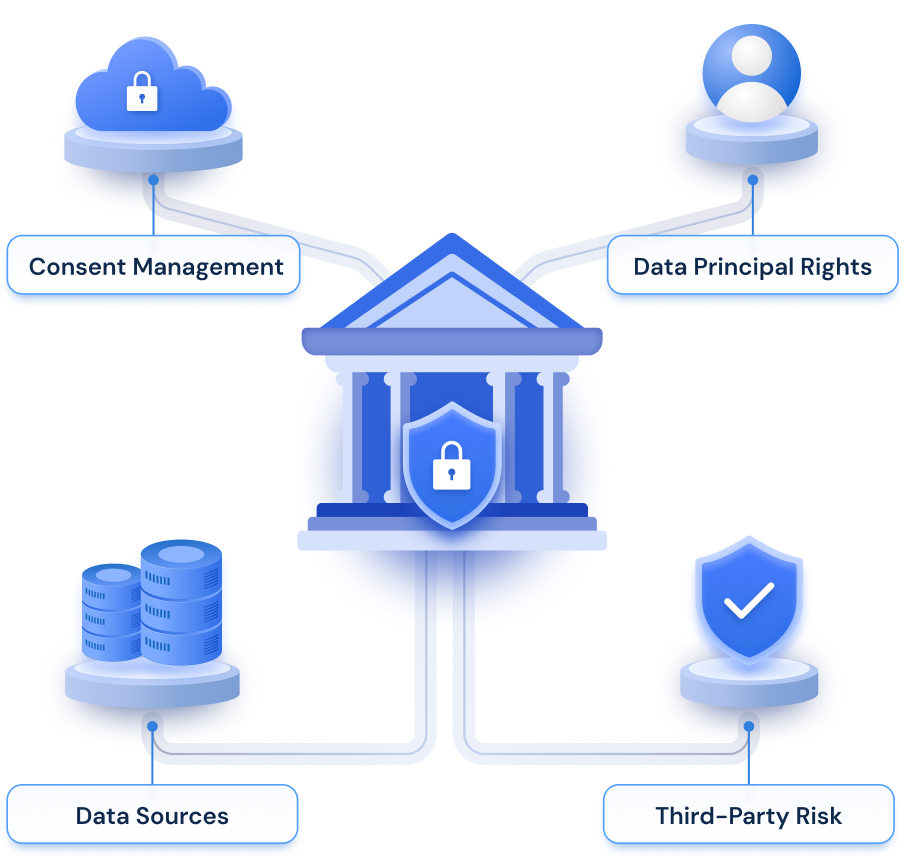
Key Compliance & Data Governance Challenges

Personal data is fragmented across core banking, LOS/LMS, CRM, collections, credit bureaus, and verification systems.
Consent is captured differently across branches, mobile apps, net banking, call centres, and digital lending journeys.
Customer data moves across cloud providers, BPOs, video KYC partners, and credit bureaus, expanding third-party risk.
RBI data localisation requirements and the DPDP Act's cross-border transfer rules must be managed together.
Customer data spread across multiple products makes Data Principal rights requests difficult to fulfil.
Continuous visibility into data flows, consent, and third-party processing is essential for audit readiness.
Built to Solve Every DPDP Challenge
| Banking/NBFC Challenge | Privy by IDfy Capability |
|---|---|
| KYC and biometric data scattered across core banking, LOS/LMS, and BPO vendor systems | Personal Data Discovery & Governance (Data Compass) maps personal data across structured and unstructured systems |
| Consent captured inconsistently across branch forms, mobile app, and net banking | Consent Lifecycle Management unifies capture, versioning, and withdrawal across every channel |
| RBI data-localisation rules for payment data running alongside the DPDP Act's separate cross-border regime | Personal Data Discovery & Governance tracks where each data element sits and which regime applies to it |
| Heavy dependence on BPOs, collection agencies, cloud core banking, and credit bureaus | Continuous Compliance & Risk Management monitors third-party processors against data-processing agreement terms |
| Data Principal rights requests hard to fulfil when a customer's record spans multiple systems | Data Principal Rights Management routes and fulfils access, correction, and erasure requests across connected systems |
| Breach response needs to identify affected data and notify within tight statutory windows once Rule 7 is in force | Continuous Compliance & Risk Management provides an auditable, time-stamped incident response workflow |
| Anticipated Significant Data Fiduciary obligations (DPIA, India-based DPO, algorithmic due diligence for credit models) | Continuous Compliance & Risk Management runs the DPIA cycle and builds the evidence trail regulators expect |
| Net banking portal and marketing site use tracking cookies without DPDP-aligned consent | Cookie Manager brings banner logic and preference storage in line with consent requirements |
| Credit-scoring and fraud models need training data without directly exposing customer PII | Personal Data Discovery & Governance supports classification that enables masking and de-identification ahead of model training |
| No single, current view of privacy posture across consent, data, and vendor risk | InspectAI gives a unified view across all modules, continuously scanning for gaps |

KYC and biometric data scattered across core banking, LOS/LMS, and BPO vendor systems
Personal Data Discovery & Governance (Data Compass) maps personal data across structured and unstructured systems
Consent captured inconsistently across branch forms, mobile app, and net banking
Consent Lifecycle Management unifies capture, versioning, and withdrawal across every channel
RBI data-localisation rules for payment data running alongside the DPDP Act's separate cross-border regime
Personal Data Discovery & Governance tracks where each data element sits and which regime applies to it
Heavy dependence on BPOs, collection agencies, cloud core banking, and credit bureaus
Continuous Compliance & Risk Management monitors third-party processors against data-processing agreement terms
Data Principal rights requests hard to fulfil when a customer's record spans multiple systems
Data Principal Rights Management routes and fulfils access, correction, and erasure requests across connected systems
Breach response needs to identify affected data and notify within tight statutory windows once Rule 7 is in force
Continuous Compliance & Risk Management provides an auditable, time-stamped incident response workflow
Anticipated Significant Data Fiduciary obligations (DPIA, India-based DPO, algorithmic due diligence for credit models)
Continuous Compliance & Risk Management runs the DPIA cycle and builds the evidence trail regulators expect
Net banking portal and marketing site use tracking cookies without DPDP-aligned consent
Cookie Manager brings banner logic and preference storage in line with consent requirements
Credit-scoring and fraud models need training data without directly exposing customer PII
Personal Data Discovery & Governance supports classification that enables masking and de-identification ahead of model training
No single, current view of privacy posture across consent, data, and vendor risk
InspectAI gives a unified view across all modules, continuously scanning for gaps
Recommended
Implementation Journey

Build the Foundation
 Discover and classify personal data across core banking, LOS/LMS, and CRM.
- Audit consent collection across every customer channel.
- Inventory third-party vendors handling customer data.
- Identify contracts requiring updated data-processing terms.


Operationalise Compliance
- Align consent infrastructure with DPDP notice and consent requirements.
- Implement Data Principal rights workflows.
- Establish breach notification processes.
- Update vendor agreements identified during the audit.


Continuous Governance
- Conduct DPIAs if notified as a Significant Data Fiduciary
- Appoint an India-based Data Protection Officer.
- Engage an independent data auditor.
- Continuously monitor compliance, consent, and third-party risks.

Key Takeaways

Banks and NBFCs are Data Fiduciaries under the DPDP Act for customer KYC, transaction, and credit data.

DPDP Rules 2025 were notified on 13 November 2025, with Consent Manager registration from 13 November 2026 and major obligations effective from 13 May 2027.

Non-compliance can attract penalties of up to ₹250 crore per contravention, depending on the nature of the violation.

RBI requirements on data localisation, outsourcing, and governance apply alongside DPDP, requiring institutions to manage both regulatory frameworks together.
A unified privacy management platform enables faster regulatory responses through centralised data mapping, consent records, automated rights management, and continuous third-party risk monitoring.

Early DPDP readiness helps banks build audit-ready evidence, reduce manual compliance effort, and stay prepared for evolving regulatory requirements.
Why Privy by IDfy for Banks & NBFCs
Leading banks and financial institutions trust Privy by IDfy to operationalise DPDP compliance across complex data ecosystems. Our platform enables continuous data governance, centralized consent management, and audit-ready compliance at enterprise scale.

DPDP ready
FAQs
A bank is almost always a Data Fiduciary for the personal data it collects directly from customers KYC documents, transaction records, and credit data because it determines the purpose and means of processing. Vendors it engages to process that data on its behalf, such as a BPO running collections calls, act as Data Processors under contract to the bank.
The Act applies to personal data processing generally, not just data collected after a specific date. Existing customer records collected before the Act's provisions came into force still need to meet the Act's consent, purpose-limitation, and security requirements going forward.
The two operate alongside each other rather than one replacing the other. RBI's 2018 circular requires payment system data to be stored in India specifically. The DPDP Act governs cross-border transfer more broadly and currently permits transfer to any country the government hasn't specifically restricted by notification — no such restriction list has been published as of mid-2026. A bank needs both rules mapped against its actual data flows, not just the more permissive one.
A Consent Manager under the DPDP Act is a registered intermediary through which a Data Principal can manage consent across multiple platforms. It's structurally similar to RBI's existing Account Aggregator framework, which already lets customers consent to share financial data across institutions, but the Consent Manager framework is broader in scope and sits under the Data Protection Board rather than the RBI. Registration for Consent Managers opens 13 November 2026.
The DPDP Act allows the government to notify certain Data Fiduciaries as Significant Data Fiduciaries based on the volume and sensitivity of data they process, among other factors. Institutions processing data at the scale of a large bank or NBFC are widely expected to qualify, but as of this writing the government has not published the specific list or criteria for that notification; treat this as a strong likelihood to prepare for, not a confirmed classification.
Penalties can run up to ₹250 crore per contravention, depending on the nature and severity of the violation, as stated in the Act's Schedule. The exact figure depends on which specific obligation was breached.




 shivani@idfy.com
 Unit no. 801, Skyline Icon, 804, Andheri - Kurla Rd, Chimatpada, Marol, Andheri East, Mumbai, Maharashtra 400059
 1800 123 4339