

How to Map Personal Data for DPDPA Compliance: A Step-by-Step Guide for Indian Enterprises
Every DPDPA obligation that matters writing an accurate consent notice, honouring a data principal's erasure request, scoping a breach within 72 hours, filing a compliant report with the Data Protection Board assumes a single thing your enterprise either has or does not: a current, accurate map of your personal data.
Most Indian enterprises do not have one. They have a data governance policy document, a privacy notice, and a general sense of where customer data lives. That is not a personal data map. It is the precondition for eventually building one. This guide gives you the 7-step process to build a personal data map that satisfies DPDPA obligations, holds up in a compliance audit, and actually stays current after you build it.
What a Personal Data Map Is, and What It Is Not
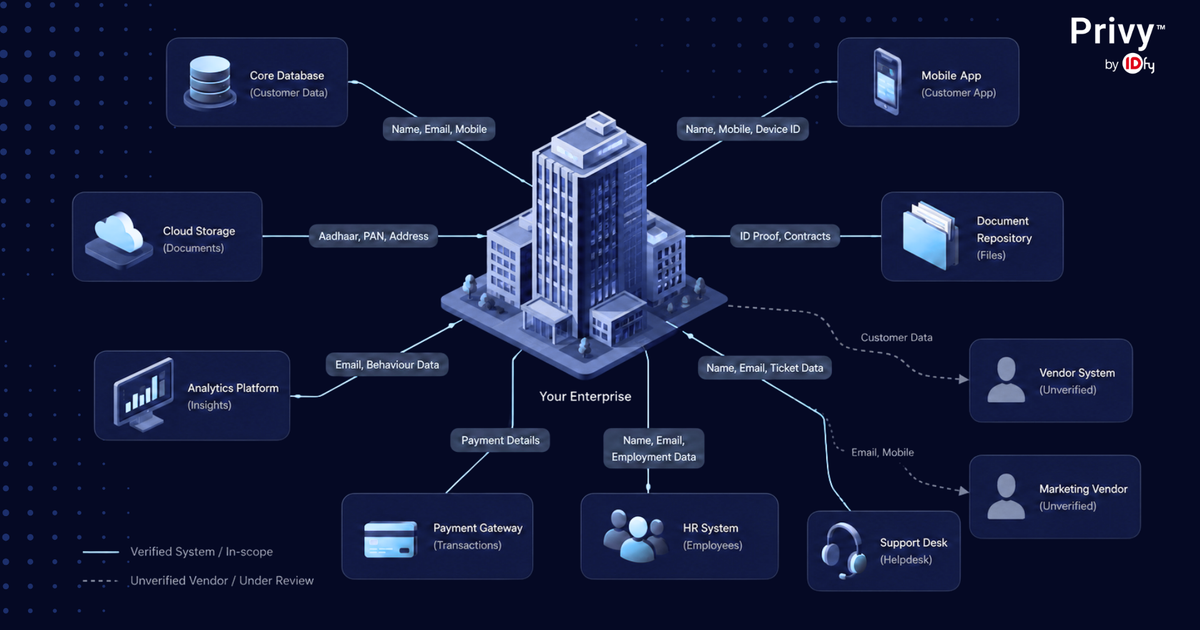
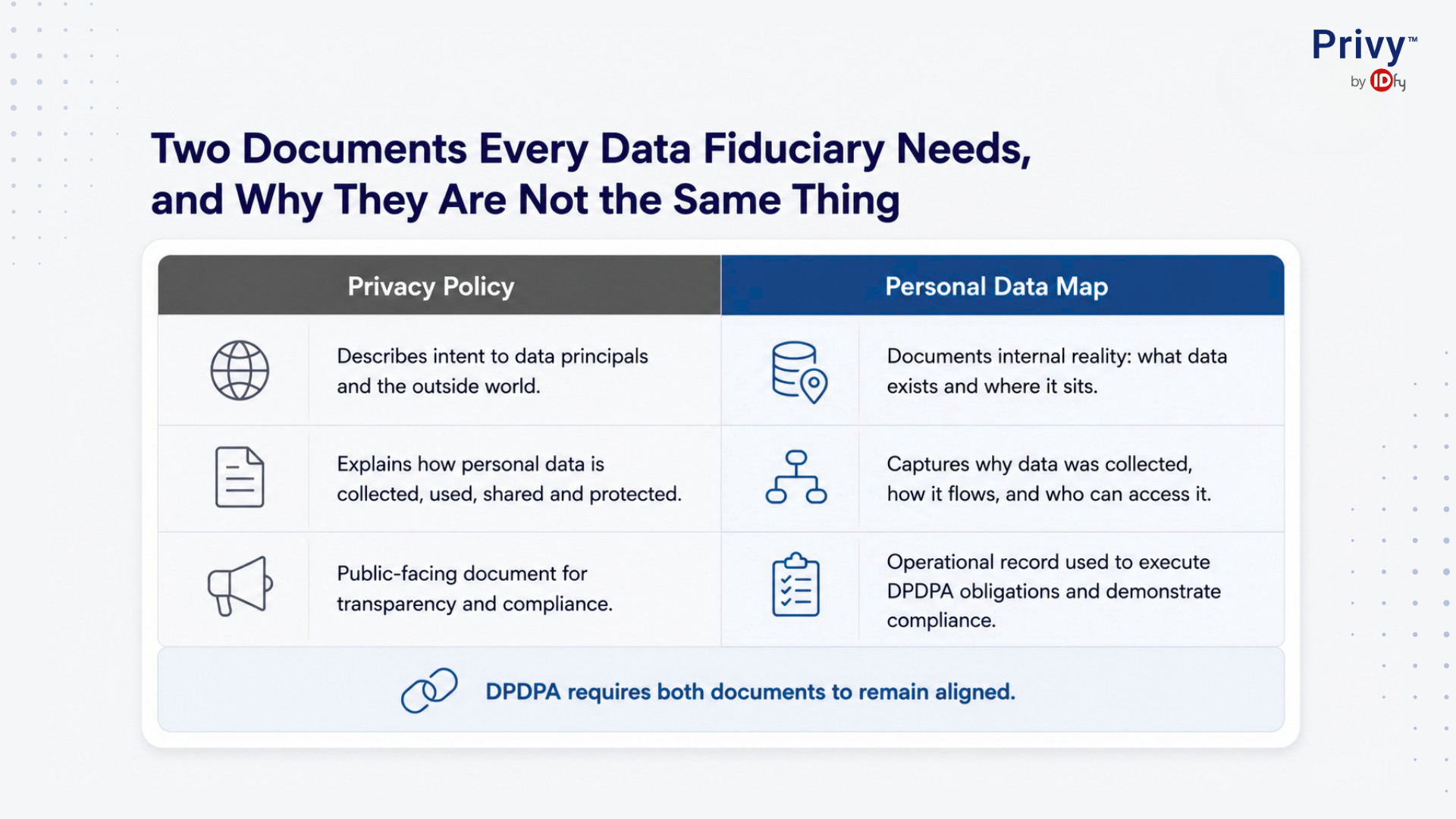
A personal data map is a documented inventory of every category of personal data your enterprise collects, processes, stores, and shares, connected to the purpose it was collected for, the system it sits in, the data processors it flows to, and the retention period that applies to it. It is not a privacy policy. A privacy policy describes your intent to the outside world. A personal data map describes your internal reality, and those two things can diverge significantly once a business has been operating for a few years. A data fiduciary under the DPDP Act needs both, and needs them to match.
It is also not a one-time exercise. Systems change, vendors change, and product features add new data collection points every quarter. A map that was accurate when it was built but never updated is a compliance liability, not an asset.
Why DPDPA Makes Data Mapping Non-Negotiable
The DPDP Rules, 2025 were notified on 13 November 2025, with most substantive obligations taking effect around May 2027. Every one of those obligations contains a hidden prerequisite: knowing what personal data you hold.
A consent notice under Rule 3 must itemise the personal data collected and the specific purpose for each item. You cannot itemise what you haven't catalogued. A data principal requests erasure of their data. You cannot erase data you haven't located. A system is breached, and you need to report affected data categories and individuals within 72 hours. You cannot report what you don't know you held. Data mapping is not a compliance task that sits alongside these obligations. It is the prerequisite that makes all of them executable.
Step 1: Define Your Scope
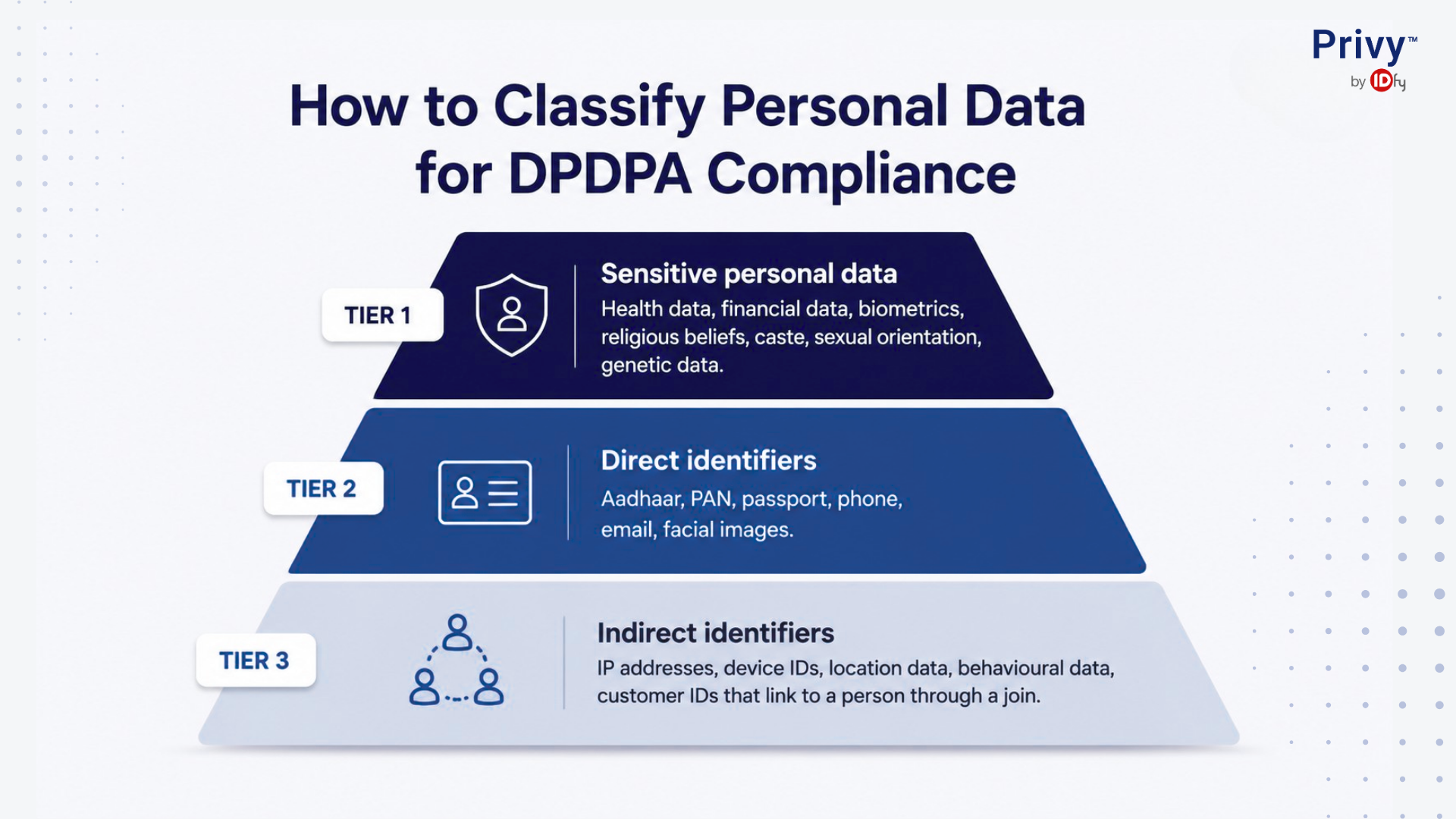
Before mapping anything, define what counts as personal data for your enterprise specifically. The DPDP Act defines it as any data about an individual who is identifiable by or in relation to such data. That is broader than most teams initially assume. Start with 3 categories:
Direct identifiers: Aadhaar numbers, PAN cards, passport numbers, phone numbers, email addresses, facial images, biometrics. Each identifies a person on its own.
Sensitive personal data: Health data, financial data, religious or political beliefs, caste, sexual orientation, genetic data. The DPDP Act applies stricter obligations to these categories, so they need to be flagged separately in your map from the start.
Indirect identifiers: IP addresses, device IDs, location data, behavioural data, customer IDs that link to a person through a join. These are personal data even though they don't name anyone directly.
Your scope definition becomes the classification taxonomy the rest of the mapping exercise applies. To know more about this topic, check this blog: Data Classification Tools and Indian PII, The Gap That Matters
Step 2: Discover Where Personal Data Flows
Data discovery is the process of finding every system, database, file store, application, and vendor environment where personal data exists. This step is where most mapping exercises underestimate their scope. Personal data in an Indian enterprise typically lives in: core product databases, CRMs, HR platforms, marketing automation tools, customer support and helpdesk systems, data warehouses, analytics platforms, file shares and email, and an expanding set of third-party SaaS tools that individual teams have connected over time.
The practical starting point is a system inventory, a list of every application and database that processes customer, employee, or partner data. Once that list exists, each system gets a data discovery pass: what categories of personal data does it hold, and does it hold any sensitive personal data? This step is where automated data discovery tooling earns its value. An enterprise with hundreds of systems and millions of records cannot do a credible discovery pass through interviews and spreadsheets alone. The result will be a partial map with gaps, and the gaps tend to cluster in the places where the highest risk sits: legacy systems, shared drives, vendor environments.
Step 3: Classify the Data by Category and Sensitivity
Once you know what systems hold personal data, classify every data element within them. The classification taxonomy from Step 1 applies here: direct identifiers, sensitive personal data, indirect identifiers, and non-personal data that sits alongside personal data in the same systems.
Data classification at this stage does 3 things for your DPDPA programme:
- It determines which security safeguards apply. Sensitive personal data under the DPDP Act requires stronger controls than ordinary personal data. You cannot apply proportionate safeguards without knowing what you are protecting.
- It identifies where your highest risk sits. A single field of health data in a system that also holds ordinary customer records changes the risk profile of the entire system.
- It gives the consent notice team the input it needs. The notice must itemise personal data by category and purpose. Classification produces the categories.
Step 4: Map Processing Purposes to Each Data Category
A personal data map without purpose mapping is a system inventory, not a compliance document. For every data category in every system, you need to record the specific purpose for which it was collected and is being processed.
This is the step that reveals the consent and purpose limitation gaps most enterprises have. A customer's phone number collected for OTP verification is being processed for a specific purpose. If the same number is also being used for marketing calls, that is a second purpose that requires its own lawful basis and its own disclosure in the consent notice.
The purpose mapping exercise asks 4 questions for each data category in each system:
- Why was this data collected in the first place?
- What is it being used for now?
- Is the current use covered by the notice and consent the data principal gave?
- Who authorised the current use?
Where the answers to questions 1 and 2 diverge, you have a purpose limitation gap that needs either a notice update, fresh consent, or a decision to stop the secondary use.
Step 5: Map Data Processors and Third Party Flows
Personal data rarely stays within a single system. It flows to data processors, vendors, analytics platforms, payment gateways, cloud providers, and a range of other third parties. Under the DPDP Act, the data fiduciary remains responsible for that data regardless of who is processing it at any given moment.
This step maps every outbound data flow: which data category, from which system, flows to which external party, for what purpose, and under what contractual terms. The output is a processor register. For each processor it records: the categories of personal data shared, the purpose of the transfer, the security obligations the processor has agreed to, and the retention limit that applies to data held by that processor. Many enterprises discover at this step that their data retention policy does not extend to processor-held data. A customer's data deleted from the primary system 3 years after account closure may still be sitting in a marketing vendor's database with no deletion instruction ever sent.
Step 6: Apply Retention Rules and Flag Gaps
For every data category, your map needs a retention rule: how long is this data kept, what triggers deletion, and what is the process for actually executing that deletion? Under DPDPA, personal data must not be retained beyond the period for which it was collected or is required for the stated purpose. That obligation is continuous. It does not end when the privacy policy is published. An enterprise with no data lifecycle management process active in its systems is accruing a retention liability every day.
Flagging gaps at this step typically reveals 3 patterns: data held indefinitely with no documented retention trigger, data deleted from primary systems but not from downstream processors or backups, and data originally collected for a purpose that has ended but never been purged. Each gap gets documented in the map with a remediation owner and a target date. The map is not a pass or fail exercise. It is an operational record of the current state and the work to close gaps.
Step 7: Maintain the Map and Build an Audit Trail
A personal data map built once and never updated describes a version of the enterprise that no longer exists. Step 7 is the operational layer that keeps the map current.
Assign a review trigger for every system in scope: any new data field, any new vendor integration, any new product feature that changes how data is collected or processed should trigger an update to the relevant section of the map. Quarterly reviews should verify that nothing has changed outside the trigger process.
The map also needs to be audit-ready. When the Data Protection Board asks, or when a compliance audit is conducted, the map needs to show not just the current state but the history: when each entry was reviewed, who approved it, and what changed. That evidence trail is the difference between demonstrating compliance and claiming it.
How Data Mapping Connects to the Rest of Your DPDPA Programme
A completed personal data map is not a standalone deliverable. It is the input that makes the rest of your compliance programme executable. Consent management becomes accurate when the notice team knows exactly what data is collected and for which purposes. Data principal rights requests get fulfilled completely when the rights team has a map showing every system and processor where an individual's data exists. Breach response becomes faster when the incident team can look up affected data categories and individuals from a current inventory rather than reconstructing it under a 72-hour deadline.
Third party risk management depends on the processor register built in Step 5. A Privacy Impact Assessment for a new product or process starts from the map's current state. Every audit, internal or external, runs against the map as its primary evidence source. The map is also the earliest warning system for data breach prevention. An enterprise that knows exactly what personal data sits in each system can identify which systems present the highest risk exposure and prioritise security investment accordingly, rather than applying security uniformly across systems regardless of what they actually hold.
How Privy by IDfy Helps You Build and Maintain This Map
Privy by IDfy is built around the view that data governance comes before consent. You cannot manage what you cannot see. Data Compass automates Steps 2 and 3 of this guide: data discovery across structured and unstructured systems, and classification of personal and sensitive personal data with context-aware intelligence rather than pattern matching. The output connects directly to Privy's consent, rights, and incident workflows, so the map is not a standalone document but the operating basis for the whole programme.
InspectAI runs continuously across digital journeys to flag new data collection points, purpose misalignments, and processor flows that would change the map, so the trigger process in Step 7 catches changes as they happen rather than waiting for a quarterly review. Together, they turn a personal data map from a compliance project into a live, evidence-backed governance system.
Conclusion
A personal data map is the document that makes every other DPDPA obligation executable. Without it, consent notices guess at scope, rights requests miss copies, breach reports miss categories, and audits rely on memory rather than evidence.
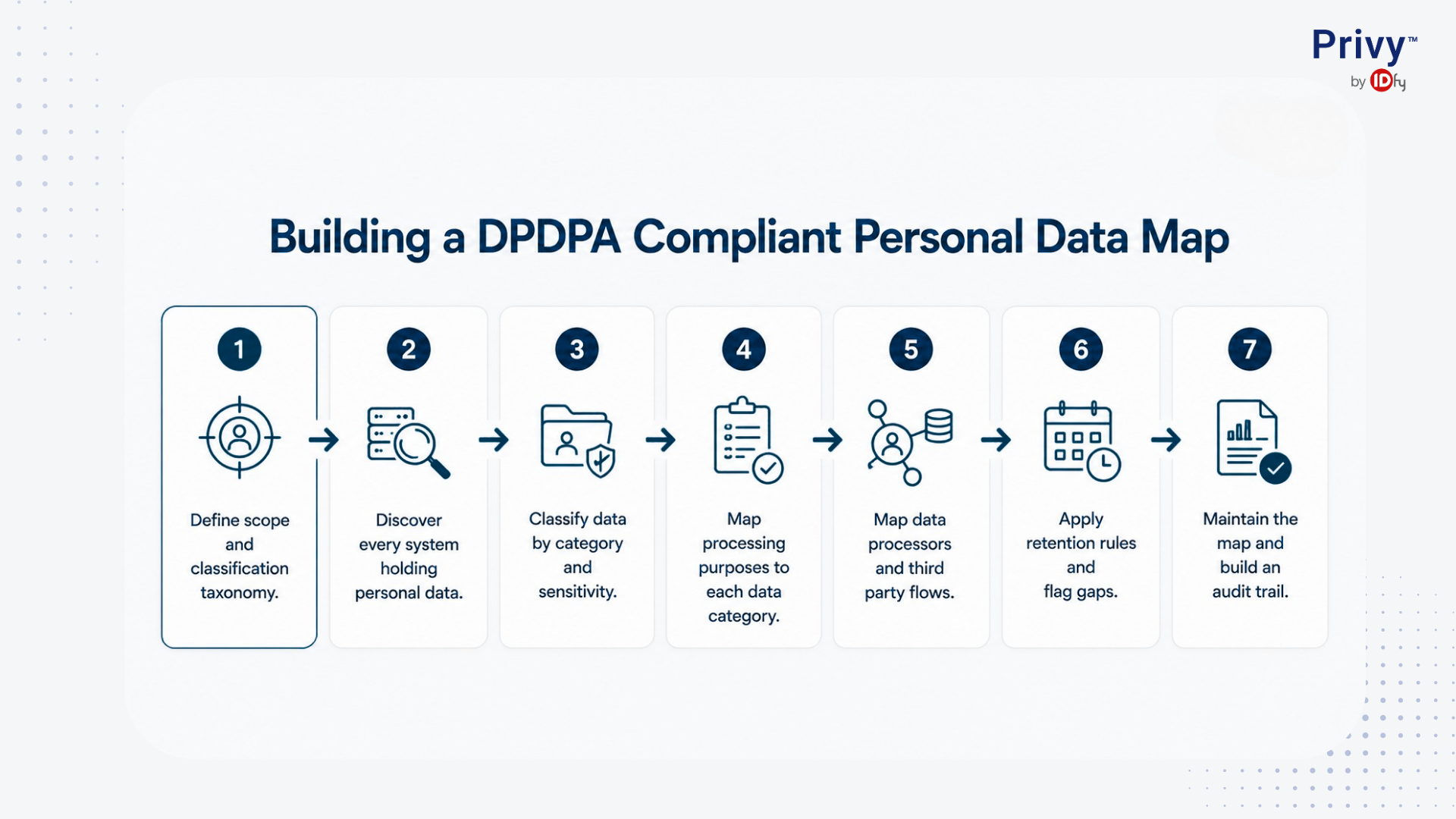
The 7-step process above define scope, discover data, classify it, map purposes, map processors, apply retention rules, and maintain the map with an audit trail, is the path from compliance intent to compliance proof. Enterprises that complete this before May 2027 will be answering a regulator's questions with records. Enterprises that do not will be answering them with explanations. If you want to talk through how to start your personal data mapping exercise, or you would like a demo of how Data Compass automates discovery and classification for your systems, write to shivani@idfy.com.
FAQs
What is personal data mapping under DPDPA?
Personal data mapping is a documented inventory of every category of personal data a data fiduciary collects, processes, stores, and shares, connected to its collection purpose, its system location, the processors it flows to, and the retention period that applies to it.
Why do Indian enterprises need a personal data map?
Every substantive DPDPA obligation, from itemised consent notices to data principal rights fulfilment to 72-hour breach reporting, assumes the enterprise already knows what personal data it holds and where. A data map is how that knowledge gets built and maintained.
What is the difference between a privacy policy and a personal data map?
A privacy policy describes intent to data principals. A personal data map documents internal reality. DPDPA requires both, and requires them to align.
How often should a personal data map be updated?
Whenever a new data field, vendor integration, or product feature changes how personal data is collected or processed. A quarterly review should verify nothing has changed outside the formal trigger process.
What is a data processor register and why does it matter? A processor register documents every third party that processes personal data on the data fiduciary's behalf, including what data categories they hold, what purpose governs that processing, and what security obligations they have agreed to. Under DPDPA, the data fiduciary remains responsible for processor-held data.
Does automated tooling replace the need to manually review a personal data map?
No. Automated data discovery tools like Data Compass significantly reduce the effort of Steps 2 and 3, but purpose mapping, processor review, and gap remediation still require human judgment and ownership.
Can ROPA (Records of Processing Activities) serve as a personal data map?
ROPA is a GDPR concept. The DPDP Act does not use this term or mandate this specific document format. However, the underlying exercise, documenting processing activities, purposes, and processors, maps closely to what DPDPA compliance requires, and many Indian DPOs familiar with GDPR use it as a starting template.
Search Here
Explore More

May 18, 2025
What constitutes as PII Data in India?

Mar 26, 2026
Beyond Consent: Why Data Security Posture Management is the New Trust Infrastructure for Indian Businesses
Share





 shivani@idfy.com
 Unit no. 801, Skyline Icon, 804, Andheri - Kurla Rd, Chimatpada, Marol, Andheri East, Mumbai, Maharashtra 400059
 1800 123 4339