

Personal Data Discovery: What Makes Data Identifiable, Where It Hides and Who Owns It
A customer opens a savings account and hands over her name, date of birth, PAN, Aadhaar number, address, and mobile number. Within a week, copies sit in the core banking system, the CRM, the data warehouse, a disaster recovery site and an email thread with a processing centre.
Two years later, she asks the bank what it holds about her and tells it to stop using her data for marketing. The DPDP Act gives her the right to ask. Whether the bank can answer depends on personal data discovery.
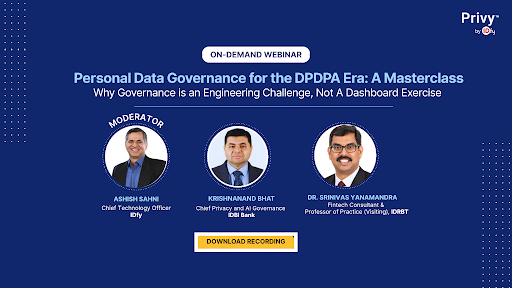
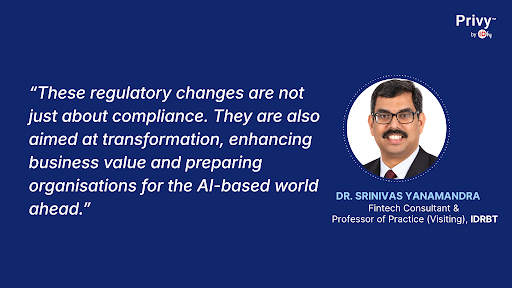
Consent banners, notices and rights workflows all assume the organisation knows what personal data it holds and where. In large enterprises, that rarely holds, as speakers at a recent IDfy webinar on personal data governance made clear. To watch the full webinar, click on the button below.
What Is Personal Data Discovery?
Personal data discovery is the process of finding every place an organisation stores or processes personal data: databases, documents, emails, endpoints, copies and third-party systems. For each element, it answers four questions. What is it? Where does it live? How does it move? Who is accountable for it?
General data discovery catalogues data for analytics. Personal data discovery has a stricter goal: find everything that can identify a person, because that is the scope of the DPDP Act.
What Is Personal Data Under the DPDP Act?
Section 2(t) defines personal data as "any data about an individual who is identifiable by or in relation to such data." The test is identifiability, yet most programmes only scan for names, PAN, Aadhaar, and phone numbers.
Identity Resolution: What Most Teams Miss
Teams encrypt, mask, or tokenise attributes and move on. But a token can be turned back into a card number or name through a mapping table, as with RBI's card tokenisation framework or UIDAI's Virtual ID. Discovery has to find those mapping tables, keys, and resolution services too.
Quasi-Identifiers and Combined Data
A birth month and year could belong to millions of people. Put a name beside it, and it points to one. Since the DPDP Act has no "sensitive personal data" category, enterprises set their own tiers: primary personal data, quasi identifiers, and resolution assets such as token vaults and keys. For examples by field, see our guide to what counts as PII data in India.
Why Discovery Must Come Before Consent, Notices and Rights
Under Section 11, the customer can ask for a summary of her personal data, its processing and who it was shared with. If she withdraws marketing consent, the bank and its processors must stop (Section 6). If her data is breached, the bank must notify the Data Protection Board and her (Section 8(6)).
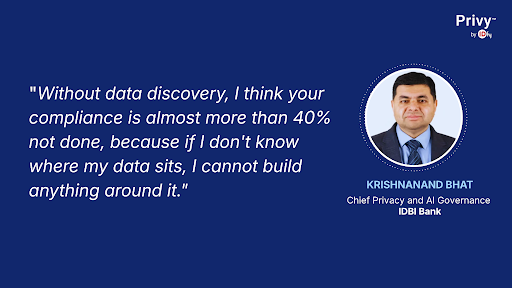
Each obligation assumes the bank can find every copy of her data, which is why data mapping makes privacy audits easier only when it starts from real discovery. Without it, breach teams start with guesswork while the 72-hour reporting window under the DPDP Rules runs. Our guide to incident management under DPDP covers the full response.
Where Personal Data Hides in a Large Enterprise
Banks, insurers, NBFCs and hospitals grew in layers, each collecting personal data at a different time and in a different format.
Legacy Systems and Mislabelled Fields
Many systems predate mobile numbers and Aadhaar as everyday identifiers, so columns got repurposed. Aadhaar numbers turn up in mobile number fields, and mobile fields fill with placeholders like 12345678. Any tool that trusts column names will miss personal data and flag noise.
Unstructured Data, Endpoints and Copies
Customer details moved through email for years, a layer we cover in where personal data hides in email, chat, and call recordings. Large institutions run endpoints in the lakhs, and each record is replicated into analytics, disaster recovery, test environments, and logs- the problem behind data silos and duplicate copies.
Vendors and Third Parties
One card payment passes through networks, aggregators, switch providers, and processors. Enterprises also hold years of records on suppliers, employees, and job applicants.
Data Discovery at Scale: Cover Every Database, Sample for Depth
Scan every database at the metadata level, find the columns holding personal data, and sample around 100 rows to confirm what each holds. Coverage (which databases, environments, and vendors are in scope) should be all of them. Depth (how much of each table to inspect) can be sampled. Our article on why complete coverage is the slowest path to DPDP compliance explains the sampling design.
Accurate Classification for Indian Personal Data
Judge tools on precision (how many flags are real) and recall (how much personal data they catch). A missed field is a field nobody protects. Aadhaar, PAN, and Voter ID formats, regional names and mixed scripts trip up tools trained on Western data, as we explain in why Indian PII breaks generic classification tools. RBI's draft data governance guidance of 15 July 2026 also covers lineage and third-party data sharing; see RBI's data governance framework and the DPDP Act.
Data Ownership, Data Custodians and the Purpose Layer
A scanner shows where personal data sits, not why. Banks already hold that context in Product and Process Approval Committee records. A bank with 700 products may run around 7,000 processes. Map each to the data it should collect, compare with the scan, and gaps stand out.
Who Owns Personal Data?
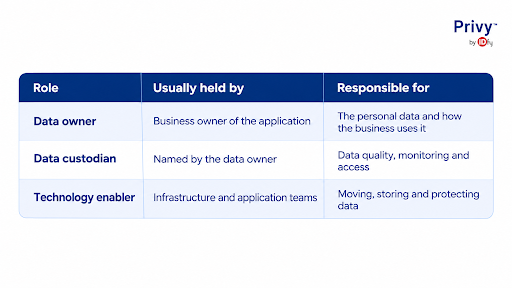
Discovered tables belong to applications, and each application has a business owner. This is a practitioner model the DPDP Act does not prescribe, though RBI's draft guidance proposes similar roles.
Purpose-Based Access Control Under DPDP
The DPDP Act adds purpose, set by the data principal through consent, on top of role-based access. If a customer declines secondary use, field-level controls may need to keep her data off the relationship manager's screen. A purpose cannot be attached to a field nobody has found. See how to map personal data for DPDP compliance.
Personal Data Discovery and AI Governance
Models, embeddings, and prompts all need to know which fields are personal and where every copy lives. Get consent before personal data reaches a model, keep children's data out (Section 9), and use privacy-enhancing technologies where consent is absent. More in AI governance and the inference gap under DPDP.
How to Build a Personal Data Discovery Programme
- Discover. Scan every database, environment, and reachable vendor system.
- Classify. Tier primary data, quasi-identifiers, and resolution assets, with human review.
- Map. Check automated lineage against product and process records.
- Assign. Name a data owner, custodian, and technology team per application.
- Connect. Feed results into notices, consent, impact assessments, and rights workflows.
- Monitor. Rerun discovery for new products, systems, vendors, and AI use cases.
- Govern. Run privacy, security and AI under one data governance model.
How Privy by IDfy Supports Personal Data Discovery
Privy by IDfy is India's full-stack privacy and data governance platform. Data Compass finds and classifies personal data across structured and unstructured sources, built on IDfy's experience verifying Aadhaar, PAN, and Voter ID at scale, and Automated Data Lineage shows where it travels. Findings flow into consent governance, Data Principal Rights Management, impact assessments, third-party risk, and incident management. Privy's consent governance platform won the MeitY-NeGD DPDP Innovation Challenge. See the Privy solutions page or the IDfy DPDP compliance platform overview.
Conclusion: Strong DPDP Compliance Begins With Knowing Your Data
When the customer asks what the bank holds, a bank with personal data discovery answers from its records. One without it searches systems, inboxes, backups, and vendors while her request waits.
The DPDP Act's substantive obligations take effect on 13 May 2027. Most enterprises still have time to do discovery once and do it properly. Few will have time to do it twice.
Privy by IDfy helps enterprises operationalise personal data discovery across consent, rights, vendors, and incidents. Book a demo or reach out to shivani@idfy.com
FAQs
What is personal data discovery?
Personal data discovery is the process of finding every place an organisation stores or processes personal data, across databases, files, endpoints, copies and vendors. DPDP notices, consent, rights requests, and breach response all depend on it.
What makes data "personal data" under the DPDP Act?
Section 2(t) covers any data about an individual who is identifiable by or in relation to it. A field that identifies nobody alone still counts when combined with other fields or linked back through a mapping table.
What is the difference between data discovery and data classification?
Discovery finds where data lives. Classification labels what it is and its risk tier, such as primary personal data, a quasi-identifier, or a token mapping table.
What are quasi-identifiers?
Fields that identify nobody alone but can in combination, such as date of birth with a name, or location with employer.
Do we need to scan every row of every database?
Usually not. Scan every database at the metadata level and sample rows. Sampling controls depth, never which databases you include. This is implementation practice, not a statutory requirement.
Who owns personal data inside a bank?
Usually the business owner of each application, supported by a data custodian and IT teams. Under the DPDP Act, the data principal's consent sets the permitted purposes.
How does personal data discovery support data principal rights?
Access, correction, and erasure requests (Sections 11 and 12) can only be met completely if the fiduciary knows every system holding that person's data.
Search Here
Explore More

May 18, 2025
What constitutes as PII Data in India?

Aug 11, 2026
Why Data Classification is Broken and How ML Fixes It: A Guide to Intelligent Data Discovery
Share





 shivani@idfy.com
 Unit no. 801, Skyline Icon, 804, Andheri - Kurla Rd, Chimatpada, Marol, Andheri East, Mumbai, Maharashtra 400059
 1800 123 4339