

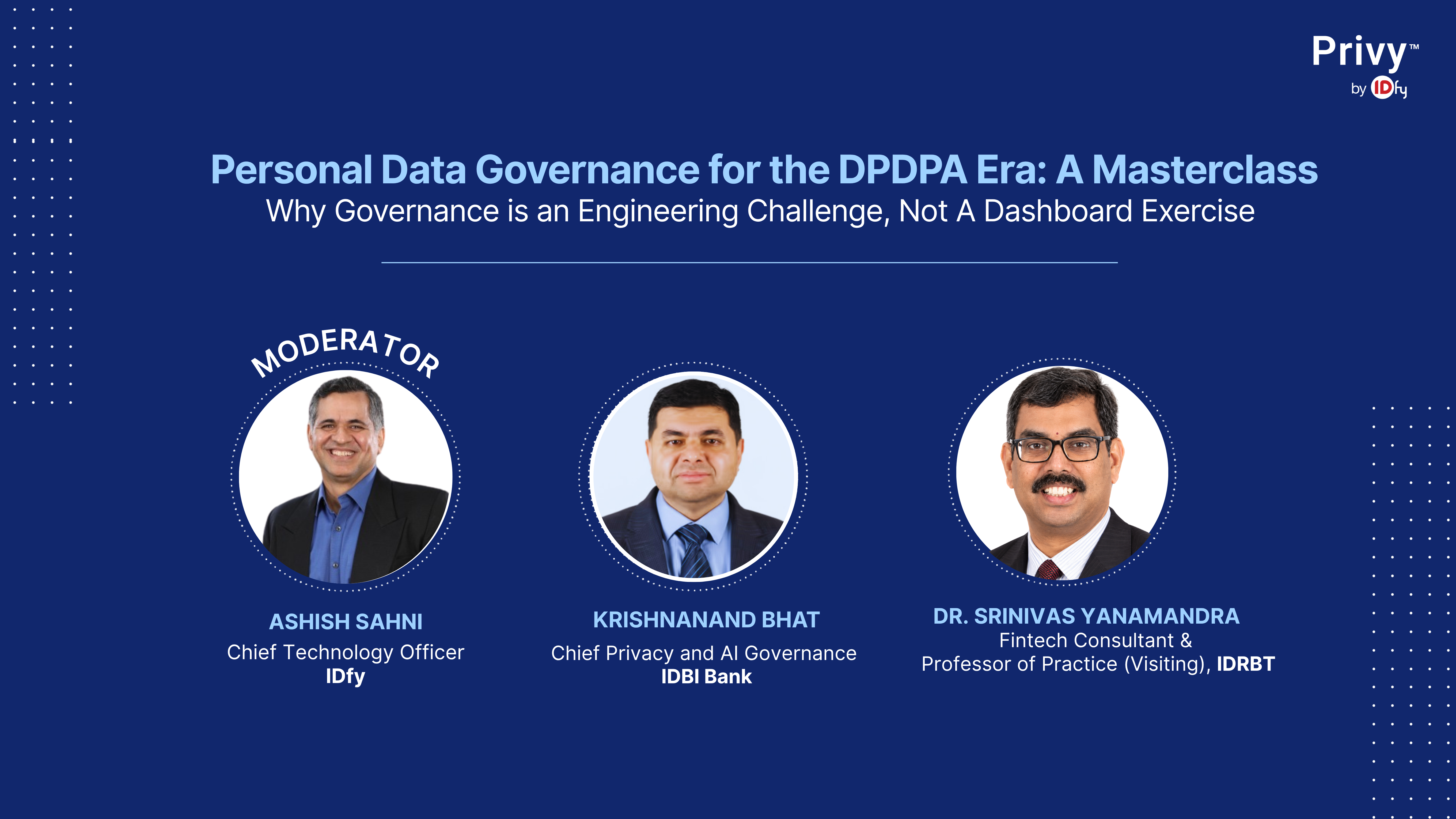
About This Webinar
As organisations prepare for the Digital Personal Data Protection Act (DPDPA), one of the biggest challenges is not simply understanding what the law requires. It is knowing what personal data they actually hold, where it resides, how it is processed, and whether they can act on it.
For large enterprises, particularly those operating in complex and regulated environments, personal data is spread across databases, endpoints, cloud environments, legacy applications, vendor systems and unstructured files. Much of it may be difficult to identify through conventional discovery methods, especially when dealing with Indian PII, regional languages, inconsistent data formats and contextual information.
This makes personal data governance far more than a documentation or dashboard exercise. It is an engineering challenge that requires organisations to build an accurate, continuously updated understanding of their data estate.
Effective DPDPA compliance begins with knowing what qualifies as personal data, identifying it across structured and unstructured environments, and classifying it with the right context. This foundation is essential to mapping data to its purpose, understanding consent states, managing retention obligations, responding to Data Principal requests and ensuring that deletion obligations extend across internal systems and third-party ecosystems.
However, identifying personal data is only the starting point. Organisations must also reconcile competing regulatory requirements, establish traceability across data flows and ensure that governance controls extend into AI pipelines, security environments and enterprise risk frameworks.
This on-demand masterclass explores how enterprises can approach personal data discovery and classification as an engineering discipline, drawing on insights from 50+ enterprise implementation journeys and examining what it takes to build scalable, accurate and actionable data governance under the DPDPA.
Why Watch This Now
- Understanding Personal Data Under the DPDPA: How the Act's definition of personal data differs from conventional checklist-based identification, and what enterprise implementation experience reveals.
- Where Personal Data Actually Resides:How to identify personal data across endpoints, legacy systems, shadow data, structured databases and unstructured environments.
- Engineering Accurate PII Classification:How metadata-first discovery, contextual classification, Indian PII detection, vernacular language support and sampling approaches contribute to classification accuracy and coverage.
- From Data Classification to Governance: How purpose, consent status and data lineage can be connected to personal data to enable meaningful governance and accountability.
- Retention, Deletion and Regulatory Conflicts:How organisations can manage Data Principal requests, system-triggered deletion, PMLA and KYC retention requirements, legal holds and downstream vendor dependencies.
- Connecting Data Governance with AI, Risk and Security:How personal data visibility supports DLP, DSPM, data catalogues, consent management and responsible AI adoption.

Ashish Sahni
Chief Technology Officer
IDfy

Krishnanand Bhat
Data Protection Officer
IDBI Bank

Dr. Srinivas Yanamandra
Fintech Consultant & Professor of Practice (Visiting), IDRBT
FAQs
Organisations cannot govern personal data without knowing what they hold, where it resides and how it is used. Existing data inventories and classification frameworks may not capture personal data across legacy systems, endpoints, unstructured files and shadow environments. Personal data discovery helps establish an accurate view of the enterprise data estate, making it a foundational step towards demonstrable DPDPA readiness.
Conventional pattern matching and regex-based methods may struggle to accurately identify Indian PII across diverse formats and contexts. Identifiers such as Aadhaar, PAN and voter IDs, regional-language information, inconsistent data formats and contextual identifiers require more specialised detection capabilities. Combining metadata, contextual analysis and language understanding can improve classification accuracy and coverage across Indian enterprise environments.
Data classification identifies personal information, but effective governance requires connecting that information to its purpose of collection, consent status, retention requirements and processing activities. Linking these attributes enables organisations to move beyond static data labels towards purpose-linked and traceable governance. It also supports Data Principal request management, deletion workflows and accountability across the data lifecycle.
Personal data deletion involves more than removing records from databases. Organisations must account for regulatory retention obligations under frameworks such as PMLA and KYC, legal holds, backups, endpoints and third-party systems. They must also distinguish between deletion requests initiated by Data Principals and system-triggered retention expiry. Data mapping, classification and lineage help establish visibility into where personal data resides and support more complete deletion workflows.
Personal data governance provides a common foundation for managing information across AI applications, analytics platforms, security systems and third-party environments. Understanding what data exists, where it resides and how it is used helps organisations strengthen controls across functions such as Data Loss Prevention (DLP), Data Security Posture Management (DSPM), data cataloguing, consent management and AI governance.





 shivani@idfy.com
 Unit no. 801, Skyline Icon, 804, Andheri - Kurla Rd, Chimatpada, Marol, Andheri East, Mumbai, Maharashtra 400059
 1800 123 4339