
Automated Data Lineage
Definition
Automatic tracking of how data moves, transforms, and is used across systems.
Automated data lineage refers to the ability to continuously track the flow of data across systems without manual effort, capturing where data originates, how it is transformed, and where it is used. As data moves through pipelines, applications, and teams, lineage provides a connected view of its journey, making dependencies and transformations visible.
This becomes critical in environments where data is reused, enriched, and shared across multiple systems. Without lineage, it is difficult to understand how a dataset was created or how changes in one system impact others. In the context of the Digital Personal Data Protection Act, 2023, lineage supports accountability by enabling organizations to trace how personal data flows, how it is processed, and whether its usage aligns with defined purposes.
In practice, gaps emerge when:
- Data flows are documented manually and quickly become outdated.
- Transformations are not tracked, making it hard to understand how data changed.
- There is no visibility into the downstream usage of data.
- Lineage exists in silos and does not provide an end-to-end view.
To address this, organizations implement automated lineage that continuously captures data flows and transformations across systems. This ensures that data movement is visible, traceable, and linked to governance controls. Within Privy, this is supported through capabilities such as data mapping, consent lifecycle management, and audit trails, enabling organizations to maintain a clear view of how data moves and is used across environments.
Questions About Staying in Control?
Here’s everything you need to know about this term and how it fits into your compliance program.
Data lineage can be documented manually, while automated lineage continuously captures data flows and transformations without manual intervention.
Because data pipelines change frequently, manual documentation is incomplete and outdated.
Continuous tracking of data movement and transformations across systems, ensuring lineage stays accurate as environments evolve.
When it captures flows but lacks context, such as purpose, ownership, or linkage to governance controls.
It enables organizations to trace how data is processed and used, helping validate that usage aligns with defined purposes.
Still have a question?
Latest Blog
Sep 30, 2026
RBI NBFC Rules Just Banned Dark Patterns and Fake Consent
Sep 29, 2026
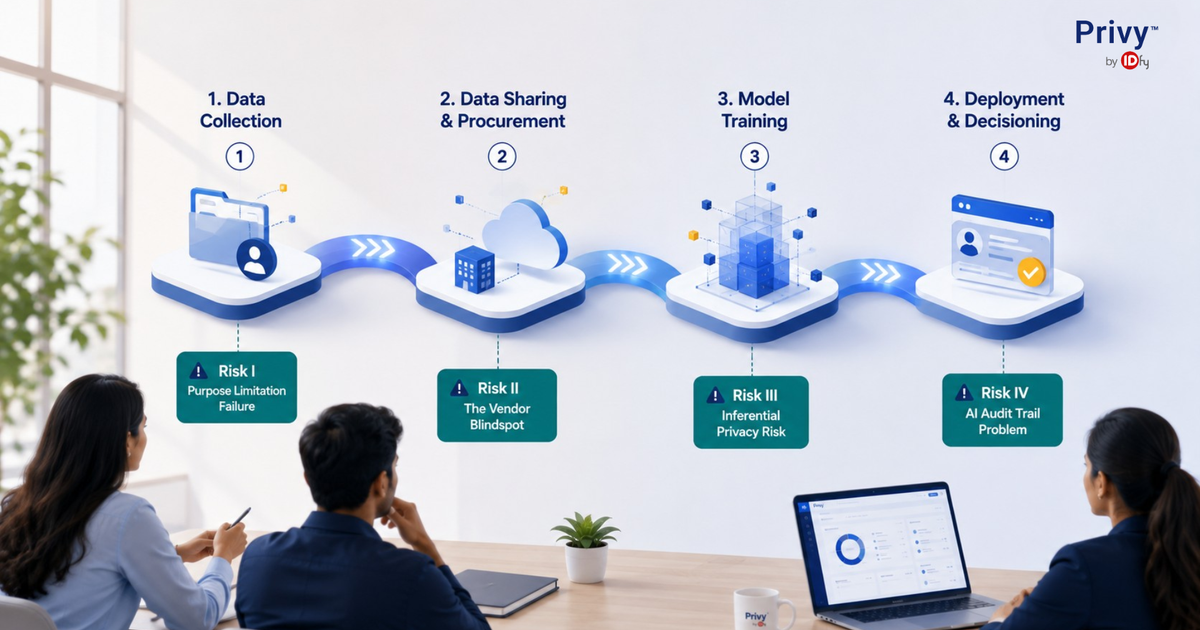
Data Privacy in the AI Era: The Four Risks Indian Corporations Have Already Inherited
Sep 10, 2026




 shivani@idfy.com
 Unit no. 801, Skyline Icon, 804, Andheri - Kurla Rd, Chimatpada, Marol, Andheri East, Mumbai, Maharashtra 400059
 1800 123 4339