

Azure Cloud
Definition
Cloud platform by Microsoft for computing, storage, and managing applications and data.
Azure Cloud, offered by Microsoft, is an enterprise cloud platform that provides infrastructure, storage, and application services over the internet. It enables organizations to build, deploy, and scale systems without maintaining physical infrastructure, while offering integrated capabilities for security, monitoring, and data management.
As organizations move data and applications to the cloud, governance and control become critical. In environments like Azure, data is distributed across services, regions, and teams, making it essential to maintain visibility into how data is stored, accessed, and processed. In the context of the Digital Personal Data Protection Act, 2023, organizations remain responsible for ensuring that personal data hosted on cloud platforms is handled securely, accessed only by authorized entities, and used within defined purposes.
In practice, gaps emerge when:
- Data is distributed across multiple cloud services without clear visibility.
- Access controls are inconsistently applied across environments.
- There is limited traceability of how data moves between services.
- Compliance responsibilities are assumed to be handled entirely by the cloud provider.
To address this, organizations implement governance layers on top of cloud environments to track data flows, enforce access controls, and maintain traceability across systems. This ensures that data usage remains controlled and aligned with compliance requirements, regardless of where it is stored or processed. Within Privy, this is supported through capabilities such as data mapping, consent lifecycle management, and audit trails, enabling organizations to maintain visibility and control across cloud-based data environments.
Questions About Staying in Control?
Here’s everything you need to know about this term and how it fits into your compliance program.
No, while Azure provides secure infrastructure, organizations are responsible for how data is managed, accessed, and governed within it.
Control shifts from physical infrastructure to configuration and governance, making visibility, access management, and monitoring more critical.
When data is spread across multiple services without unified visibility, and access or usage is not consistently tracked.
By implementing controls that track data movement, enforce access policies, and ensure that usage aligns with defined purposes.
Organizations must ensure that personal data hosted on Azure is processed lawfully, securely, and with proper controls, regardless of the platform.
Still have a question?
Latest Blog

Sep 30, 2026
RBI NBFC Rules Just Banned Dark Patterns and Fake Consent
Sep 29, 2026
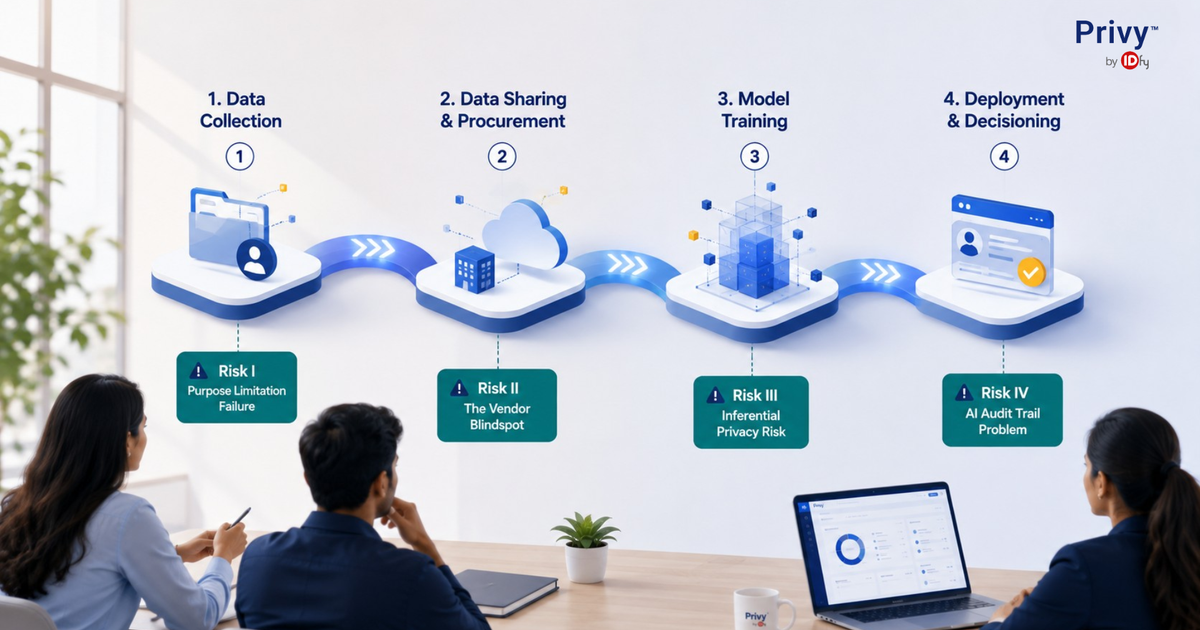
Data Privacy in the AI Era: The Four Risks Indian Corporations Have Already Inherited
Sep 10, 2026




 shivani@idfy.com
 Unit no. 801, Skyline Icon, 804, Andheri - Kurla Rd, Chimatpada, Marol, Andheri East, Mumbai, Maharashtra 400059
 1800 123 4339