

Bulk Data Processing
Definition
Bulk data processing refers to the large scale collection, analysis, transfer, or processing of high volumes of data across systems and business operations.
Bulk data processing enables organizations to handle massive datasets for analytics, operations, automation, reporting, AI models, and business intelligence workflows. It supports high speed decision making and operational scale, but also increases the complexity of governing how personal data is accessed, processed, shared, and retained.
As organizations process data across cloud environments, internal systems, vendors, and AI driven platforms, bulk processing creates significant visibility and control challenges. Large scale processing activities can amplify the impact of unauthorized access, excessive data retention, inaccurate classifications, or misuse of personal information.
In the context of the Digital Personal Data Protection Act, 2023, organizations are expected to ensure that personal data processed at scale remains protected, purpose aligned, and governed through appropriate safeguards and accountability mechanisms.
In practice, gaps emerge when:
- Large datasets are processed without clear visibility into sensitive data exposure.
- Data processing activities are not linked to consent or lawful purpose.
- Access controls do not scale consistently across high volume environments.
- Bulk processing workflows operate without auditability or governance oversight.
To address this, organizations implement governance frameworks that combine data classification, access controls, monitoring, and policy enforcement across large scale processing environments. This ensures that bulk operations remain secure, traceable, and compliant throughout the data lifecycle. Within Privy, this is supported through capabilities such as data mapping, consent lifecycle management, audit trails, and governance visibility, enabling organizations to operationalize bulk data processing with greater control and accountability.
Questions About Staying in Control?
Here’s everything you need to know about this term and how it fits into your compliance program.
Because large-scale processing increases the impact of unauthorized access, data misuse, and compliance failures across interconnected systems.
Maintaining visibility into how personal and sensitive data is being processed across multiple environments and workflows.
AI and analytics systems often rely on high volume datasets, making data classification, purpose limitation, and access governance critical.
Manual controls cannot scale effectively across dynamic datasets, distributed systems, and continuously changing processing activities.
Through automated governance mechanisms that connect data visibility, access management, monitoring, and auditability across processing workflows.
Still have a question?
Latest Blog

Sep 30, 2026
RBI NBFC Rules Just Banned Dark Patterns and Fake Consent
Sep 29, 2026
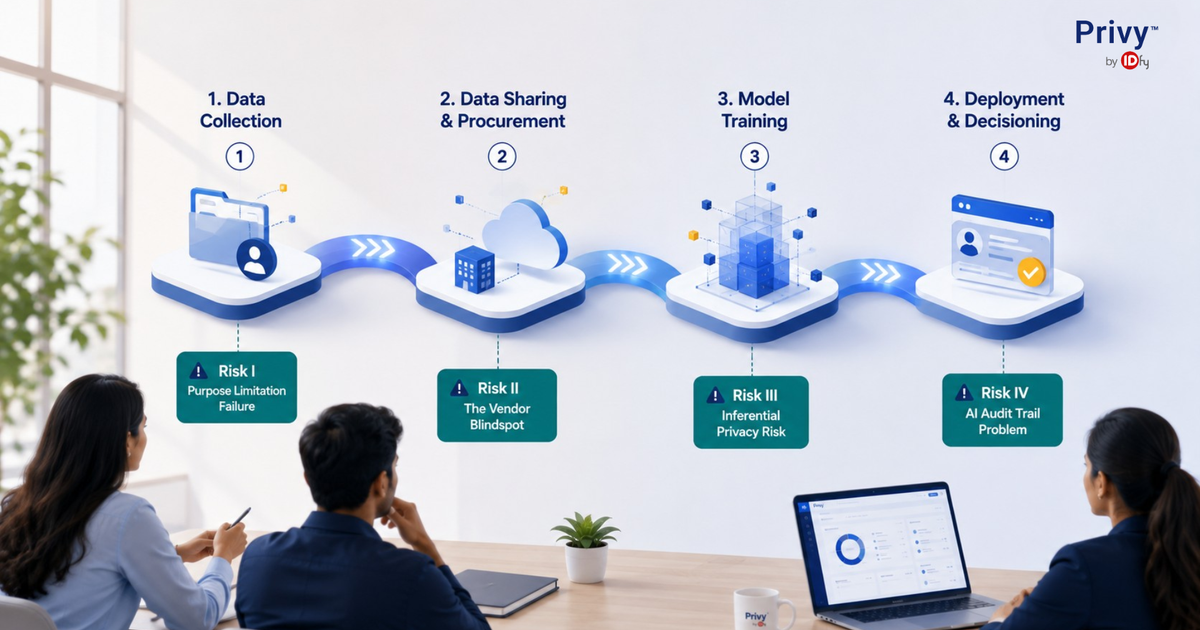
Data Privacy in the AI Era: The Four Risks Indian Corporations Have Already Inherited
Sep 10, 2026




 shivani@idfy.com
 Unit no. 801, Skyline Icon, 804, Andheri - Kurla Rd, Chimatpada, Marol, Andheri East, Mumbai, Maharashtra 400059
 1800 123 4339