

Data Intelligence
Definition
Data intelligence is the process of analyzing data, metadata, and context to generate insights that improve governance, operational efficiency, compliance, and business decision-making.
Data intelligence refers to the ability to understand, analyze, and derive meaningful insights from data by combining information about the data itself with metadata, lineage, usage patterns, quality, relationships, and business context. Rather than focusing solely on storing data, data intelligence enables organizations to understand what data they possess, where it resides, how it is used, and the value or risks associated with it.
Modern organizations generate vast amounts of structured and unstructured data across cloud applications, databases, AI systems, and business platforms. Data intelligence helps transform this complexity into actionable information by supporting better governance, improving data quality, identifying redundant or sensitive information, optimizing business processes, and enabling informed decision-making across departments.
Although data intelligence is broader than privacy regulation, it can support implementation of the Digital Personal Data Protection Act, 2023 by helping organizations identify personal data, understand data flows, maintain accurate records, and improve governance over data processing activities. These insights assist organizations in implementing privacy controls more effectively.
In practice, gaps emerge when:
- Organizations cannot identify where sensitive or personal data exists.
- Data quality issues reduce confidence in business decisions.
- Teams work with inconsistent or outdated metadata.
- Data relationships and lineage are poorly understood.
- Governance and compliance decisions rely on incomplete information.
Organizations improve data intelligence by combining automated discovery, metadata management, classification, lineage, and analytics to build a comprehensive understanding of enterprise data. Within Privy, capabilities such as data discovery, classification, data mapping, and governance reporting help organizations improve visibility into personal data while strengthening privacy and governance processes.
Questions About Staying in Control?
Here’s everything you need to know about this term and how it fits into your compliance program.
Data intelligence is the process of understanding and analyzing data, metadata, lineage, and business context to generate insights that improve governance and decision-making.
Business intelligence focuses on analyzing business performance, while data intelligence focuses on understanding the data itself, including its quality, usage, relationships, and governance.
Yes. Data intelligence helps organizations identify personal data, understand processing activities, and improve governance, which supports privacy and regulatory initiatives.
Organizations commonly use metadata management, AI, machine learning, data catalogs, lineage tools, analytics platforms, and automated discovery technologies.
Privy provides capabilities such as data discovery, classification, mapping, and governance reporting to help organizations gain better visibility into personal data across their environments.
Still have a question?
Latest Blog

Sep 30, 2026
RBI NBFC Rules Just Banned Dark Patterns and Fake Consent
Sep 29, 2026
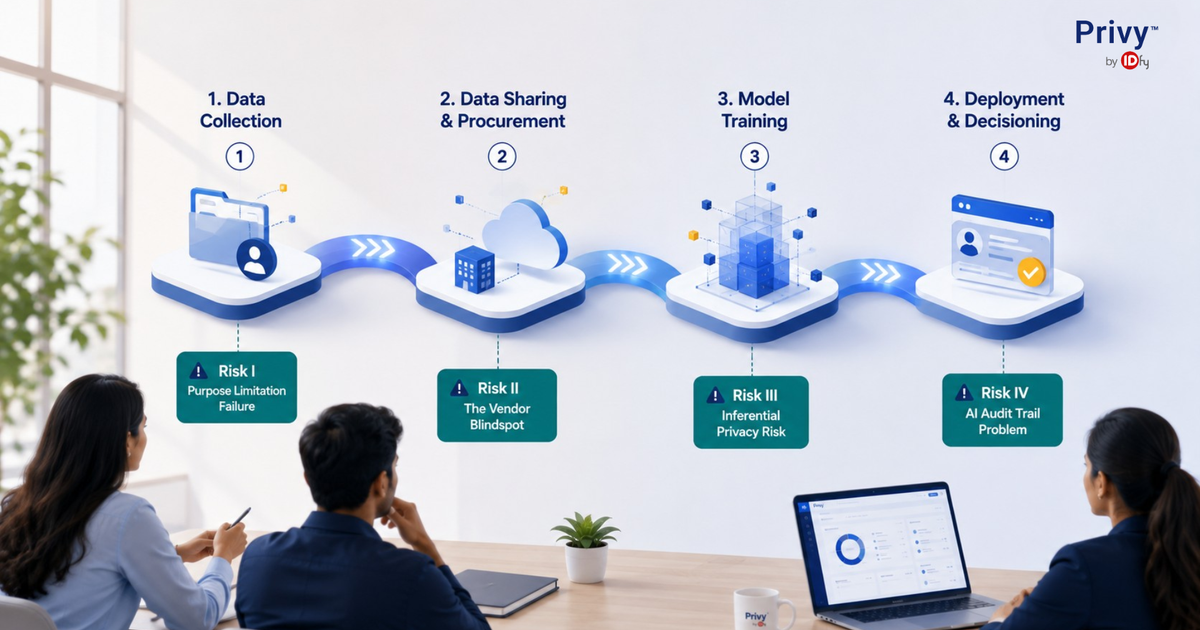
Data Privacy in the AI Era: The Four Risks Indian Corporations Have Already Inherited
Sep 10, 2026




 shivani@idfy.com
 Unit no. 801, Skyline Icon, 804, Andheri - Kurla Rd, Chimatpada, Marol, Andheri East, Mumbai, Maharashtra 400059
 1800 123 4339