

Processing Purpose
Definition
Processing purpose refers to the specific reason for which a Data Fiduciary collects and processes personal data under the DPDP Act.
Under the DPDP Act, processing purpose refers to the defined objective for which a Data Fiduciary processes a Data Principal’s personal data. Organizations must clearly identify why personal data is being collected and ensure that processing activities remain aligned with the stated purpose.
Purpose clarity is a key part of responsible personal data processing. Data Fiduciaries must inform Data Principals about the purpose of processing through appropriate notices and ensure that personal data is not processed in ways that are inconsistent with the communicated purpose or applicable requirements under the DPDP Act.
Defining processing purposes helps organizations apply principles such as purpose limitation and data minimisation. It enables better governance by helping teams understand what personal data is required, why it is needed, who can access it, how long it should be retained, and when it should be deleted.
In practice, gaps emerge when:
- Organizations collect personal data without clearly defining the purpose.
- Personal data is reused for purposes different from the original intent.
- Processing purposes are documented inconsistently across teams.
- Notices do not accurately reflect actual data usage.
- Organizations cannot identify why specific personal data is being processed.
Organizations address these challenges by maintaining processing inventories, documenting purposes, mapping personal data flows, reviewing processing activities, and aligning notices and consent workflows with actual usage. Within Privy, capabilities such as data discovery, data mapping, consent management, and privacy workflows help organizations maintain visibility into personal data processing purposes.
Questions About Staying in Control?
Here’s everything you need to know about this term and how it fits into your compliance program.
A processing purpose is the specific reason or objective for which a Data Fiduciary collects and processes personal data.
It helps organizations ensure personal data is used only for intended activities and supports transparency with Data Principals.
When consent is required, Data Fiduciaries must communicate the purpose of processing so Data Principals can make informed decisions.
Organizations must ensure that any further processing aligns with applicable DPDP requirements and transparency obligations.
Privy helps organizations discover personal data, map processing activities, manage consent workflows, and maintain governance visibility.
Still have a question?
Latest Blog

Sep 30, 2026
RBI NBFC Rules Just Banned Dark Patterns and Fake Consent
Sep 29, 2026
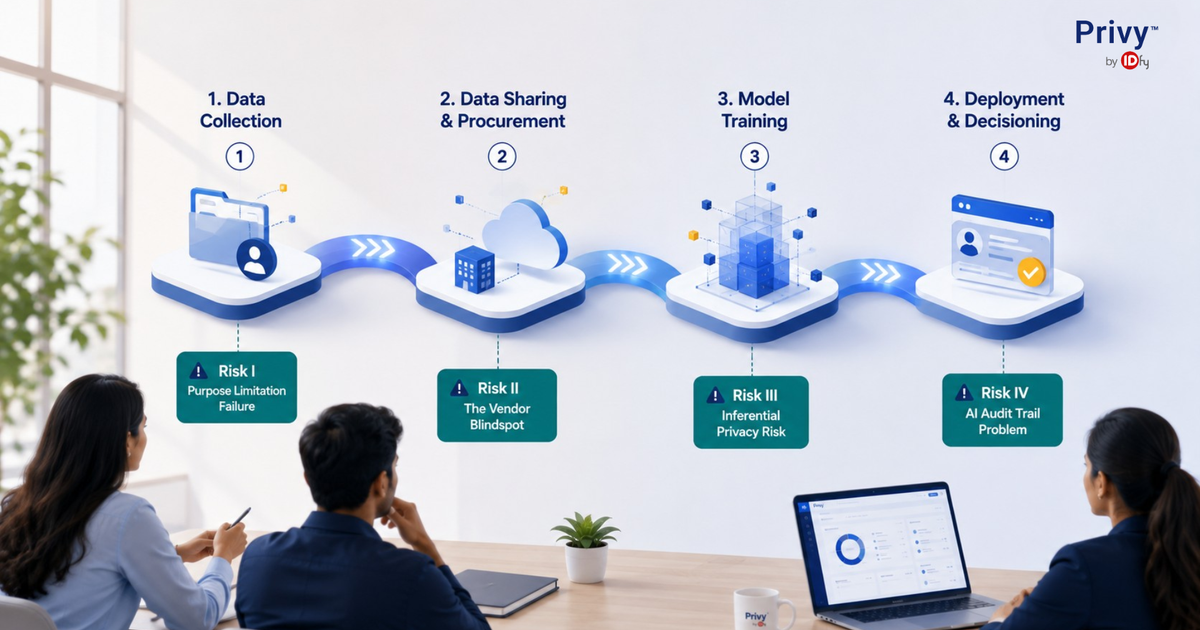
Data Privacy in the AI Era: The Four Risks Indian Corporations Have Already Inherited
Sep 10, 2026




 shivani@idfy.com
 Unit no. 801, Skyline Icon, 804, Andheri - Kurla Rd, Chimatpada, Marol, Andheri East, Mumbai, Maharashtra 400059
 1800 123 4339