
Business Unit
Definition
A business unit is a distinct organizational division responsible for specific functions, operations, services, or business outcomes.
A business unit represents a dedicated segment within an organization that manages specific operational responsibilities such as sales, marketing, finance, customer operations, technology, or product delivery. Each business unit may operate with its own workflows, systems, teams, vendors, and data handling practices while contributing to broader organizational objectives.
As organizations scale across digital platforms, cloud systems, and distributed operations, business units often manage personal data independently across multiple environments. This creates governance challenges around consistency, accountability, access controls, consent management, and compliance alignment across the enterprise.
In the context of the Digital Personal Data Protection Act, 2023, organizations are expected to ensure that all business units handling personal data operate within consistent governance frameworks, lawful processing requirements, and enterprise wide accountability structures.
In practice, gaps emerge when:
- Business units manage personal data without centralized governance visibility.
- Different teams follow inconsistent data handling or consent practices.
- Data ownership and accountability are unclear across departments.
- Compliance processes operate in silos across business functions.
To address this, organizations implement governance structures that connect business units through standardized policies, data visibility, access controls, consent governance, and auditability mechanisms. This ensures that privacy and compliance obligations are enforced consistently across the organization. Within Privy, this is supported through capabilities such as data mapping, consent lifecycle management, audit trails, and governance visibility, enabling organizations to operationalize accountability across business units with greater control and compliance readiness.
Questions About Staying in Control?
Here’s everything you need to know about this term and how it fits into your compliance program.
Because different business units often collect, process, and manage personal data independently across operational workflows and systems.
Maintaining consistent privacy, security, and compliance controls across decentralized teams and operations.
Because disconnected processes and inconsistent controls make it difficult to enforce governance and maintain enterprise wide visibility.
Each business unit handling personal data must operate within lawful processing, consent, retention, and accountability requirements.
By implementing centralized governance frameworks connected with data visibility, monitoring, access controls, and auditability.
Still have a question?
Latest Blog

Sep 30, 2026
RBI NBFC Rules Just Banned Dark Patterns and Fake Consent
Sep 29, 2026
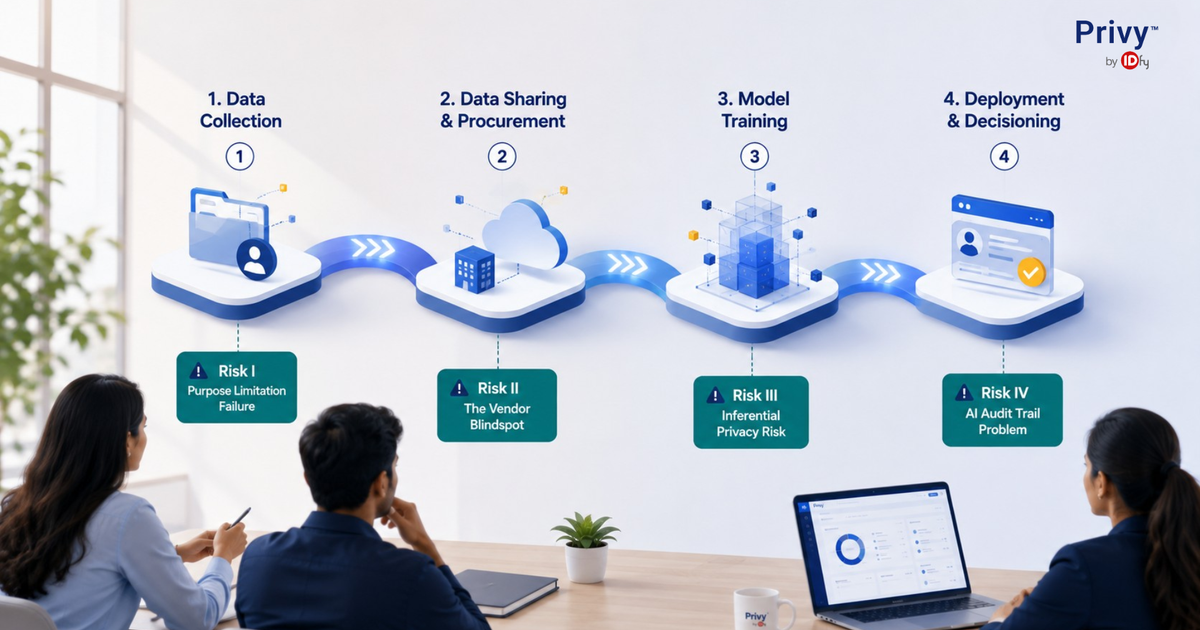
Data Privacy in the AI Era: The Four Risks Indian Corporations Have Already Inherited
Sep 10, 2026




 shivani@idfy.com
 Unit no. 801, Skyline Icon, 804, Andheri - Kurla Rd, Chimatpada, Marol, Andheri East, Mumbai, Maharashtra 400059
 1800 123 4339