


Best Alternative to Securiti for DPDP Compliance in India
Securiti is a genuinely capable data security and privacy platform. It is also, structurally, the wrong starting point for India's DPDP Act, and that gap doesn't show up until an enterprise is deep into implementation. This isn't a feature checklist dressed up as an opinion. It's a pillar-by-pillar look at where a GDPR-first, global DSPM architecture creates real gaps for an Indian data fiduciary, and how a DPDP-native platform differs at each layer.
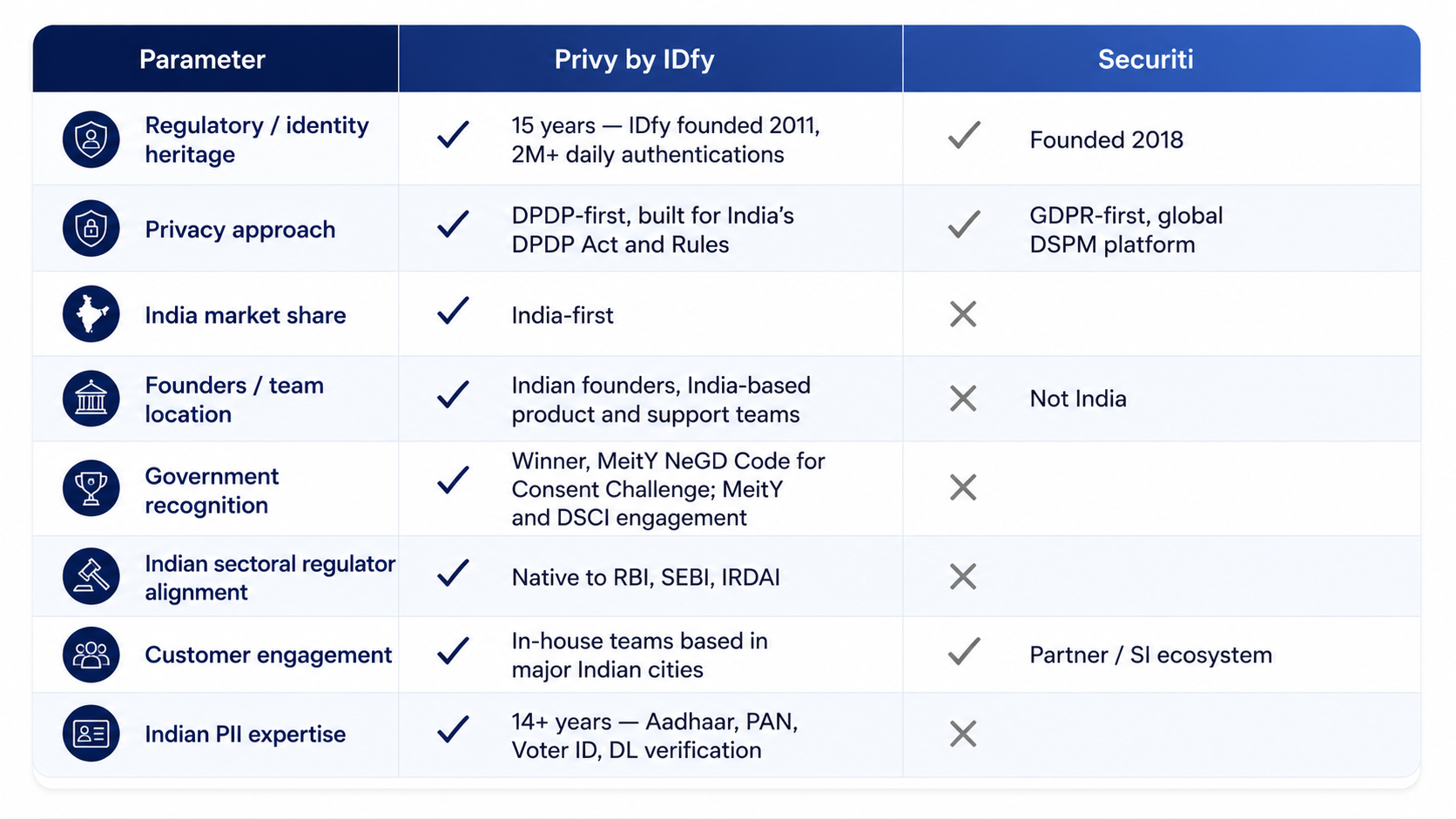
Securiti was founded in 2018 as a global data security and privacy platform, built around the broad category of data security posture management (DSPM), with GDPR as its primary regulatory frame. DPDP support has been layered on since. That adaptation shows up in specific, checkable places, not in a slogan.
Why This Is a GRC Decision, Not a Consent Decision
The mistake most evaluations make is treating this as a data discovery tool purchase. DPDP compliance is closer to a GRC software decision than a point-tool purchase: it touches consent, data discovery, risk management, breach response, and audit evidence, all at once, across every system that touches personal data.
That reframing matters more with Securiti specifically than with most competitors, because Securiti's actual strength is broad, generic data discovery. That's a real capability, not a marketing claim. But a platform can scan an enterprise's entire data estate well and still leave a data fiduciary exposed on consent architecture, Indian PII recognition, vendor risk, or breach notification, the areas where DPDP's specific mechanics diverge furthest from a global DSPM playbook.
Company Snapshot
Pillar One: Consent Lifecycle Management
Consent is the part every vendor gets asked about first, and the part where the gap is easiest to demonstrate. DPDP is built around consent and a narrower set of legitimate uses than GDPR, with its own Rules for how a consent artefact must be structured: purpose-bound, immutable, and versioned. Securiti's consent architecture, like most GDPR-first platforms, treats consent as an attribute mapped to PII rather than a standalone, data-blind artefact, which means the platform itself ends up handling the PII it's meant to govern, effectively becoming another third-party data processor in the flow.
The same gap shows up in how consent is collected. Securiti's collection layer is JavaScript-based, which means the consent payload is editable client-side, a real security consideration for any regulator asking how consent integrity is protected end-to-end. A DPDP-native platform builds consent collection as a REST API, encrypted and access-controlled by default, so the artefact can't be tampered with between collection and storage.
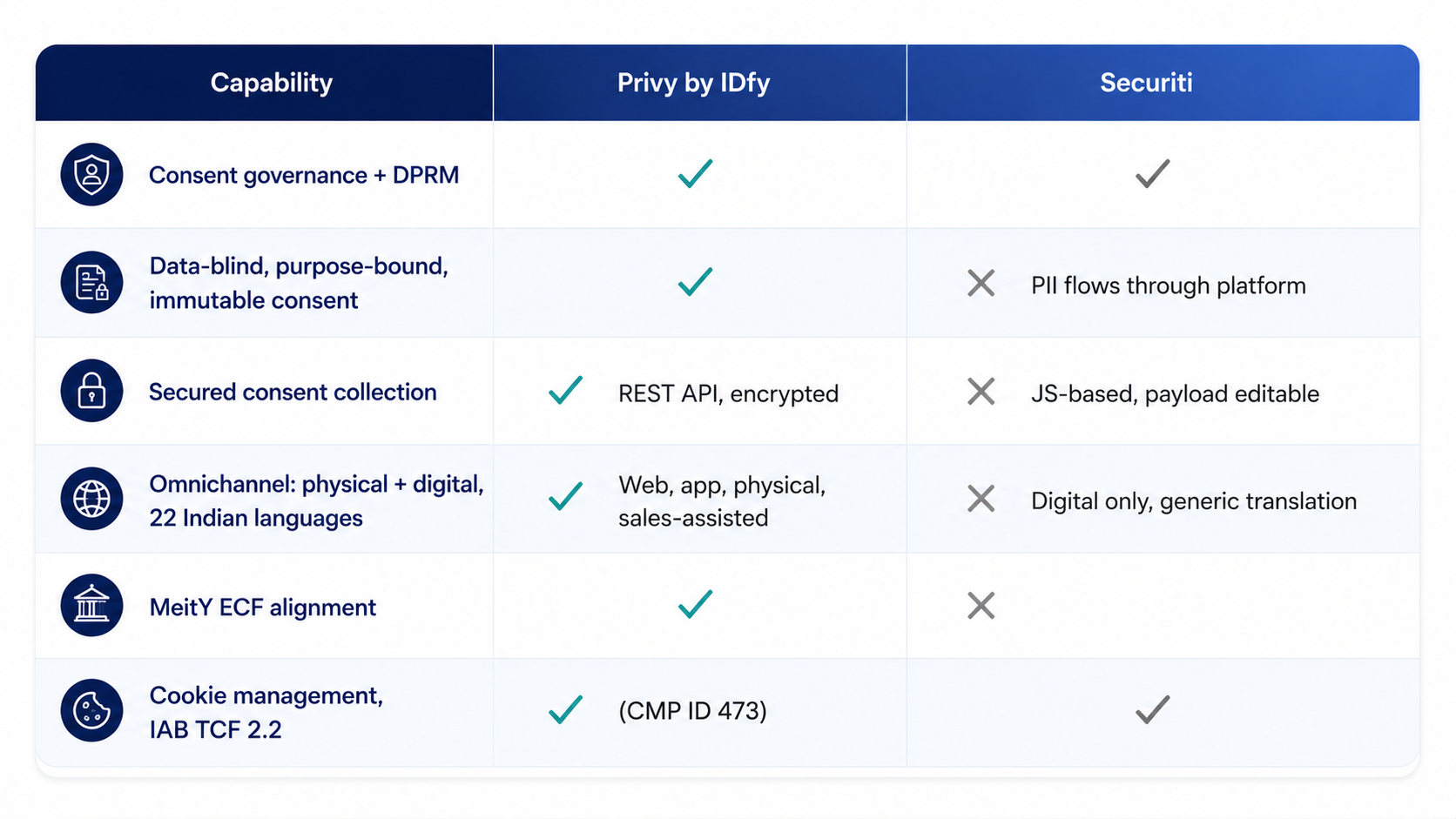
The consent governance and cookie manager modules cover this pillar end to end, including the offline and assisted consent journeys that a digital-first platform tends to treat as an edge case rather than a core requirement.
Pillar Two: Continuous Compliance and Risk Management
This is where "we already have a data discovery tool" framing falls apart fastest. DPDP compliance requires privacy impact assessments, a live record of processing activities, breach response within statutory windows, and ongoing oversight of every third party that touches personal data. That last piece, vendor and processor governance, is effectively its own category of vendor risk management software, and it's worth evaluating separately from the discovery question entirely.
Third-party risk management under DPDP means tracking BPOs, cloud vendors, collection agencies, and credit bureaus against their actual data-processing agreement terms, not just maintaining a vendor list. Securiti's processor governance today is largely a manual linkage between processors, data, and consents, without the real-time, visual audit trail a fast-moving compliance team needs during a review or an incident.
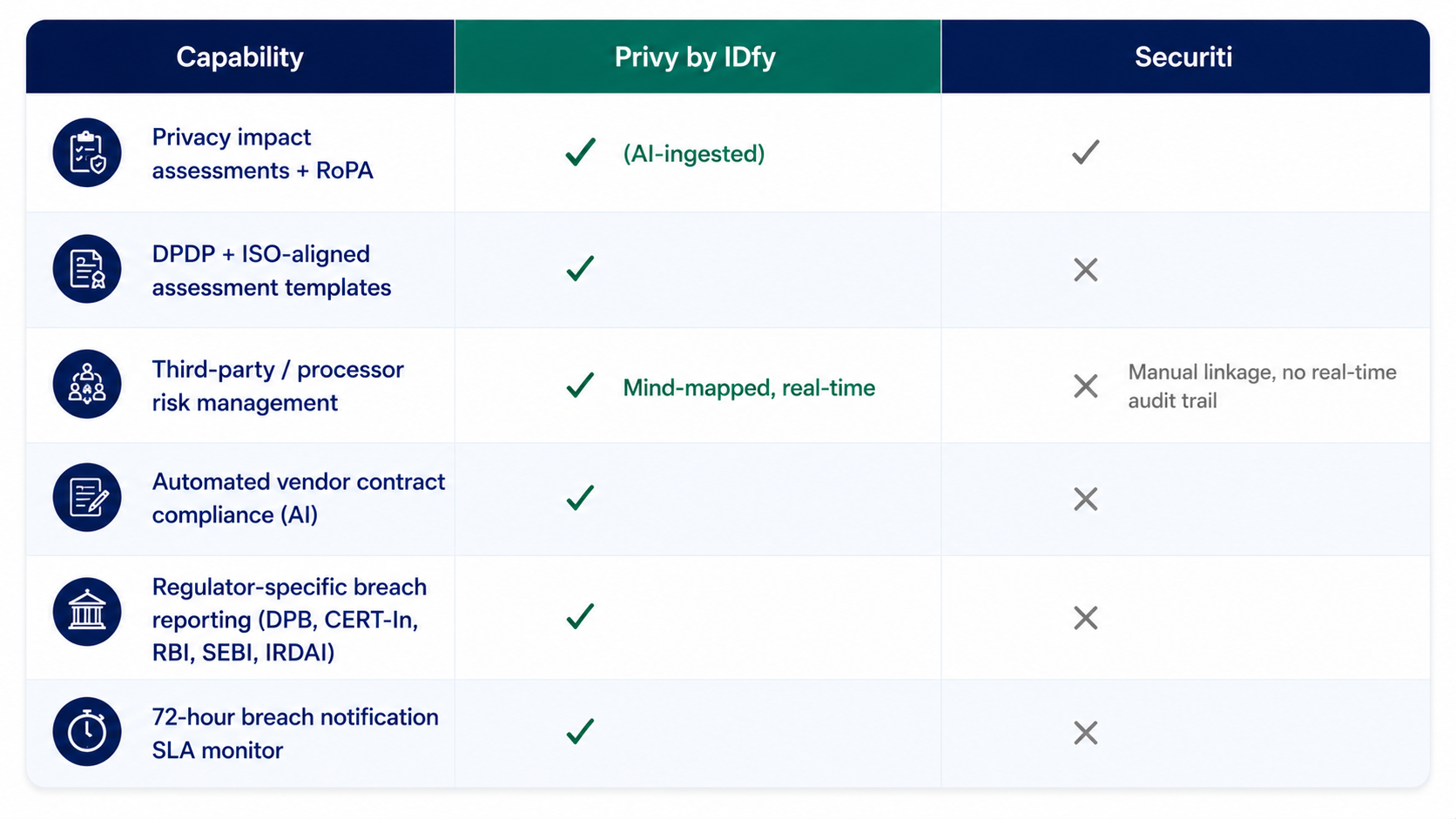
Breach response is the sharpest example. DPDP's Rule 7 sets its own timelines for notifying the Data Protection Board and affected data principals, aligned to India's regulatory structure rather than a global one. A workflow built for a generic global compliance clock needs to be rebuilt for the DPDP one, not just relabeled.
Pillar Three: Personal Data Discovery and Governance
This is the pillar where it would be inaccurate to claim Securiti has nothing. Securiti's data discovery engine covers structured, semi-structured, and unstructured data across databases, files, and streams, with 200+ connectors and genuine data lineage tracking, upstream and downstream. That's real breadth, and it's the category Securiti was built around.
The gap isn't breadth; it's specificity. A data model tuned on European and North American identifiers was never built to recognise Aadhaar, PAN, Voter ID, or driving licence numbers, none of which have a global equivalent, or their older, legacy formats, which still appear across a large share of Indian enterprise data. Personal Data Discovery & Governance, Privy's discovery and classification engine, recognises 40+ Indian PII classes natively, including inside scanned and unstructured documents, using object-pattern, AI-based classification rather than regex matching alone. Securiti's real-time discovery is also flagged as limited in side-by-side testing, compared to Privy's real-time coverage across email, chat, web logs, and web forms.
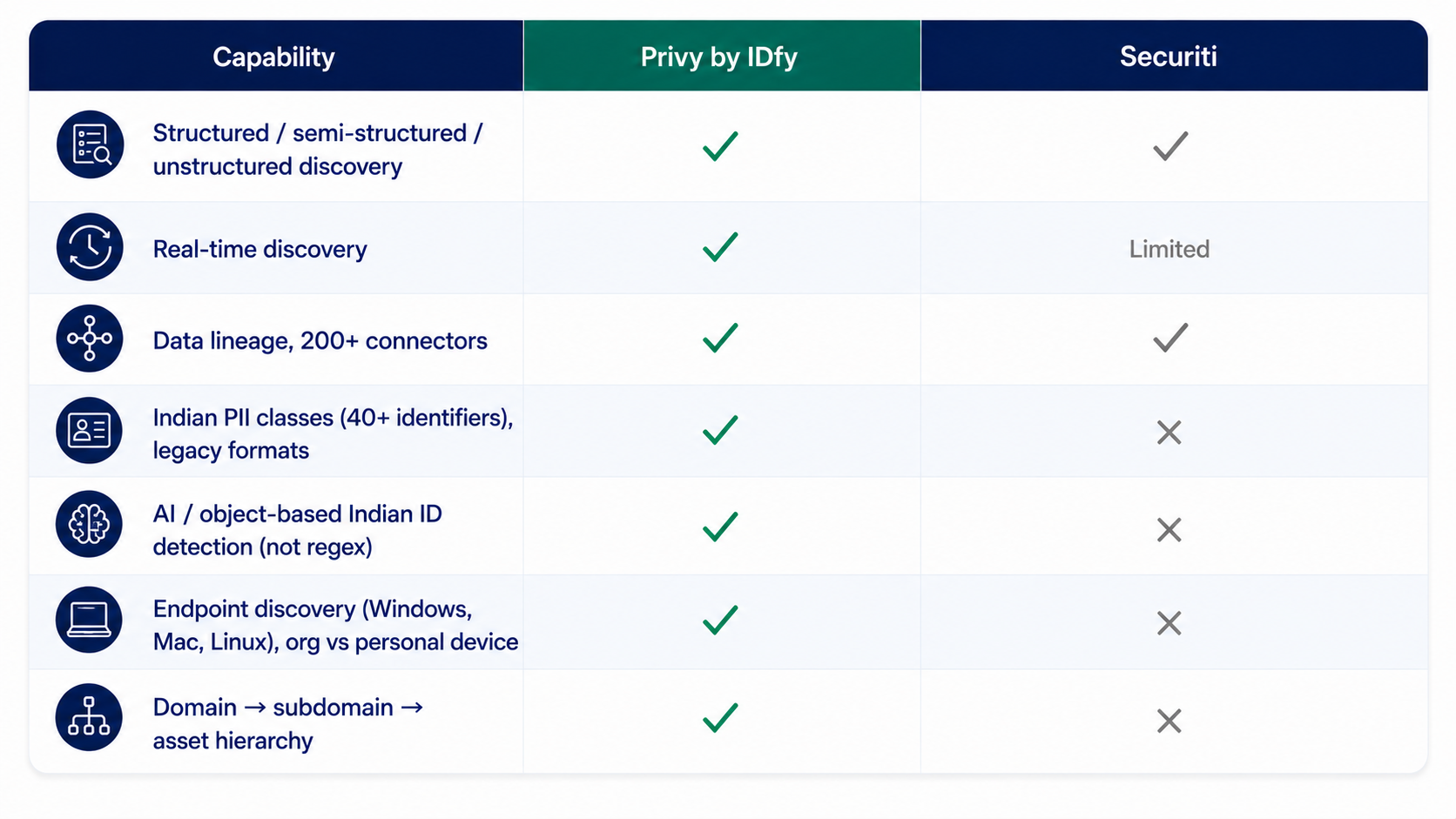
This is also where the practical difference shows up fastest during implementation: an enterprise doesn't just need to know where personal data lives; it needs the platform to correctly recognise the specific Indian identifiers that DPDP actually regulates, including the older document formats that still show up across a large, live Indian data estate.
The AI Layer
Every major platform is adding an AI layer to its compliance stack, but AI governance software is only as useful as the data model underneath it. InspectAI, Privy's compliance copilot, scans consent, data discovery, and third-party risk together on a live digital journey, because DPDP gap detection depends on cross-referencing all three, not summarising one. An AI layer added to a GDPR-first, global platform inherits that platform's blind spots on Indian PII and India-specific rules; it can't flag a gap the underlying data model was never built to see.
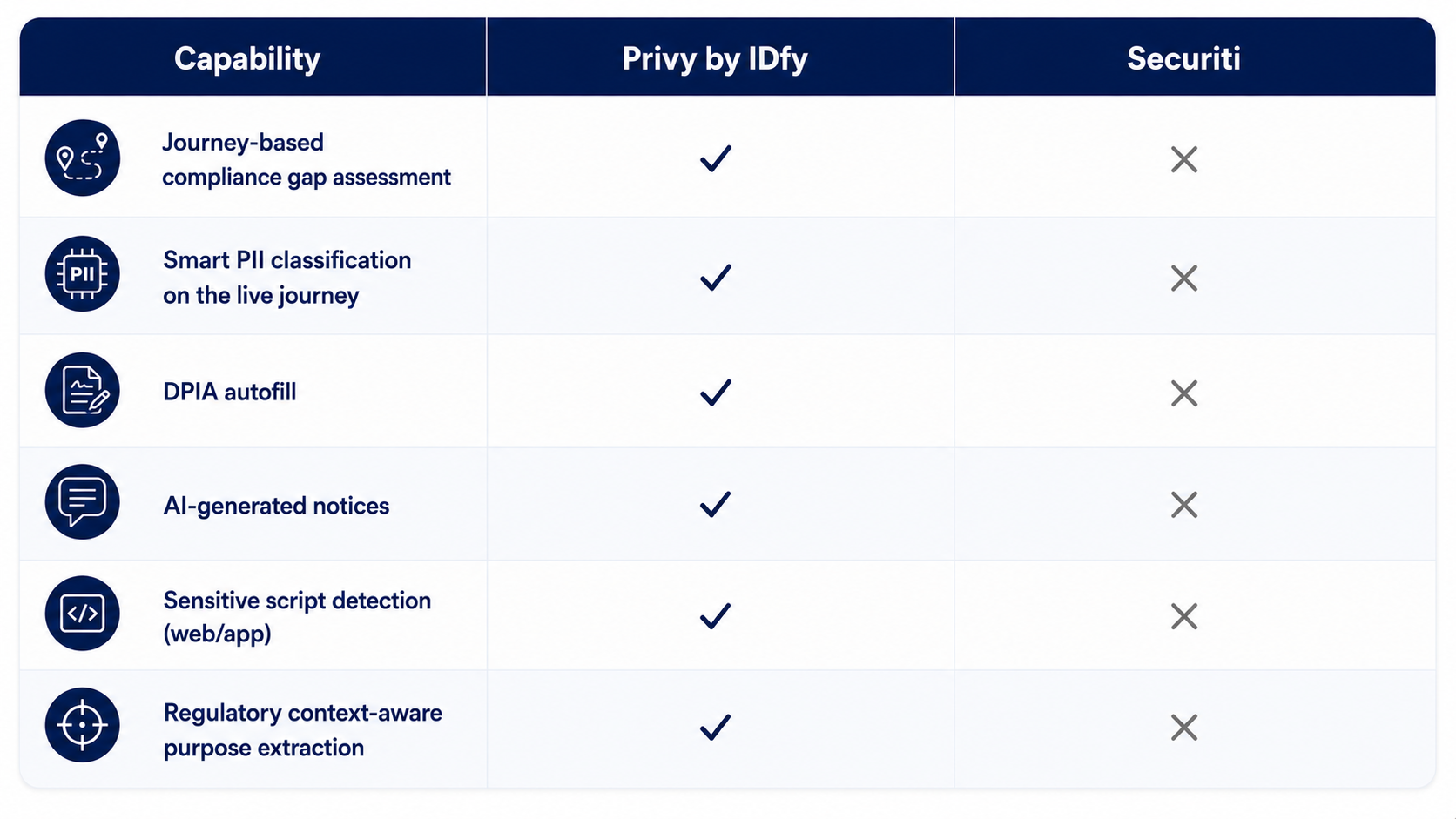
No Indian competitor, including Securiti, has published an equivalent AI-governed DPDP compliance layer as of this comparison.
Implementation and Enterprise Readiness
The features matter less than who actually implements them, and how much of that implementation has already been proven on Indian DPDP deployments specifically, not just on a global data security use case.
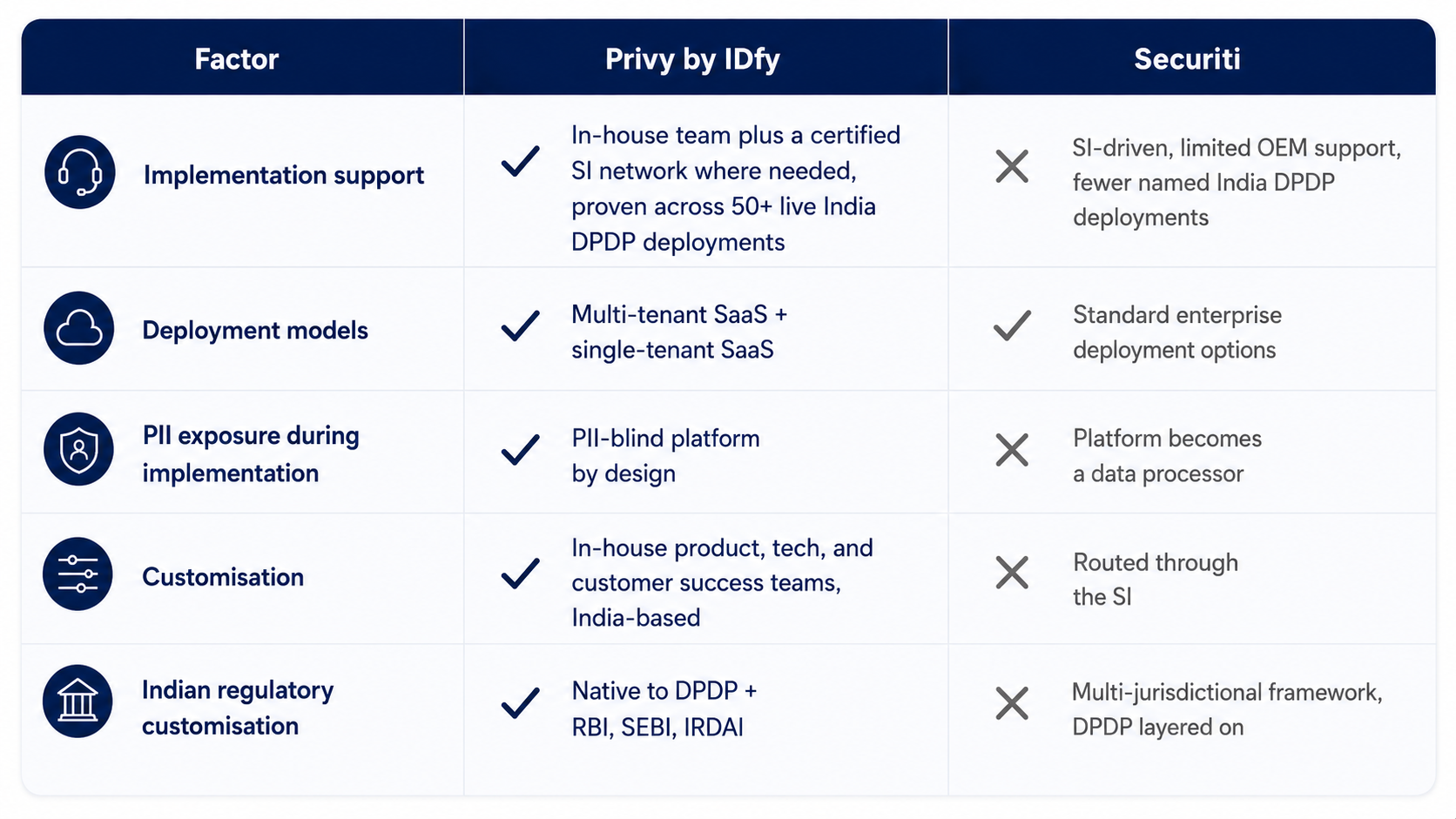
PII-blind design is worth pausing on. It means the platform itself never processes or stores the sensitive PII it's discovering and classifying, which simplifies InfoSec review considerably compared to a platform where the compliance tool becomes a new PII exposure point in its own right, and a new third-party processor to account for in the vendor risk register.
What You're Actually Buying, Beyond the Features
Every vendor comparison eventually gets reduced to a checkbox grid. What a CXO is actually signing up for looks more like this:
Stress-free audits. Audit evidence, activity trails, and compliance reports available on demand, not assembled under deadline pressure.
Confidence during a breach. Identifying affected data principals, understanding the data involved, and tracking regulatory timelines to the Data Protection Board, CERT-In, RBI, SEBI, and IRDAI, without a war room.
Fewer privacy blind spots. Knowing where Indian personal data actually lives, including the 40+ identifier classes and legacy document formats a global classification model was never trained on.
Less compliance firefighting. Moving from periodic assessments to continuous privacy operations, with InspectAI scanning live journeys instead of waiting for the next audit cycle.
Leadership confidence. A current, India-specific view of privacy posture, risk, and open gaps, not a snapshot translated from a global framework.
Readiness for regulatory change. DPDP's rules will keep evolving; a platform built for the Act adapts with it more easily than one built for a broader, multi-jurisdictional framework with DPDP layered on afterward.
The long-term outcome, if this works the way it should, is privacy becoming an operating capability rather than another compliance project that resets every audit cycle.
The Five Questions to Ask Before You Sign
- Does the platform treat consent as a data-blind, purpose-bound artefact, or does PII flow through the platform itself, making it another processor you have to account for?
- Can it recognise Aadhaar, PAN, Voter ID, and driving licence formats natively, including older, legacy versions, or does it need custom tuning after the contract is signed?
- Does breach management map to India's actual regulatory timelines, the Data Protection Board, CERT-In, RBI, SEBI, and IRDAI, or only to a generic global notification window?
- Who actually implements the platform: an India-based team that also built the product, or a systems integrator working from a global playbook?
- Is there any independent, government-level validation of the platform's DPDP readiness, or is "DPDP compliant" solely the vendor's own claim?
Where This Leaves the Decision
Choosing a DPDP compliance platform is not about finding the broadest data discovery engine. It is about whether the platform, end to end, is built around India's regulatory and operational realities. The key question is simple: can the platform give you a current, connected, and defensible view of privacy risk across your enterprise? That means DPDP-native consent, Indian PII discovery, processor risk, breach management, and India-specific implementation, not a strong global DSPM engine with DPDP layered on.
Conclusion
Privy by IDfy is built with this India-first approach across consent, data discovery, risk management, AI-powered compliance, and enterprise implementation. For organisations evaluating Securiti, the real question is not "does it support DPDP?" but "how much of DPDP was designed into the platform from the beginning, versus how much is a global DSPM engine's discovery strength extended to cover it?" To learn more, write to shivani@idfy.com or book a demo. This comparison is based on publicly available information about Securiti.
FAQ’s
Is Securiti DPDP compliant?
Securiti supports some DPDP-relevant capabilities, like data discovery and consent artefacts, but it's a global DSPM platform with DPDP layered on. It doesn't currently offer 22-language consent journeys, physical or phygital consent collection, or MeitY ECF alignment.
What's the single biggest gap for an Indian enterprise using Securiti?
Indian PII recognition depth. Securiti's data discovery engine is genuinely broad, but Aadhaar, PAN, Voter ID, and driving licence formats, including their legacy versions, have no global equivalent, so a data model tuned on European and North American identifiers needs significant extension to work reliably on Indian document formats.
Is DPDP compliance software the same as GRC software?
Related but not identical. DPDP compliance touches the same ground as general GRC software, risk, controls, evidence, but with India-specific requirements (consent artefacts, Indian PII, RBI/SEBI/IRDAI overlap) that a generic GRC platform or a GDPR-first, global DSPM platform doesn't cover by default.
What should a vendor risk management evaluation look for under DPDP specifically?
Whether the platform ties vendor and processor tracking to the actual personal data flows DPDP regulates, not just a generic contract and SLA tracker. DPDP requires visibility into what data a processor handles and how, not only that a contract exists.
Does Securiti have an India-specific implementation team?
Securiti's implementation and support for Indian enterprises commonly runs through a systems integrator and partner ecosystem rather than an in-house, India-based product and support team.
Is there independent validation of DPDP readiness for either platform?
IDfy, the company behind Privy, won MeitY NeGD's Code for Consent Challenge, a government evaluation of DPDP technical, functional, and legal readiness, verifiable independently rather than taken from vendor marketing.
Search Here
Explore More
-1.png)
Jul 09, 2026
Why Privy by IDfy's #1 MeitY-NeGD Ranking Matters for India's DPDP Compliance
-1.png)
Aug 28, 2026
Best OneTrust Alternatives For DPDP Compliance

Jun 03, 2026
Aftermath of DPDP In 2027, What Happens After the Deadline
Share





 shivani@idfy.com
 Unit no. 801, Skyline Icon, 804, Andheri - Kurla Rd, Chimatpada, Marol, Andheri East, Mumbai, Maharashtra 400059
 1800 123 4339