

-1-1200x630.png)
Complete Coverage Is the Slowest Path to DPDP Compliance
Your scan covered 94 percent of your data estate. Your team called it a success. Three weeks later, engineering shipped a new microservice carrying Aadhaar numbers to a third-party processor. Your inventory had no record of it. Your last full classification scan ran before the integration existed. You were thorough. You were looking at the wrong problem.
The Assumption Holding Your Programme Back
Every enterprise data classification programme starts from the same premise: the more completely you scan, the more compliant you are. It sounds like rigour. It is actually the thing making your programme slower, more expensive, and structurally weaker than it needs to be.
Current coverage matters more than complete coverage. A data classification inventory that is 100 percent accurate as of last quarter is not a compliance asset. It is a liability with a timestamp on it. The Digital Personal Data Protection Board, in any inquiry under the Act, will not ask how deep your last scan went. It will ask where your personal data is right now.
Exhaustive Scanning Produces a Shrinking Programme
Within two quarters, the asset list shrinks. Not because personal data stops appearing in new places, but because the cost of a full scan forces a choice: depth on a curated subset, or breadth across the full estate. Teams choose depth.
What gets covered:
- The data warehouse
- The legacy on-premise database
- The file shares that IT owns
What falls outside the programme:
- File shares that engineering owns
- Cold archive buckets
- New microservices that spun up last month
- Third-party integrations added after the last scan window
The result is detailed coverage of a structurally incomplete estate, which is precisely the outcome exhaustive data discovery was designed to prevent. This is a failure of strategy. An organisation that insists on 100 percent row coverage across every connected asset will always end up scanning less of its estate than one that designs for breadth first. Depth without breadth is the more common DPDP compliance failure — and the harder one to detect, because the reports look thorough even as the gaps accumulate.
The Paradox: Thoroughness Creates Staleness
Exhaustive scanning has a second problem that compounds the first. Because it is resource-intensive, it runs infrequently. A full data classification scan across large transactional databases creates sustained read load that competes with production workloads. Engineering teams push back. Scan windows get compressed. The cycle stretches from monthly to quarterly to semi-annual.
At an enterprise operating across multiple petabytes of structured and unstructured data, a full classification scan takes weeks to complete, depending on architecture, network bandwidth, and data quality across legacy systems. By the time it finishes, the estate it mapped has already changed. The scan is stale before it is signed off.
The comparison that matters:
A 100 percent coverage scan run once a quarter is epistemically weaker than a calibrated 20 percent sample run every week.
What weekly 20 percent sampling actually delivers:
- Personal data introduced into a schema in the last seven days is surfaced within the next scan cycle
- Schema drift gets detected; new columns carrying financial identifiers are flagged before they accumulate months of unchecked data
- New tables created by a product deployment get classified within days rather than quarters
The same logic holds for unstructured assets: a data discovery workflow with a defined sampling percentage and maximum object count per directory, running on a scheduled cadence, continuously refreshes the classification inventory as new files arrive. For data in motion, the eBPF agent's transaction volume thresholds operate continuously, which means the sampling is always live rather than periodic.
The DPDP Act's obligations under Section 8 require data fiduciaries to ensure completeness, accuracy, and consistency of personal data used in decisions that affect data principals. That obligation is continuous. A quarterly snapshot does not satisfy it. Freshness is a compliance variable, not an operational preference, and exhaustive scanning trades freshness for depth every time.
Sampling Is Not the Compromise. It Is the Architecture.
The instinctive objection is that incomplete scanning means incomplete coverage, and incomplete coverage means risk. It is also the wrong comparison.
The alternative to sampling is not perfect coverage. It is narrow coverage. An organisation insisting on exhaustive scanning will always scope down to a manageable subset of assets because full depth across full breadth is not achievable within operational windows or budgets.
The actual choice is between:
- Sampling across all connected asset classes, a living, organisation-wide data inventory
- Exhaustive scanning of a curated subset, a detailed but structurally incomplete one
If a column contains Permanent Account Numbers, a 15 percent row sample will find it. PII patterns in enterprise data are not randomly distributed edge cases. They cluster. They repeat. A statistically representative sample surfaces them reliably.
The risk of a sampling-based false negative is real but bounded. The risk of an asset never connected to your data discovery platform because your team was resource-constrained is unbounded. Depth without breadth is the more common compliance failure.
Sampling parameters are also explicit, auditable engineering decisions:
- For structured assets: the data classification scan configuration captures the sampling type and value
- For unstructured assets: the scan workflow captures the sampling percentage and maximum number of objects per directory
- For data in motion: the transaction volume threshold is a configured parameter with a documented rationale
Each is a defensible, documented choice made in the context of your organisation's risk profile and operational constraints. A regulator examining your DPDP compliance posture would find a programme with documented sampling rationale, scheduled execution, and a maturity roadmap more credible than an undated exhaustive inventory with no evidence of ongoing maintenance.
Cost, Cadence, and Depth: One Decision, Three Surfaces
The cost of exhaustive scanning, the case for scheduled sampling, and the maturity path toward deeper coverage of high-risk assets are not three separate conversations. They are the same decision made across three surfaces.
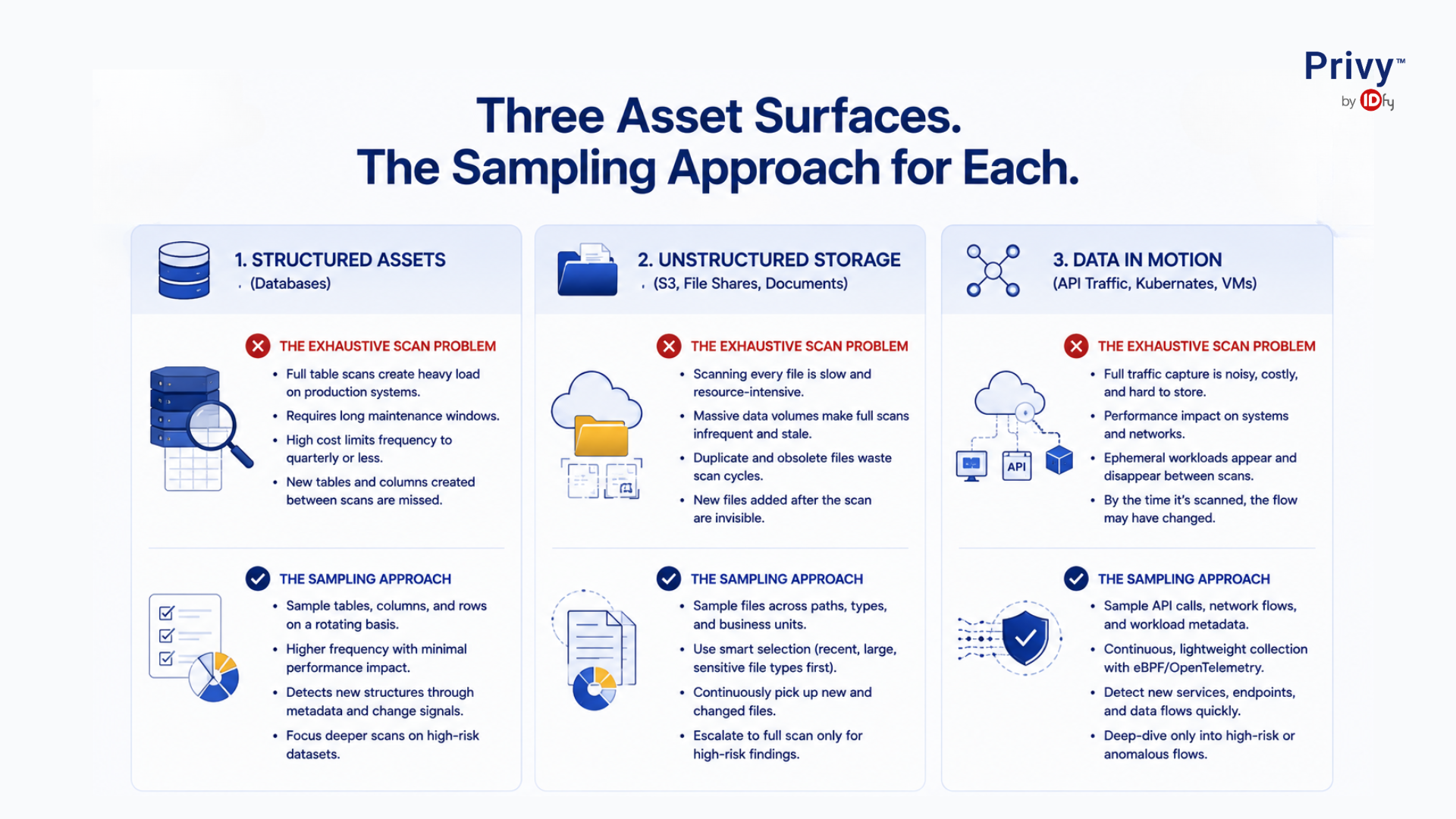
For structured assets: A full data classification scan generates sustained read load on production databases. The operational pushback compresses scan frequency, which is exactly when scheduled sampling at a lighter threshold recovers the cadence. A full scan at petabyte scale runs for weeks, consumes sustained compute, and generates operational friction across every team whose production systems share infrastructure with the scan workload. A decade-old archive of scanned documents costs as much to classify as a live customer onboarding database but carries a fraction of the compliance relevance. High-sensitivity schemas carrying financial identifiers, health data, or government-issued identifiers warrant aggressive sampling thresholds and short scheduling intervals. Cold archival assets get sampled lightly on a longer cycle.
For unstructured storage: Scanning every S3 object regardless of size, type, or last-modified timestamp burns compute and egress at a flat rate with no regard for risk. A sampling-based data discovery workflow with a maximum object count per directory, scheduled to run frequently, covers more of the estate more often at a fraction of the cost — while concentrating deeper scans on directories that surface PII indicators in the initial pass.
For data in motion: The eBPF agent monitoring API traffic across Kubernetes clusters and virtual machines operates in environments where transaction volumes reach millions of events per hour. Attempting to run data classification on every transaction without rate limiting is operationally infeasible. The configuration decision is what percentage of the traffic stream to classify deliberately, with deeper attention on endpoints that handle sensitive data categories. The automated data lineage layer connects this real-time flow visibility back to the classification inventory, so new data movements surface alongside new data assets, which is how the IDfy-built full-stack DPDP compliance platform maintains a living inventory rather than a point-in-time record.
Across all three surfaces, the total cost of ownership for an exhaustive scan programme outpaces budget before it outpaces scope. The organisations that design for breadth first, then concentrate depth where the risk is highest, end up with a larger, more current, and more defensible programme than those that started from the other direction.
What the Digital Personal Data Protection Board Would Actually Examine
An inquiry from the Digital Personal Data Protection Board would not open with scan logs. It would open with four questions, and a sampling-based programme answers each one directly, while a quarterly exhaustive scan does not.
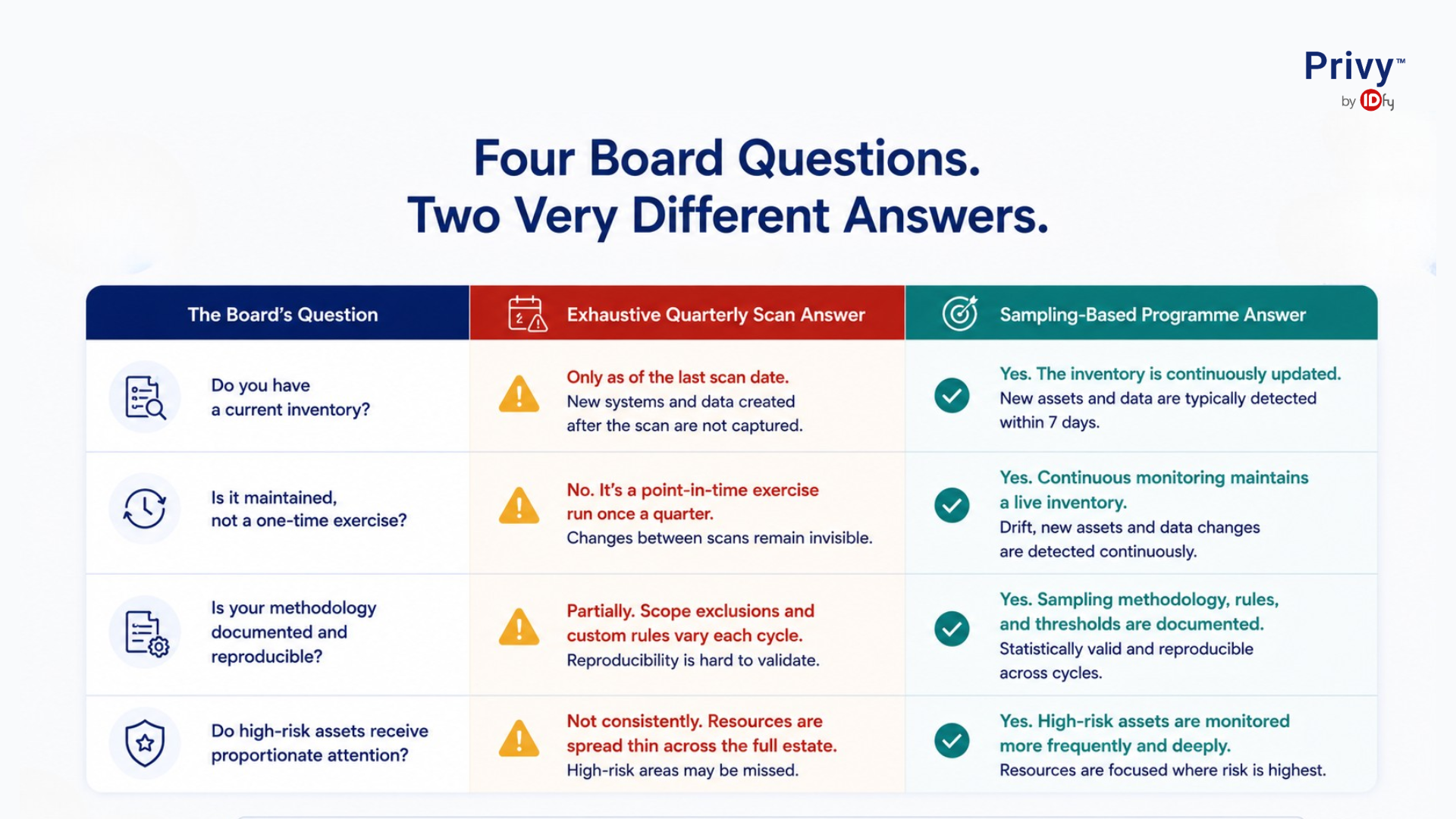
Do you have a current inventory of personal data assets? Not a historical one. A current one. A sampling-based programme with weekly or biweekly scheduling produces this. A quarterly exhaustive scan does not.
Can you demonstrate the inventory is maintained, not a one-time exercise? Scheduled scan workflows with execution logs, drift detection records, and configuration history demonstrate a living programme. A single scan artefact from several months ago demonstrates a project that has since lapsed.
Is your data classification methodology documented and reproducible? Explicit sampling parameters, PII threshold configurations, and connector-level scan policies constitute a documented data classification methodology. An ad-hoc scan with no configuration record does not.
Do high-risk assets receive proportionate attention? A maturity-based approach with deeper scan configurations on high-sensitivity asset classes directly answers this. Uniform exhaustive scanning, where it exists at all, treats a legacy cold archive the same as a live payments database.
The Act's requirement under Section 8 for data fiduciaries to implement appropriate technical and organisational measures does not specify a scan methodology. It requires that the measures be appropriate. Appropriate, in the context of a complex enterprise data estate, means sustainable, current, and risk-proportionate.
That is what a well-calibrated sampling programme delivers. An exhaustive quarterly scan, however thorough it was on the day it ran, delivers none of it the day after.
Understanding how data classification and discovery fit into the broader DPDP compliance obligations for 2026 clarifies why inventory freshness is not an operational preference — it is the foundation that rights management, breach scoping, and processor accountability all depend on. And for teams still running static point-in-time mapping, the case for moving to dynamic data discovery covers why the architecture matters before the tooling decision does.
Conclusion
The goal of a DPDP-compliant data classification programme is not to have scanned the most data. It is to know, right now, where your personal data is across your full estate, including the microservice that shipped last week, the cold archive your team inherited, and the third-party integration nobody documented.
Exhaustive scanning cannot deliver that. It narrows scope under resource pressure, runs infrequently under operational pressure, and produces an inventory that is accurate for a shrinking window of time. A calibrated, frequent sampling programme covering the full width of your data estate is architecturally stronger, more defensible, and more aligned to what the Act actually requires.
Data Compass is built for this architecture: continuous DSPM across structured, unstructured, and in-motion data, with sampling parameters that are explicit, scheduled, and auditable not a one-time scan with a timestamp attached. To see how Privy by IDfy handles data classification and discovery across your environment, write to shivani@idfy.com to book a walkthrough.
FAQ's
Why is a 100 percent exhaustive data classification scan not sufficient for DPDP compliance?
Because compliance under the DPDP Act is a continuous obligation, not a point-in-time exercise. Section 8 requires data fiduciaries to ensure completeness, accuracy, and consistency of personal data used in decisions affecting data principals, and that obligation applies to the data estate as it exists today, not as it existed when the last scan ran. An exhaustive scan completed three months ago says nothing about the microservice shipped last week, the column added last month, or the third-party integration that went live after the scan window closed. A classification inventory is only a compliance asset if it is current.
What is the risk of using sampling instead of exhaustive scanning for PII detection?
The risk of a sampling-based false negative in data classification missing a PII column because the sampled rows did not contain it is real but bounded. PII patterns in enterprise data cluster and repeat; a statistically representative sample surfaces them reliably. The risk of an asset that was never connected to the classification platform because the team was resource-constrained is unbounded: that asset is invisible to the programme and unprotected by any safeguard. Exhaustive scanning of a curated subset creates this second risk. Sampling across the full estate eliminates it. The bounded risk of sampling is manageable. The unbounded risk of narrow coverage is not.
How does the Data Protection Board evaluate data classification programmes during an inquiry?
Based on the Act's requirements, an inquiry would be likely to examine whether the organisation has a current inventory (not a historical one), whether the inventory is maintained as a continuous programme rather than a one-time project, whether the classification methodology is documented and reproducible, and whether high-risk assets receive proportionate attention relative to lower-risk ones. A programme with documented sampling rationale, scheduled execution logs, drift detection records, and a maturity roadmap answers all four questions. A single exhaustive scan artefact with no evidence of ongoing maintenance answers none of them.
What does a sampling-based data classification configuration actually look like?
For structured assets, the scan configuration captures the sampling type (percentage-based or row-count-based) and value, along with the schedule and target connectors. For unstructured storage, the workflow captures the sampling percentage and the maximum number of objects per directory per run. For data in motion, the eBPF agent configuration captures the transaction volume threshold that determines what percentage of traffic is classified. Each parameter is an explicit, auditable engineering decision, not an approximation, but a documented choice made in the context of the organisation's risk profile and operational constraints.
How does DSPM relate to data classification and DPDP compliance?
Data Security Posture Management (DSPM) is the discipline of continuously discovering, classifying, and monitoring sensitive data to assess and remediate security and privacy risk. Under DPDP, DSPM capabilities are directly relevant to the Section 8 obligation to implement appropriate security safeguards: you cannot protect personal data you have not found and classified. A DSPM approach that runs continuously with sampling-based coverage across the full estate produces the current, auditable inventory the Act requires. A periodic exhaustive scan produces a detailed inventory of a subset of the estate at a point in time.
Search Here
Explore More

Mar 23, 2026
Employee Data Governance: What HR Must Change Before DPDP Enforcement
Jun 08, 2026
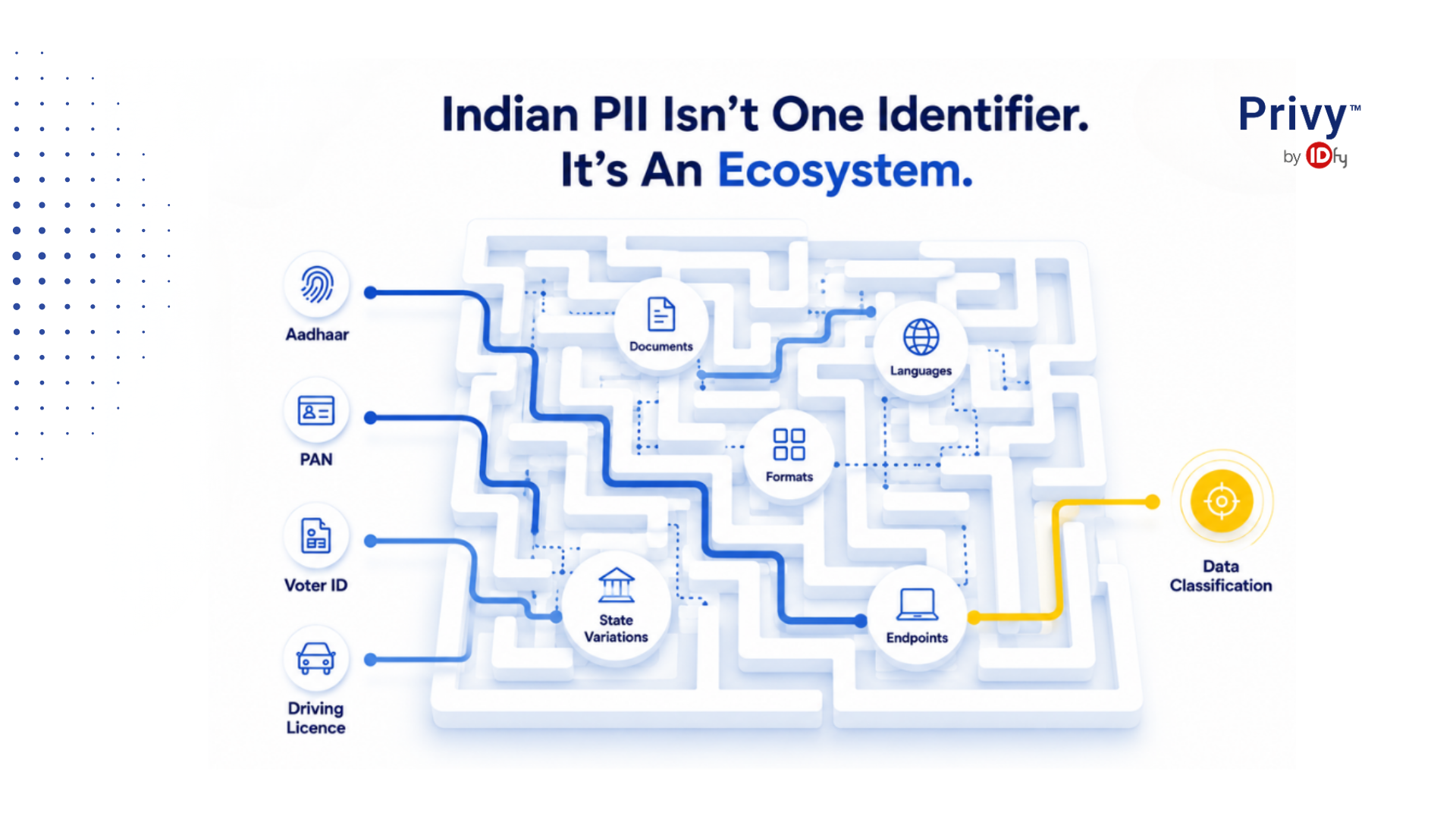
Data Classification Tools and Indian PII, The Gap That Matters
Share





 shivani@idfy.com
 Unit no. 801, Skyline Icon, 804, Andheri - Kurla Rd, Chimatpada, Marol, Andheri East, Mumbai, Maharashtra 400059
 1800 123 4339