

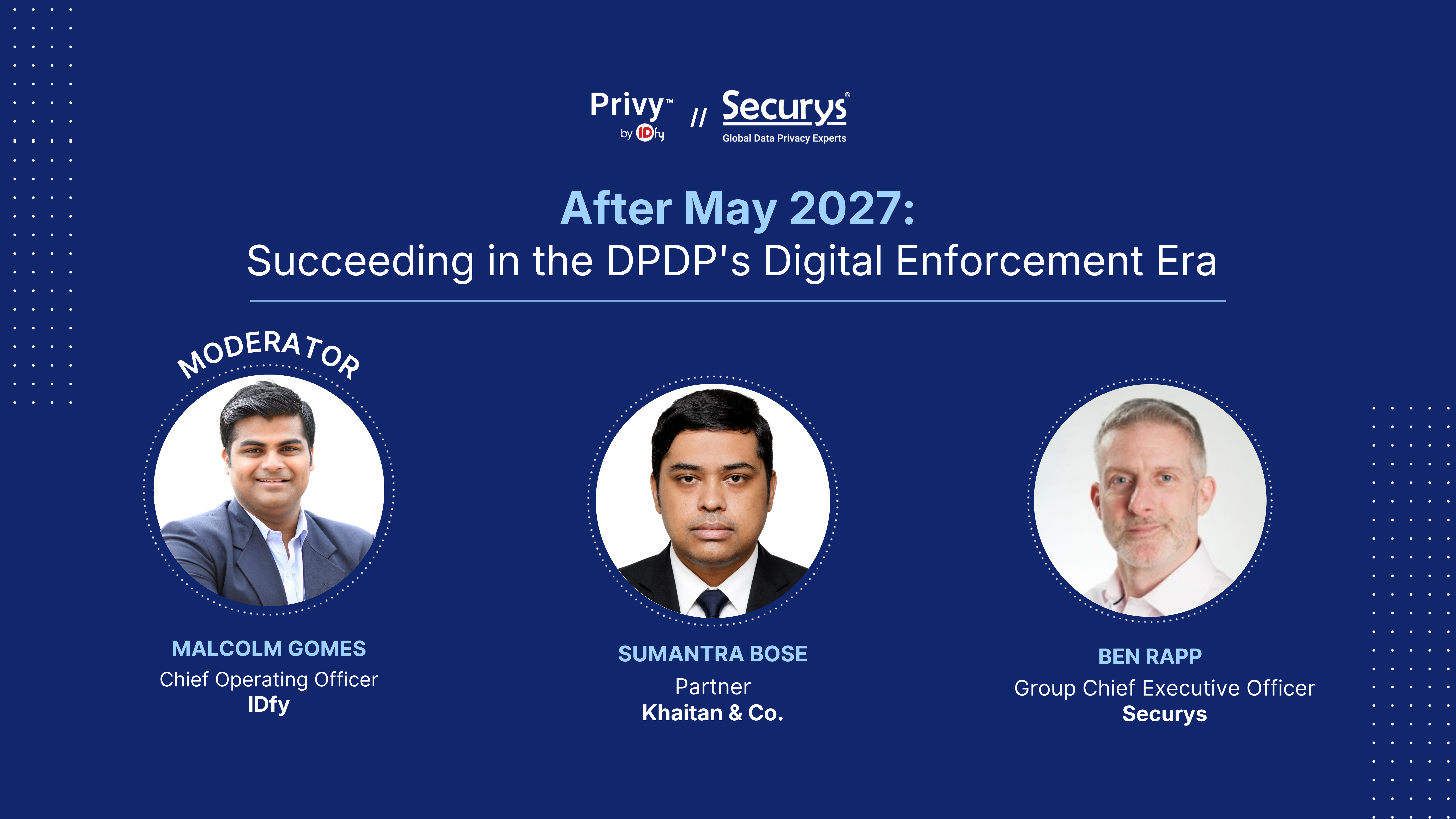
About This Webinar
As the May 2027 DPDP enforcement deadline approaches, organisations must move beyond privacy policies and compliance checklists to demonstrate operational, audit-ready compliance.
In this webinar, experts from Privy by IDfy and Securys discuss what India's DPDP enforcement era will look like, what regulators are likely to expect, and how organisations can prepare before enforcement begins.
This Webinar Covers:
 Why organisations can't afford to wait, and how to catch up if you haven't started
- Beyond GDPR: the lessons that matter for India's DPDP enforcement
- How to move from compliance planning to operational readiness
- SDF readiness, implementation priorities, and budgeting for the DPDP era
Why Watch This Now
- The countdown to May 2027 has begunWith the enforcement deadline approaching, organisations have limited time to establish the governance, controls, and operational processes needed to demonstrate DPDP compliance.
- Move beyond compliance planningLearn how to transform privacy from a policy exercise into an operational capability through structured governance, accountability, and evidence that stands up to regulatory scrutiny.
- Prepare your organisation for the enforcement eraGain practical guidance on prioritising investments, addressing implementation challenges, and building an audit-ready privacy programme that can adapt as regulatory expectations evolve.

Malcolm Gomes
COO
IDfy

Ben Rapp
Group CEO
Securys

Sumantra Bose
Partner
Khaitan & Co.
FAQs
The Board is expected to look for evidence of ongoing compliance, including governance processes, documentation, grievance handling, and accountability- not just written policies.
Understand data flows, establish governance, maintain records, train employees, and build processes that support continuous compliance.
Very important. Data fiduciaries remain accountable for how processors and third parties handle personal data, making vendor oversight and contractual controls essential.
Organizations that treat privacy as an ongoing business capability—not a one-time compliance project- will be better positioned. Embedding privacy into governance, operations, and decision-making will be key.
Treating compliance as a documentation exercise. Policies alone won't be enough—organizations must be able to demonstrate that privacy practices are operationalized, monitored, and consistently followed.





 shivani@idfy.com
 Unit no. 801, Skyline Icon, 804, Andheri - Kurla Rd, Chimatpada, Marol, Andheri East, Mumbai, Maharashtra 400059
 1800 123 4339