

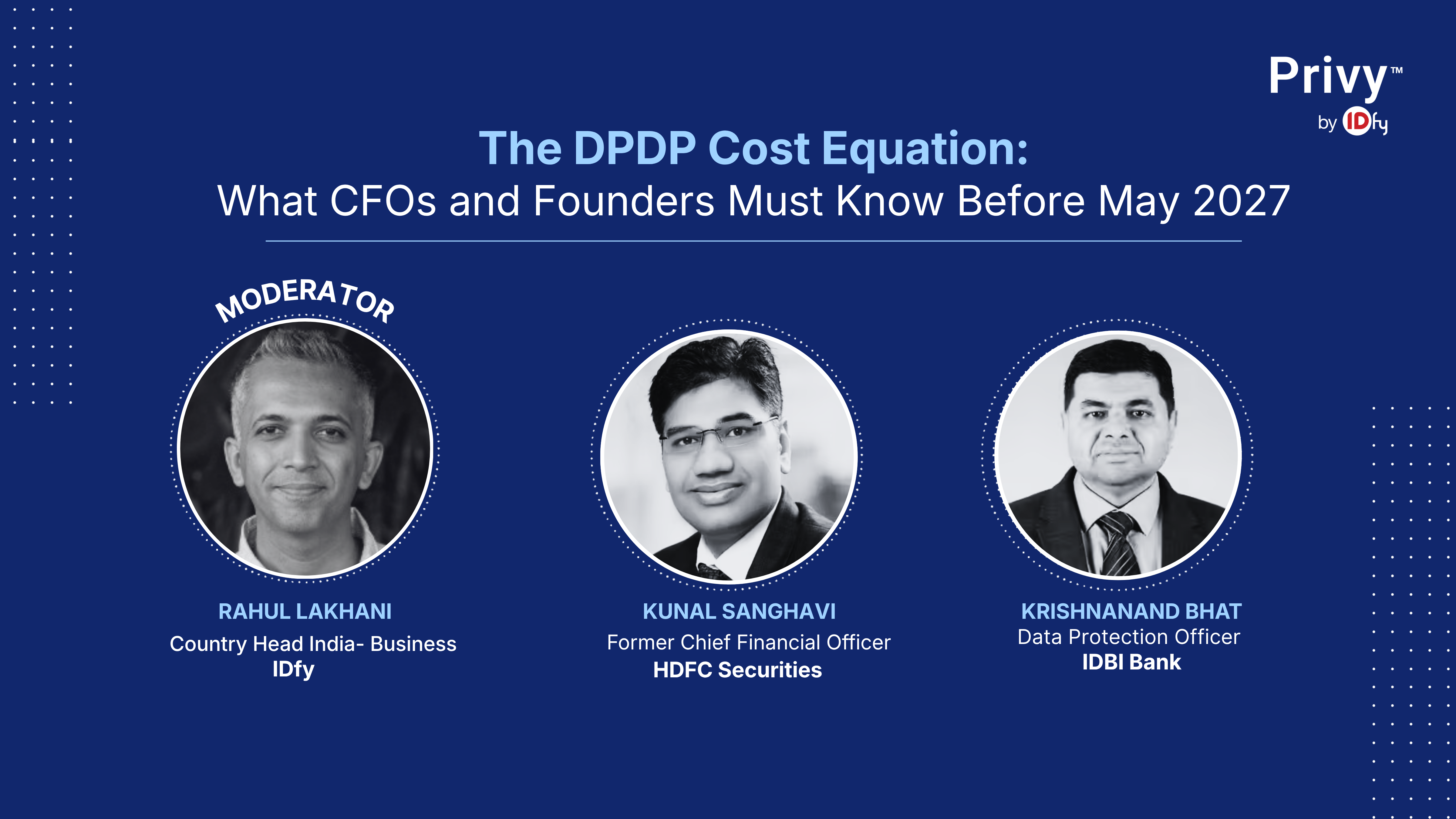
About This Webinar
With less than nine months to go before the 13 May 2027 enforcement deadline, DPDP compliance has moved from a legal checkbox to a boardroom budgeting decision. This session brings senior privacy leaders together to discuss what a defensible compliance budget actually looks like and what it costs to get it wrong.
Under DPDP Rules 2025, the obligation surface is wider than most enterprises have budgeted for: consent governance, data principal rights management, breach notification, third-party risk, and data discovery all have to be operational by 13 May 2027. For CFOs and founders, the decision between building in-house and deploying a purpose-built DPDP compliance platform is now a cost question with a hard deadline attached.
This Webinar Covers:
 The real cost of getting DPDP wrong and how one missed control cascades into security, AI, and regulatory risk
- What "getting it right the first time" means, and why it is the lowest total cost of ownership
- A practical build vs buy framework for CFOs and founders ahead of the May 2027 deadline
- What day-to-day operations look like post-May 2027 for organisations that built the foundation early, versus those still patching
Why Watch This Now
- DPDP Compliance Is Infrastructure Spend, Not a Line ItemPrivacy is the foundation AI, security, and enterprise risk all sit on. Organisations running manual DPDP compliance programmes spend significantly more year-on-year than those that automate consent logs, audit trails, and evidence collection. DPDP compliance automation cuts both the operational cost and the audit risk of managing this at scale.
- The DPDP Act Penalty Is the Smallest Part of the CostThe DPDP Act penalty ceiling is up to ₹250 crores. IBM's 2026 research puts the average data breach cost in India at ₹22 crore before legal fees and remediation, and for Significant Data Fiduciaries, exposure is higher still. The higher cost is what follows: re-architecture, extended regulator scrutiny, and repriced customer trust.
- DPDP Compliance Costs Less When You Fund It EarlyIndependent estimates put the one-time cost of building a full DPDP compliance stack in-house at ₹2.5 crore to ₹18 crore, with an 18-to-24-month build timeline. Under the DPDP Rules 2025, that timeline leaves no buffer for organisations starting today. First-time-right, funded now, is the lowest total cost of ownership before May 2027.

Rahul Lakhani
Country Head India- Business
IDfy

Kunal Sanghavi
Former Chief Financial Officer
HDFC Securities

Krishnanand Bhat
Data Protection Officer
IDBI Bank
FAQs
Independent market estimates from King Stubb & Kasiva, Protiviti, and Greyhound Research places the one-time cost of building a full in-house DPDP compliance programme at ₹2.5 crore to ₹18 crore, depending on the size of the data processing operation and the complexity of existing systems. Annual maintenance runs ₹50 lakh to ₹10 crore on top of that. A bottom-up engineering estimate for a team of eight engineers at market rates across an 18-month build timeline puts engineering spend alone at approximately ₹5 crore, before adding DPO compensation, legal review, audit, and tooling. Purpose-built DPDP compliance software compresses both the cost and the timeline, though the exact comparison depends on an organisation's data footprint and vendor terms.
A Significant Data Fiduciary (SDF) is an organisation whose processing of personal data poses significant risk to data principals, based on volume, sensitivity, national security implications, or potential societal impact. MeitY has not yet published the final SDF designation list but is expected to do so in 2026. SDFs face materially higher compliance obligations than standard Data Fiduciaries: mandatory appointment of an Indian-resident Data Protection Officer, periodic Data Protection Impact Assessments, independent data audits, and additional security safeguards. Any organisation processing personal data of more than approximately 50 lakh users should plan its DPDP compliance programme with SDF-level obligations in mind, since the cost of retrofitting compliance after designation is considerably higher than building for it upfront.
The decision turns on three variables: the size of your data footprint, your internal engineering capacity, and the time remaining before 13 May 2027. Building a full DPDP compliance stack in-house requires covering seven connected modules: consent governance, data principal rights management, cookie compliance, privacy impact assessments, incident and breach management, third-party risk management, and data discovery. Independent estimates put the build timeline at 18 to 24 months for a properly resourced team. With under nine months to the enforcement deadline, that timeline is no longer available to most enterprises. Purpose-built DPDP compliance platforms reduce implementation time significantly, though organisations with deep customisation requirements, very large in-house engineering teams, or strategic reasons to own the stack may still find a build approach viable.
The DPDP Rules were notified in November 2025 and set 13 May 2027 as the date substantive obligations become enforceable. By that date, Data Fiduciaries must have operational consent notice infrastructure meeting the language and format requirements of Rule 3, a functioning data principal rights workflow capable of processing access, correction, and erasure requests, a breach notification process that meets the prescribed reporting timelines, data processor agreements reviewed and updated for DPDP compliance, and, for Significant Data Fiduciaries, an active Privacy Impact Assessment programme. Organisations that have not started building or procuring the infrastructure have, at the time of writing, fewer than nine months to be operationally ready.
First-time-right implementation is structurally the lowest-cost approach. Organisations that deploy a comprehensive DPDP compliance programme in a single coordinated effort avoid the compounding cost of patching point solutions later: each remediation layer adds integration complexity, internal engineering time, and ongoing maintenance overhead. Three cost drivers consistently spike for organisations that delay or fragment their implementation. First, vendor selection under time pressure inflates licensing and implementation costs. Second, retroactive data mapping across legacy systems, which is required for any DPDP-compliant data governance programme, costs significantly more when done as remediation than as part of an initial scoped implementation. Third, responding to a Data Protection Board inquiry or a breach before compliance is complete carries legal and reputational costs that far exceed any savings from deferring the investment.





 shivani@idfy.com
 Unit no. 801, Skyline Icon, 804, Andheri - Kurla Rd, Chimatpada, Marol, Andheri East, Mumbai, Maharashtra 400059
 1800 123 4339