

Why the DPDP Act Matters for Telecom Now
Telecom operators act as Data Fiduciaries, while distributors, retailers, BPOs, and network vendors often act as Data Processors. DPDP adds a data protection layer alongside DoT, TRAI, and Telecommunications Act requirements.

Phased compliance timeline

Scale makes SDF designation near-certain

Two consent regimes run in parallel

Licence retention meets erasure rights

The retail chain is the exposure

State access is not a blanket exemption
Types of Personal Data Processed




Key Compliance & Data Governance Challenges

Subscriber data is fragmented across BSS/OSS, CRM, billing, network elements, analytics lakes, and BPO systems.
Onboarding consent is captured by distributors and retail agents on the operator's behalf, with quality the operator cannot see.
CDR, IPDR, and location data feed analytics and monetisation programmes whose purposes were never itemised to subscribers.
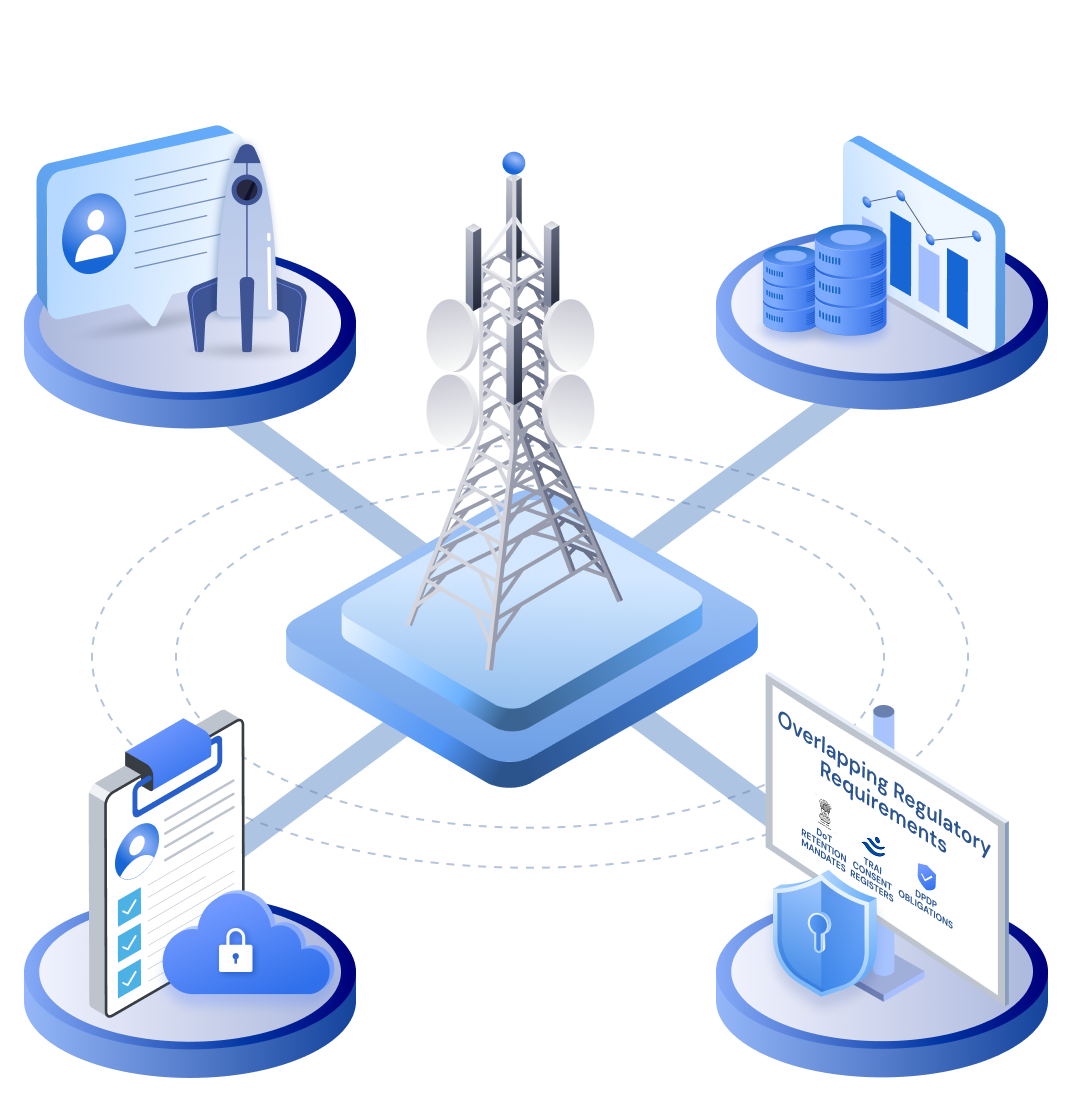
DoT retention mandates, TRAI consent registers, and DPDP obligations apply to overlapping datasets with different rules.
Network and IT vendor ecosystems, including managed services and BPOs, form one of the largest processor surfaces in any industry.
Rights requests at a national subscriber base will arrive at volumes no manual process can absorb.
Built to Solve Every DPDP Challenge
| Telecom Challenge | Privy by IDfy Capability |
|---|---|
| Subscriber data scattered across BSS/OSS, CRM, billing, and analytics lakes | Personal Data Discovery & Governance (Data Compass) maps personal data across structured systems, unstructured stores, and endpoints |
| Onboarding consent captured by distributors and agents | Consent Lifecycle Management standardises capture at point of sale, with immutable, versioned records flowing back centrally |
| Usage and location data feeding analytics without itemised purpose | Purpose mapping ties each analytics programme to a lawful basis, with masking and de-identification ahead of modelling |
| DoT retention, TCCCPR consent, and DPDP obligations overlapping | Data Compass tags each dataset by regime, automating deletion where no mandate applies |
| Vast vendor and BPO processor surface | Continuous Compliance & Risk Management assesses, contracts, and continuously monitors the full chain |
| Rights requests at national scale | Data Principal Rights Management automates intake, routing, and fulfilment across connected systems |
| Breach response spanning network, IT, and vendor systems | Continuous Compliance & Risk Management runs auditable workflows for CERT-In, DoT, and Data Protection Board notifications together |
| Care recordings and agent access without limits | Role-based access controls, retention schedules on recordings, and access audit trails |
| Anticipated SDF obligations (DPIA, India-based DPO, algorithmic due diligence) | Continuous Compliance & Risk Management runs the DPIA cycle and builds the evidence trail regulators expect |
| No single view of privacy posture across consent, data, and vendor risk | InspectAI gives a unified view across all modules, continuously scanning for gaps |

Subscriber data scattered across BSS/OSS, CRM, billing, and analytics lakes
Personal Data Discovery & Governance (Data Compass) maps personal data across structured systems, unstructured stores, and endpoints
Onboarding consent captured by distributors and agents
Consent Lifecycle Management standardises capture at point of sale, with immutable, versioned records flowing back centrally
Usage and location data feeding analytics without itemised purpose
Purpose mapping ties each analytics programme to a lawful basis, with masking and de-identification ahead of modelling
DoT retention, TCCCPR consent, and DPDP obligations overlapping
Data Compass tags each dataset by regime, automating deletion where no mandate applies
Vast vendor and BPO processor surface
Continuous Compliance & Risk Management assesses, contracts, and continuously monitors the full chain
Rights requests at national scale
Data Principal Rights Management automates intake, routing, and fulfilment across connected systems
Breach response spanning network, IT, and vendor systems
Continuous Compliance & Risk Management runs auditable workflows for CERT-In, DoT, and Data Protection Board notifications together
Care recordings and agent access without limits
Role-based access controls, retention schedules on recordings, and access audit trails
Anticipated SDF obligations (DPIA, India-based DPO, algorithmic due diligence)
Continuous Compliance & Risk Management runs the DPIA cycle and builds the evidence trail regulators expect
No single view of privacy posture across consent, data, and vendor risk
InspectAI gives a unified view across all modules, continuously scanning for gaps
Recommended Implementation Journey

Map a National Data Estate
 Discover and classify subscriber data across BSS/OSS, CRM, billing, and analytics environments.
- Audit onboarding consent quality across the distributor and retail chain.
- Classify datasets by regime: DoT retention mandate, TCCCPR register, or DPDP-only.
- Inventory network vendors, managed service providers, and BPOs; flag agreements missing DPDP terms


Standardise Consent to the Retail Edge
- Roll out standardised, evidence-grade consent capture across every point of sale.
- Reconcile TCCCPR consent registers with DPDP consent records.
- Implement rights fulfilment and breach workflows sized for a national subscriber base.
- Close flagged vendor, MSP, and BPO contracts.


Run SDF-Grade Governance
- Run DPIA cycles and algorithmic due diligence on analytics and monetisation models
- Appoint an India-based DPO and engage an independent data auditor on SDF notification.
- Enforce per-regime retention, deleting datasets no mandate co
- Continuously monitor the vendor and channel chain through the platform.

Key Takeaways

Telecom operators are Data Fiduciaries under the DPDP Act for subscriber KYC, usage, and location data; distributors, BPOs, and network vendors process it as Data Processors under their direction.

DPDP Rules 2025 were notified on 13 November 2025, with Consent Manager registration from 13 November 2026 and major obligations effective from 13 May 2027.

DoT licence retention mandates operate as a legal basis for the records they cover, but datasets outside those mandates remain subject to erasure rights and purpose limits.

TRAI's TCCCPR consent framework for commercial communications runs alongside DPDP consent; satisfying one does not satisfy the other, and penalties run up to ₹250 crore per contravention.

A unified privacy management platform enables faster regulatory responses through estate-wide data mapping, evidence-grade channel consent, automated rights fulfilment at national volume, and continuous vendor monitoring.

Early DPDP readiness lets operators fix retail-chain consent quality on a rollout schedule instead of under simultaneous DoT, TRAI, and Board scrutiny.
Why Privy by IDfy for Telecom
Operators and their service partners trust Privy by IDfy to govern subscriber data at national scale. Our platform enables discovery across the largest data estates in India, consent infrastructure that reaches the retail edge, and audit-ready evidence across the full vendor chain.

Get your subscriber data estate audit-ready
FAQs
Yes, for subscriber data collected at onboarding and generated through usage, because the operator determines purpose and means. Distributors capturing CAFs, BPOs running care lines, and network vendors act as Data Processors under its direction.
Where a licence condition requires retention, that legal mandate governs and an erasure request does not override it, for those records, for that period. Everything outside the mandate follows DPDP's purpose and retention limits. The failure mode is stretching the mandate to cover datasets it never named.
No. TCCCPR governs consent and preference for commercial communications specifically. DPDP governs consent for processing generally, with its own validity standards and withdrawal rights. The registers need to reconcile, but neither substitutes for the other.
Yes. Point-of-sale agents and distributors collect KYC on your behalf, making their conduct your accountability as fiduciary. Standardised capture flows with central, versioned records are the control that scales across a national chain.
No. State access and interception operate under their own legal framework, and the Act carves out specific state functions, not the operator's commercial processing. Analytics, marketing, and monetisation remain fully in scope.




 shivani@idfy.com
 Unit no. 801, Skyline Icon, 804, Andheri - Kurla Rd, Chimatpada, Marol, Andheri East, Mumbai, Maharashtra 400059
 1800 123 4339