

Accountability
Definition
Obligation to take responsibility for data processing and demonstrate compliance with verifiable evidence.
Accountability in data privacy refers to an organization’s responsibility not only to comply with data protection requirements but to actively demonstrate that compliance. It goes beyond having policies in place to ensuring that data processing activities are controlled, monitored, and supported by clear, verifiable records.
This principle shifts compliance from intent to proof. Organizations must be able to show how personal data is collected, used, and protected, and whether those actions align with defined purposes and obligations. In the context of the Digital Personal Data Protection Act, 2023, accountability requires organizations to implement safeguards, maintain records, and be prepared to justify data handling practices when questioned by regulators.
In practice, gaps emerge when:
- Compliance is treated as documentation rather than operational control.
- Policies exist but are not enforced in actual data workflows.
- There is limited visibility into how personal data is used across systems.
- Organizations cannot produce consistent evidence during audits or incidents.
To address this, organizations embed accountability into how systems operate by linking data processing to purpose, consent, and controls, and maintaining traceable records of all actions. This ensures that compliance is continuously demonstrated rather than reconstructed when required. Within Privy, this is supported through capabilities such as data mapping, consent lifecycle management, and audit trails, enabling organizations to operationalize accountability with visibility and proof.
Questions About Staying in Control?
Here’s everything you need to know about this term and how it fits into your compliance program.
The ability to demonstrate compliance through consistent, verifiable evidence of how data is handled.
Because controls and policies are not always connected to actual data processing activities.
By evaluating whether organizations can provide clear, traceable records that justify their data handling practices.
That having policies or certifications alone is sufficient, without the ability to prove how they are applied.
It ensures that risks are not only identified but also controlled and documented in a way that can be validated.
Still have a question?
Latest Blog

Sep 30, 2026
RBI NBFC Rules Just Banned Dark Patterns and Fake Consent
Sep 29, 2026
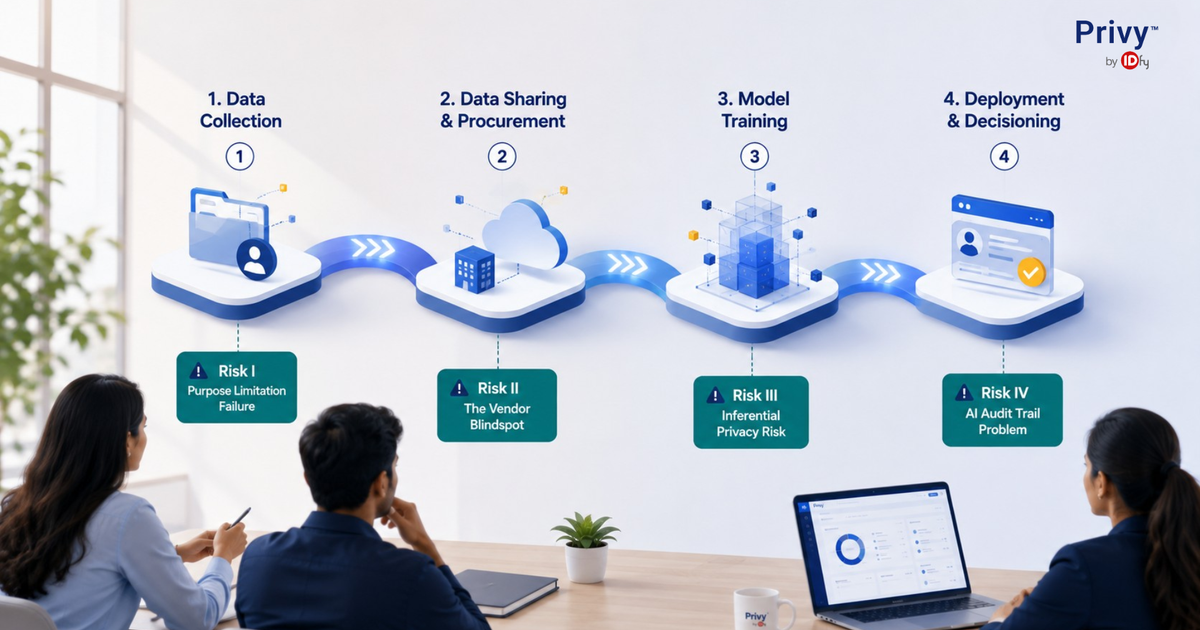
Data Privacy in the AI Era: The Four Risks Indian Corporations Have Already Inherited
Sep 10, 2026




 shivani@idfy.com
 Unit no. 801, Skyline Icon, 804, Andheri - Kurla Rd, Chimatpada, Marol, Andheri East, Mumbai, Maharashtra 400059
 1800 123 4339