

AI Risk Assessment
Definition
Process of identifying and evaluating risks in AI systems based on data usage, model behavior, and impact.
AI risk assessment refers to the structured evaluation of risks associated with how AI systems are designed, trained, and deployed. It focuses on understanding how data is used, how models behave, and what impact their decisions can have on individuals and operations. This includes risks related to bias, privacy, security, and regulatory exposure.
As AI systems become embedded in business processes, risk is not limited to model accuracy but extends to how decisions are made and justified. The assessment must consider whether personal data is used appropriately, whether outcomes are consistent and explainable, and whether controls are in place to prevent misuse. In the context of the Digital Personal Data Protection Act, 2023, this is critical when AI systems process personal data or influence user outcomes, requiring organizations to ensure lawful, purpose-driven, and accountable processing.
In practice, gaps emerge when:
- Risk assessments are conducted once and not updated as models evolve.
- Focus is limited to model performance rather than data usage and impact.
- There is no visibility into how personal data influences outcomes.
- Identified risks are not linked to enforceable controls.
To address this, organizations move toward continuous and context-driven risk assessment, where risks are evaluated across the AI lifecycle and linked to actual data flows and decision processes. This ensures that risk is not only identified but also managed in a measurable and verifiable way. Within Privy, this is supported through capabilities such as data mapping, consent lifecycle management, and audit trails, enabling organizations to assess and manage AI risks with visibility, control, and accountability.
Questions About Staying in Control?
Here’s everything you need to know about this term and how it fits into your compliance program.
It focuses not just on system security but on how data is used, how models behave, and how decisions impact individuals.
Not only before deployment but continuously as models evolve, data changes, and usage expands.
How personal data influences outcomes without visibility or control, leading to compliance and fairness issues.
Because identified risks are not linked to enforceable controls or monitored over time.
By ensuring that AI systems using personal data operate within defined purposes and can justify their outcomes.
Still have a question?
Latest Blog

Sep 30, 2026
RBI NBFC Rules Just Banned Dark Patterns and Fake Consent
Sep 29, 2026
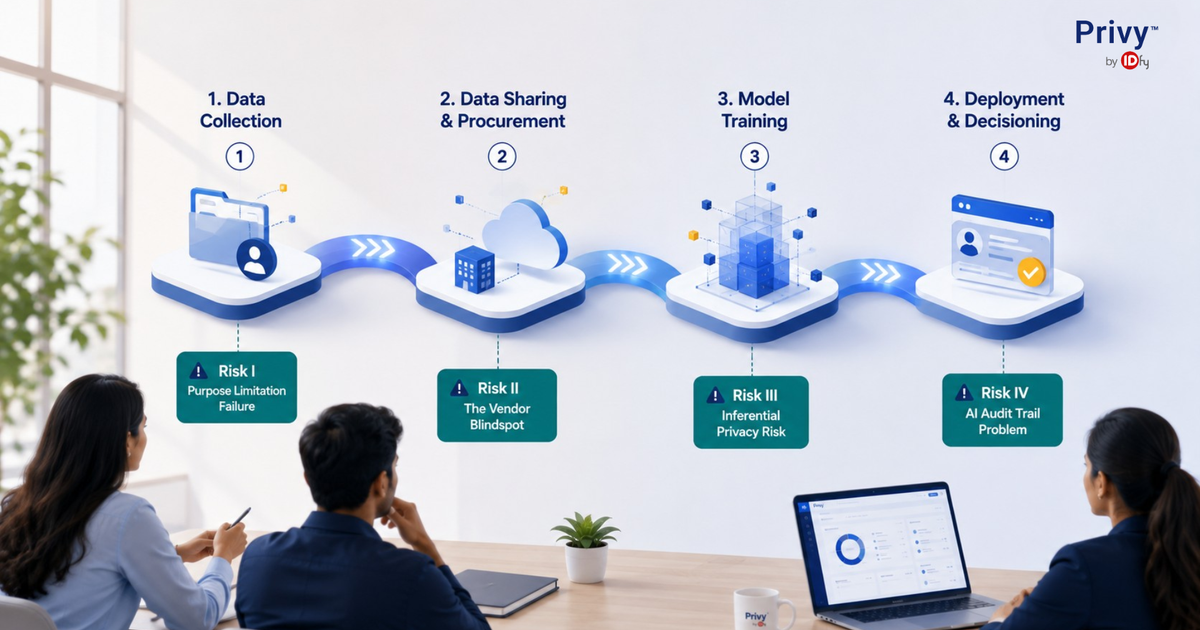
Data Privacy in the AI Era: The Four Risks Indian Corporations Have Already Inherited
Sep 10, 2026




 shivani@idfy.com
 Unit no. 801, Skyline Icon, 804, Andheri - Kurla Rd, Chimatpada, Marol, Andheri East, Mumbai, Maharashtra 400059
 1800 123 4339