

Anonymization
Definition
Irreversibly removing identifiers so individuals cannot be re-identified from data.
Anonymization is the process of transforming personal data in a way that permanently prevents the identification of individuals, either directly or indirectly. This allows organizations to use and share data for analytics, research, and operational insights without exposing personal identities. Techniques such as aggregation, masking, and data transformation are applied to remove identifiable elements while retaining utility.
Under the Digital Personal Data Protection Act, 2023, anonymized data falls outside the scope of personal data if re-identification is not reasonably possible. This makes anonymization a critical control for reducing compliance obligations, provided it is implemented rigorously. Weak or reversible techniques can still expose organizations to regulatory risk if individuals can be re-identified.
In practice, gaps emerge when:
- Anonymization techniques are reversible or insufficiently applied.
- Indirect identifiers are retained, enabling re-identification through linkage.
- Data is anonymized once but not reassessed as datasets evolve.
- There is no validation of re-identification risk before data use or sharing.
Addressing this requires applying strong anonymization methods, validating outputs against re-identification risks, and continuously monitoring how data is used and combined. This includes ensuring that anonymization is aligned with the purpose and that residual risks are assessed before data is shared. Within Privy, this is supported through capabilities such as data mapping and audit trails, enabling visibility into how data is transformed and used, and ensuring that anonymization controls are consistently applied and verifiable.
Questions About Staying in Control?
Here’s everything you need to know about this term and how it fits into your compliance program.
Anonymization is irreversible, while pseudonymization allows re-identification using additional information.
No, if data is truly anonymized and individuals cannot be re-identified, it is generally outside the scope of the law.
Poor implementation can enable re-identification, leading to compliance violations and data exposure.
By testing re-identification risk, reviewing indirect identifiers, and assessing how datasets may be combined.
Privy provides visibility into data flows and transformations, helping ensure anonymization controls are applied consistently and remain auditable.
Still have a question?
Latest Blog

Sep 30, 2026
RBI NBFC Rules Just Banned Dark Patterns and Fake Consent
Sep 29, 2026
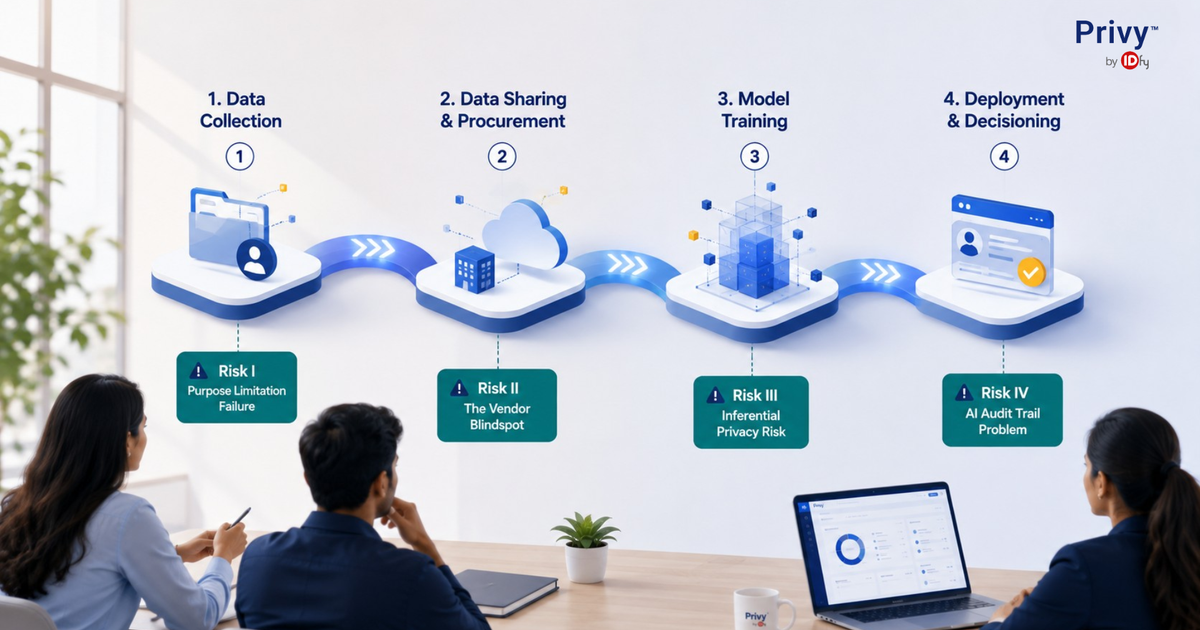
Data Privacy in the AI Era: The Four Risks Indian Corporations Have Already Inherited
Sep 10, 2026




 shivani@idfy.com
 Unit no. 801, Skyline Icon, 804, Andheri - Kurla Rd, Chimatpada, Marol, Andheri East, Mumbai, Maharashtra 400059
 1800 123 4339