

Automated Data Discovery
Definition
AI driven process to identify, classify, and map data across systems automatically.
Automated data discovery refers to the use of AI and machine learning to continuously scan systems, databases, and cloud environments to identify where data exists, what type of data it is, and how sensitive it may be. It replaces manual discovery methods with automated scanning and classification, enabling organizations to maintain an up to date view of their data landscape.
As data spreads across multiple applications and infrastructure layers, visibility becomes a core challenge. Without discovery, organizations often do not know where personal or sensitive data resides, making it difficult to govern or protect effectively. In the context of the Digital Personal Data Protection Act, 2023, this visibility is critical to ensure that personal data is identified, managed, and used within defined purposes and compliance boundaries.
In practice, gaps emerge when:
- Sensitive data exists in systems that are not scanned or monitored.
- Classification is outdated or inconsistent across environments.
- Discovery tools identify data but do not link it to ownership or usage context.
- Newly created or moved data is not detected in real time.
To address this, organizations implement continuous data discovery mechanisms that operate across environments and update classifications dynamically. This ensures that data visibility is always current and actionable. Within Privy, this is supported through capabilities such as data mapping, consent lifecycle management, and audit trails, enabling organizations to maintain continuous awareness of where data resides and how it is used.
Questions About Staying in Control?
Here’s everything you need to know about this term and how it fits into your compliance program.
Data discovery can be manual or periodic, while automated discovery continuously identifies and classifies data across systems.
Because data is constantly created, moved, and transformed, making manual tracking outdated almost immediately.
They often identify data but fail to provide full context such as ownership, purpose, or downstream usage.
It should be continuous or near real time to keep up with dynamic data environments.
By ensuring organizations know where sensitive data resides and can apply appropriate controls and governance.
Still have a question?
Latest Blog

Sep 30, 2026
RBI NBFC Rules Just Banned Dark Patterns and Fake Consent
Sep 29, 2026
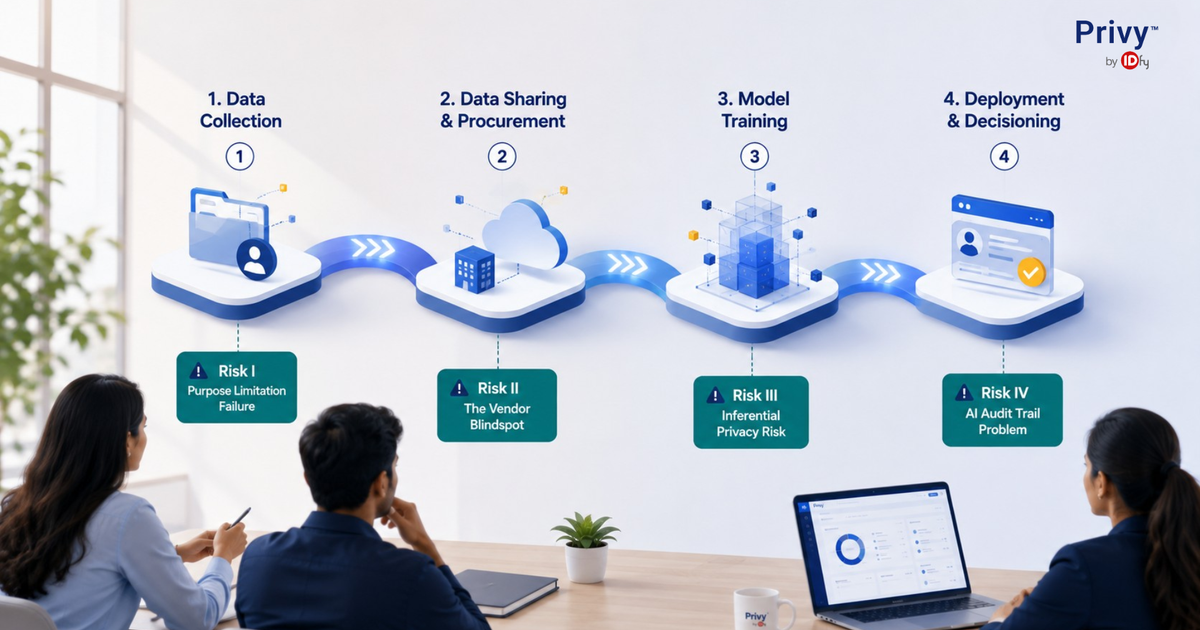
Data Privacy in the AI Era: The Four Risks Indian Corporations Have Already Inherited
Sep 10, 2026




 shivani@idfy.com
 Unit no. 801, Skyline Icon, 804, Andheri - Kurla Rd, Chimatpada, Marol, Andheri East, Mumbai, Maharashtra 400059
 1800 123 4339