

Child Data Processing
Definition
Child data processing refers to the collection, use, and management of personal data belonging to minors, where additional legal and governance safeguards apply due to heightened privacy risk.
When personal data belongs to a minor, every stage of its handling carries higher scrutiny — from initial collection to storage, sharing, and eventual deletion. Unlike standard user data flows, child-related data requires additional validation of consent authority, stricter limitations on usage, and tighter controls over how systems interact with it.
Digital platforms that serve broad user bases often face challenges in correctly distinguishing minors from adults at entry points. Once misclassification occurs, downstream systems — including onboarding flows, analytics pipelines, recommendation engines, and engagement tools — may continue processing data without the appropriate legal basis.
Under the Digital Personal Data Protection Act, 2023, processing a child’s data is only permitted when verifiable parental consent is established and continuously respected across all processing activities. This places emphasis not just on capturing consent, but on ensuring that consent status remains enforceable across interconnected systems.
In practice, gaps emerge when:
- Age signals are captured once but not consistently enforced across systems
- Parental consent exists in records, but is not linked to actual data processing workflows
- Child accounts are treated similarly to adult accounts in analytics or personalization pipelines
- Restrictions on profiling or tracking are not uniformly applied across third-party integrations
To address this, organizations shift toward governance models where age status and consent context travel with the data itself rather than remaining in isolated records. This means enforcement becomes system-driven rather than process-dependent, ensuring that every downstream interaction respects the child-specific constraints attached at the point of entry.
Within Privy, this is supported through connected identity validation, consent enforcement layers, and traceable governance records that ensure child data is consistently identified, restricted, and auditable across systems and business units.
Questions About Staying in Control?
Here’s everything you need to know about this term and how it fits into your compliance program.
Because minors are considered more vulnerable requiring stronger legal safeguards and stricter control over how their data is used.
Verifiable parental consent before any form of data processing involving a minor.
Most gaps arise when age classification is not consistently enforced across downstream systems.
Only within strict regulatory boundaries, and typically with additional restrictions or prohibitions depending on context.
The complexity comes from ensuring age-based restrictions persist across multiple interconnected systems and vendors.
Still have a question?
Latest Blog

Sep 30, 2026
RBI NBFC Rules Just Banned Dark Patterns and Fake Consent
Sep 29, 2026
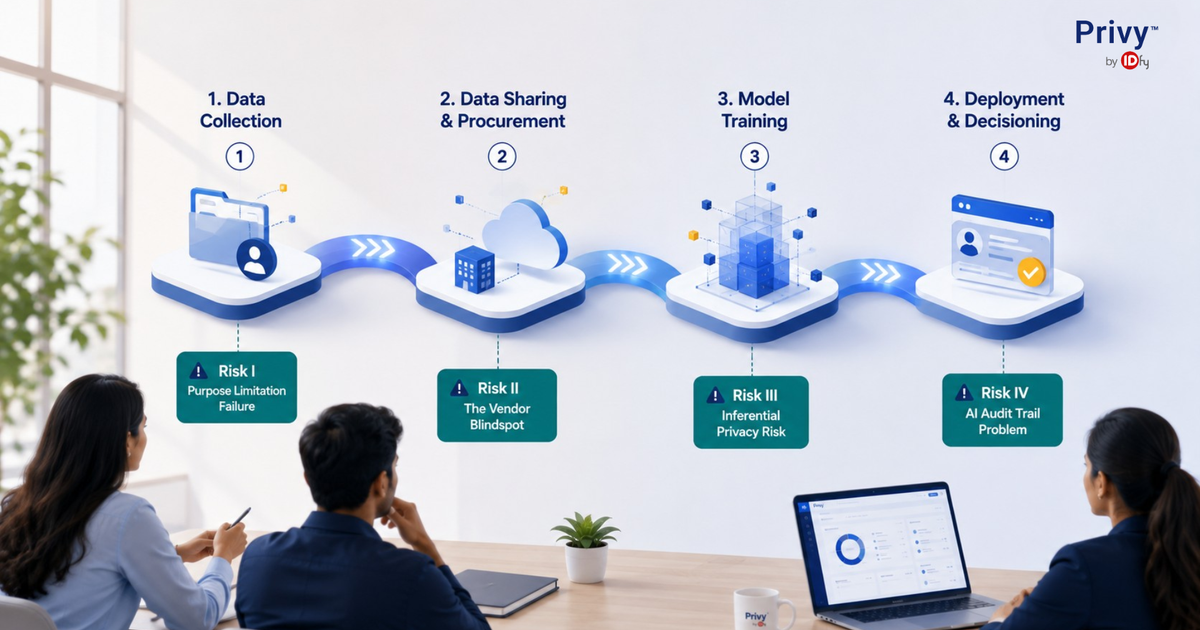
Data Privacy in the AI Era: The Four Risks Indian Corporations Have Already Inherited
Sep 10, 2026




 shivani@idfy.com
 Unit no. 801, Skyline Icon, 804, Andheri - Kurla Rd, Chimatpada, Marol, Andheri East, Mumbai, Maharashtra 400059
 1800 123 4339