

Consent Governance
Definition
Consent governance is the framework that defines how user consent is managed, enforced, and audited across an organization.
Consent governance operates as the enterprise-wide control system for consent accountability, ensuring that consent is not treated as a static record but as a continuously governed lifecycle across all data processing environments.
As organizations scale across applications, vendors, APIs, and analytics platforms, consent becomes fragmented across systems unless governed through a unified framework. Consent governance ensures that all consent-related actions capture, usage, update, and withdrawal adhere to consistent rules across the ecosystem.
Under regulations like GDPR and the Digital Personal Data Protection Act, 2023, organizations are required to demonstrate accountability over how consent is obtained, enforced, and maintained over time, making governance a regulatory necessity rather than a design choice.
In practice, gaps emerge when:
- Consent policies exist, but are not consistently enforced across systems
- Lifecycle events like revoke or update are not synchronized across platforms
- Different business units apply inconsistent interpretations of consent rules
- Audit teams cannot reconstruct end-to-end consent history reliably
To address this, organizations implement structured consent governance models that unify policy definition, enforcement logic, monitoring, and auditability into a single coordinated framework across systems.
Within Privy, consent governance ensures that every consent action remains enforceable, traceable, and aligned with regulatory requirements across its entire lifecycle.
Questions About Staying in Control?
Here’s everything you need to know about this term and how it fits into your compliance program.
Because storing consent does not ensure it is correctly enforced across all systems processing data.
Consent becomes inconsistent across systems, leading to unauthorized processing or compliance gaps.
It ensures that every lifecycle event (grant, update, revoke) is enforced uniformly across systems.
Inability to reconstruct how consent was applied at each stage of data processing.
It provides structured accountability, ensuring consent decisions can be demonstrated across systems and time.
Still have a question?
Latest Blog

Sep 30, 2026
RBI NBFC Rules Just Banned Dark Patterns and Fake Consent
Sep 29, 2026
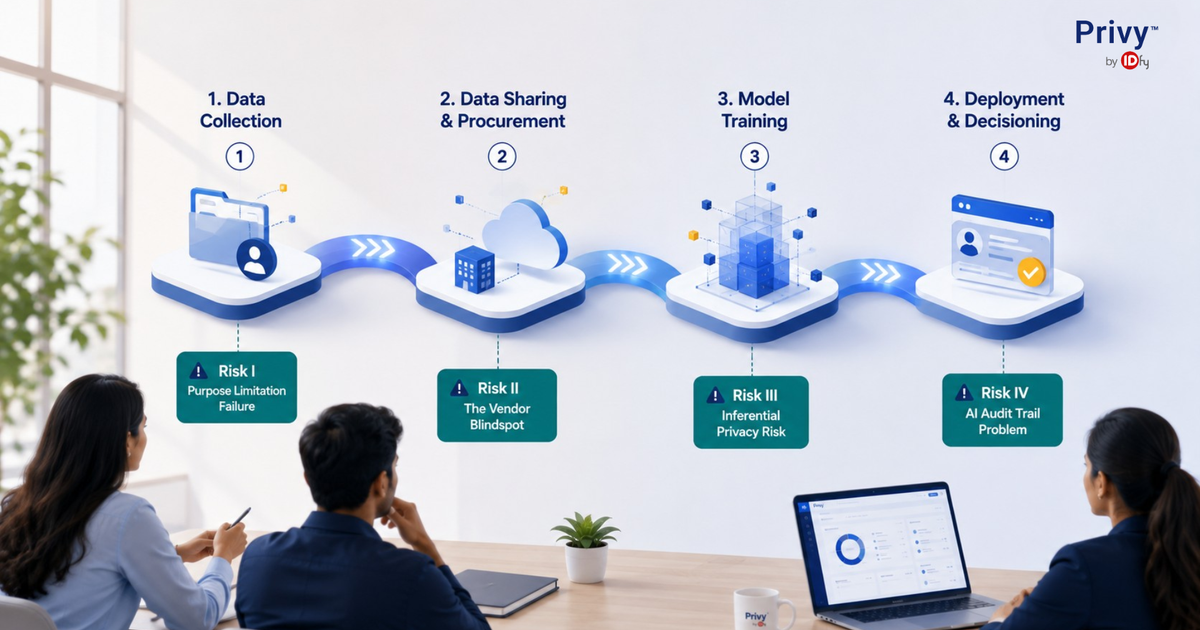
Data Privacy in the AI Era: The Four Risks Indian Corporations Have Already Inherited
Sep 10, 2026




 shivani@idfy.com
 Unit no. 801, Skyline Icon, 804, Andheri - Kurla Rd, Chimatpada, Marol, Andheri East, Mumbai, Maharashtra 400059
 1800 123 4339