

Data Protection Board of India
Definition
The Data Protection Board of India is the regulatory authority established under the Digital Personal Data Protection Act, 2023, to oversee enforcement, grievance handling, and compliance related to personal data protection.
The Data Protection Board of India (DPBI) is the adjudicatory body constituted under the Digital Personal Data Protection Act, 2023, to enforce obligations related to personal data processing in India. It is responsible for handling complaints from Data Principals, directing remedial actions, investigating personal data breaches, and determining penalties for non-compliance under the Act.
Under the DPDP Act, the Board has powers to inquire into breaches, call for information, issue directions, and impose significant financial penalties depending on the nature and impact of non-compliance. While the Act lays down the legal obligations, the DPBI operationalizes enforcement by evaluating whether organizations can demonstrate responsible and accountable data governance practices in real environments.
As organizations process personal data across cloud systems, vendors, AI models, and distributed infrastructure, the role of the DPBI extends beyond breach response. It represents a shift toward continuous accountability, where enterprises are expected to maintain operational visibility into consent governance, data flows, retention controls, rights handling, and security safeguards through audit-ready systems and measurable controls.
“In DPDP Context”
Under the Digital Personal Data Protection Act, 2023, the Data Protection Board of India is empowered to:
- Investigate personal data breaches and non-compliance events
- Hear grievances raised by Data Principals
- Direct organizations to take corrective or mitigation actions
- Impose financial penalties for violations under the Act
- Assess whether reasonable security safeguards were implemented
- Evaluate compliance with obligations related to consent, purpose limitation, and Data Principal rights
The Act also places emphasis on demonstrable accountability. This means organizations may be required to show how personal data was collected, processed, shared, retained, and protected across systems through traceable evidence and operational records.
“What Organizations Need to Demonstrate”
Organizations are increasingly expected to show:
- Traceable consent and purpose limitation records across systems
- Operational controls for access governance, retention, and deletion
- Structured workflows for Data Principal rights management
- Incident response and breach handling supported by audit trails
- Visibility into vendor ecosystems and third-party processing activities
- Evidence-backed compliance reporting without manual reconstruction
This shifts compliance from static policy documentation toward system-level governance, operational accountability, and continuous compliance readiness.
Questions About Staying in Control?
Here’s everything you need to know about this term and how it fits into your compliance program.
The DPBI is responsible for enforcing the DPDP Act by handling complaints, investigating breaches, assessing non-compliance, and directing corrective actions.
Yes. Under the DPDP Act, the Board has the authority to impose financial penalties depending on the severity and nature of non-compliance.
The Board may investigate personal data breaches, failure to implement safeguards, non-compliance with consent obligations, and violations of Data Principal rights.
Because organizations may need to demonstrate how privacy controls function across systems through logs, workflows, audit trails, and governance records.
By implementing connected governance workflows, continuous monitoring, audit-ready controls, and traceable compliance operations across the data lifecycle.
Still have a question?
Latest Blog

Sep 30, 2026
RBI NBFC Rules Just Banned Dark Patterns and Fake Consent
Sep 29, 2026
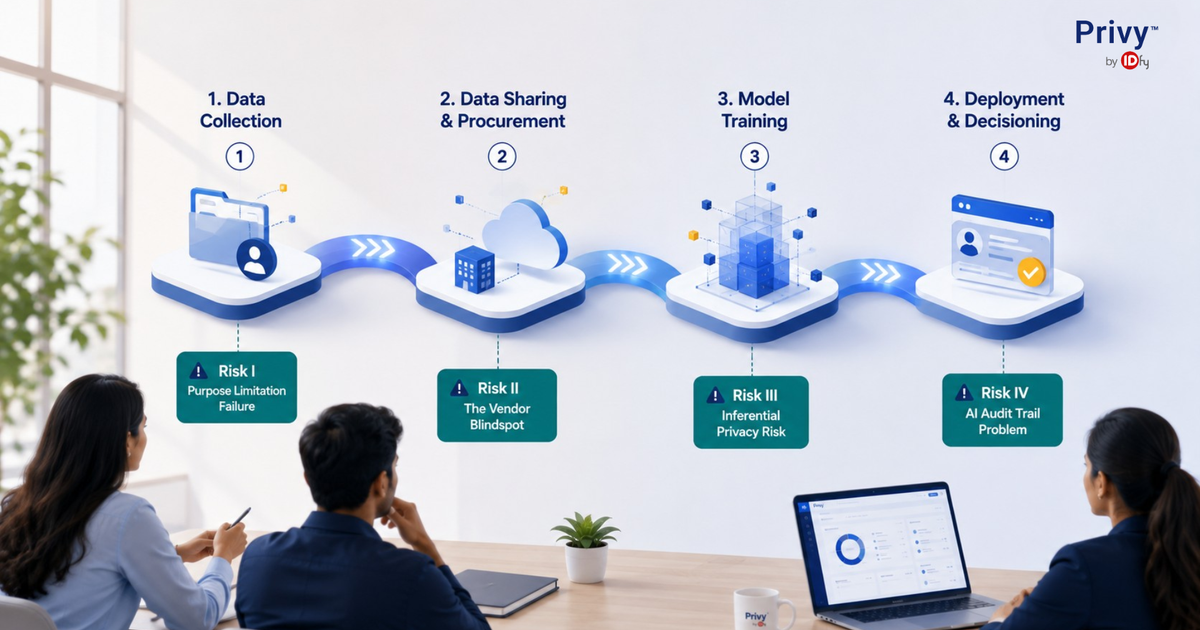
Data Privacy in the AI Era: The Four Risks Indian Corporations Have Already Inherited
Sep 10, 2026




 shivani@idfy.com
 Unit no. 801, Skyline Icon, 804, Andheri - Kurla Rd, Chimatpada, Marol, Andheri East, Mumbai, Maharashtra 400059
 1800 123 4339