
The DPDP Build Trap: Why AI-Ready Compliance Needs a Bought Platform
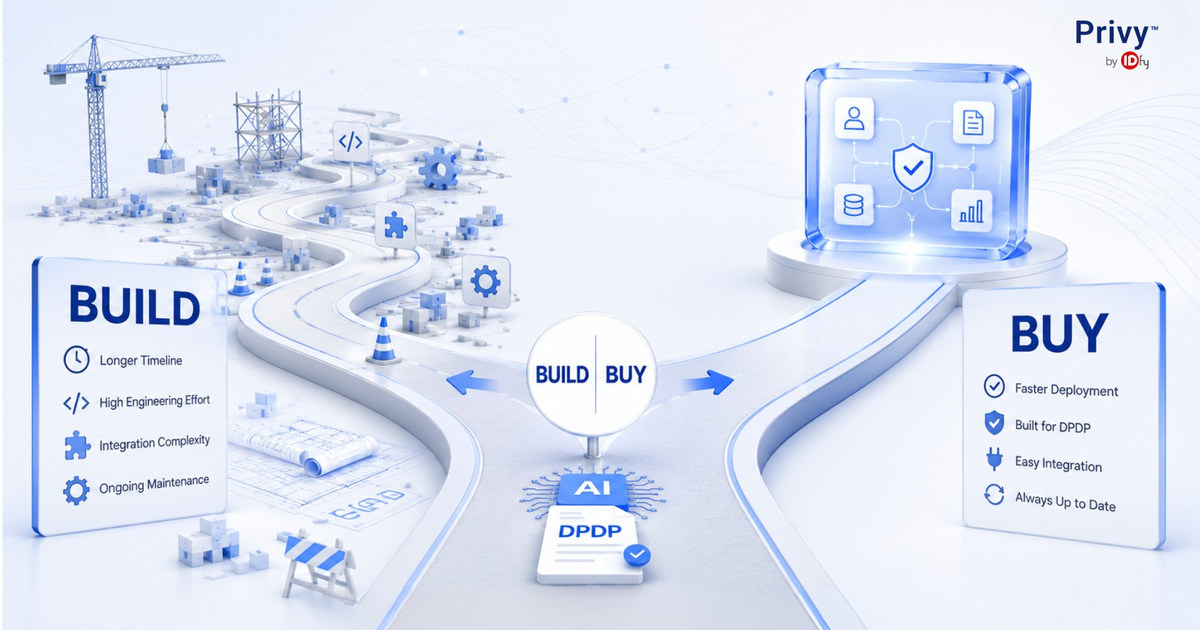
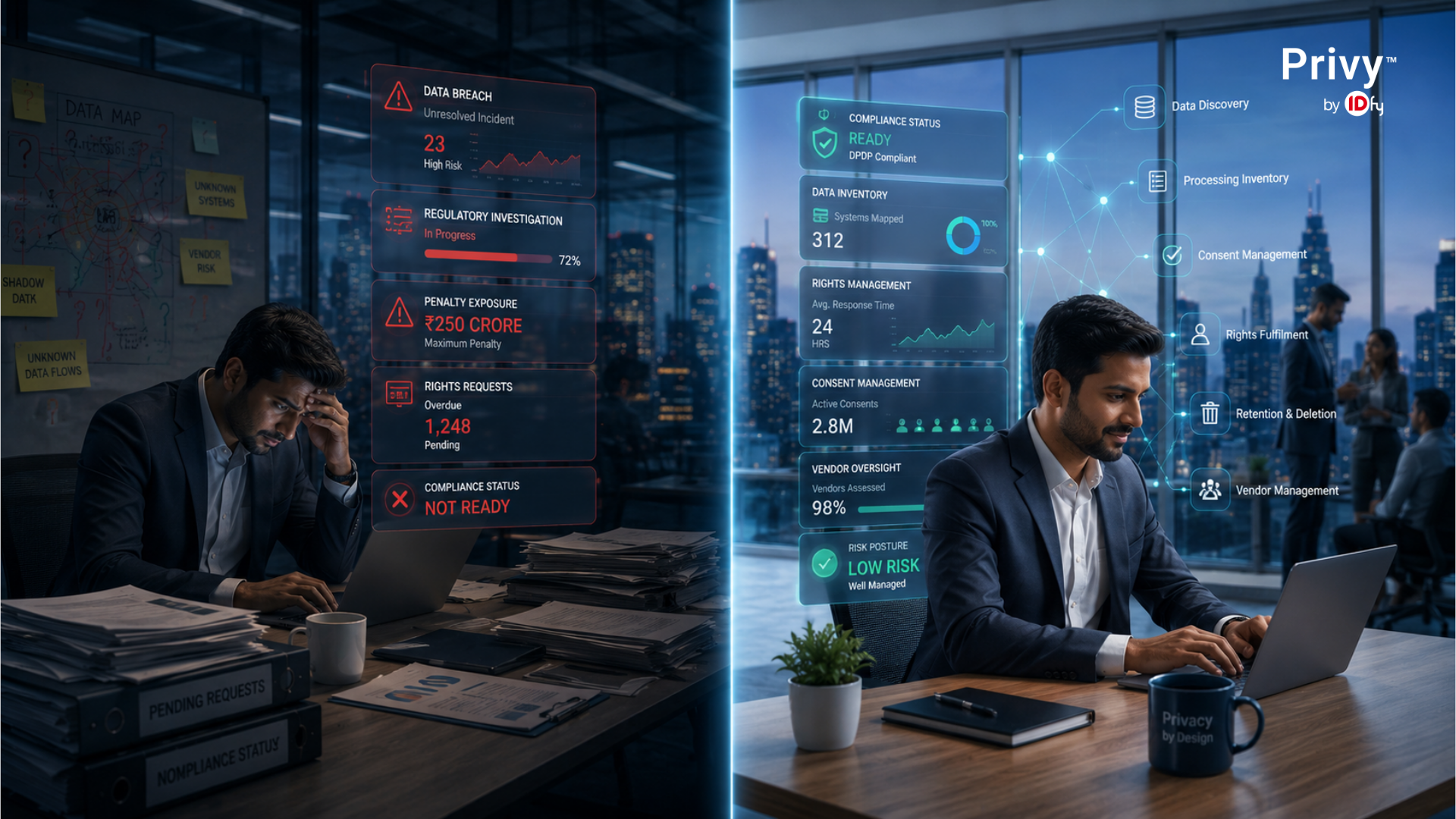
Every enterprise heading into the DPDP deadline eventually faces the same choice: build the compliance stack in-house or buy a platform. The cost side of that decision is now well documented in IDfy's build-versus-buy analysis and independent market estimates from King Stubb & Kasiva, Protiviti, and Greyhound Research. This blog makes a different argument. The problem with building is not primarily that it costs ₹2.5 crore to ₹18 crore. The problem is that a DPDP build is a trap: a project structured so that every exit point arrives after the point of no return, and the thing you finish building is obsolete on delivery in a compliance environment that now moves at machine speed.
Four mechanisms make it a trap rather than merely an expensive option. Each one operates independently. Most in-house programmes walk into all four.
Trap 1: The Scope You Approved Is Not the Scope You Owe
Build proposals almost always begin life as a consent project, because consent is the obligation everyone can see. This needs 7 connected capabilities: consent lifecycle with Rule 3-compliant notices, data principal rights fulfilment on statutory timelines, personal data discovery and classification across every system that holds it, privacy impact assessments, vendor and processor governance, incident and breach management against the 72-hour detailed report, and an evidence layer that can survive an audit.
The trap mechanism is that this scope reveals itself sequentially. The consent module ships, and then someone asks how withdrawal-triggered deletion will execute against data nobody has mapped. Discovery becomes a change request. Discovery surfaces processors nobody contracted for, and vendor governance becomes a change request. Each expansion arrives after the previous investment, which is precisely the condition under which organisations escalate commitment rather than reassess. Eighteen months in, the question "Should we have built this?" has become unaskable, because the only thing worse than an expensive build is an expensive build abandoned. Sunk cost does the deciding from there.
A related failure hides inside apparent success: the shipped v1. A working consent banner and purpose-mapped consent flow create the organisational feeling of compliance while six of the seven obligations remain unbuilt. The feeling is the danger. Boards stop asking, budgets move on, and the gap sits unexamined until a data principal request or a breach opens it in public.
Trap 2: The Calendar Is Already Decided
The DPDP Rules were notified in November 2025, and the core obligations commence on 13 May 2027. A realistic in-house build of the full seven-module surface runs 18 to 24 months before integration testing against core systems, security review, and the operational shakedown that separates software that exists from software that works under a regulator's clock. A build greenlit today reaches dependable production after the obligations are already enforceable, and that arithmetic assumes no attrition on a team doing compliance plumbing while the rest of the market hires them for AI work, no scope growth (see Trap 1), and no mid-build reinterpretation of the Rules.
Enterprises that started building in 2024 had a defensible bet. In 2026, the deadline has quietly converted the build option into a decision to be non-compliant for the first year of enforcement, and it deserves to be stated to the board in exactly those words.
Trap 3: There Is No Finish Line
The build proposal prices a project. The obligation is a function. Every direction the Data Protection Board issues, every clarification from MeitY, and every new rule commencement is an engineering event for an in-house stack: interpret, re-specify, rebuild, retest, redeploy, and re-evidence. Independent estimates put the recurring cost of running an in-house programme at ₹50 lakh to ₹10 crore a year (King Stubb & Kasiva), and the number rises with regulatory activity, because that is what it indexes. The DPO's operating burden grows the same way: the person accountable to the board becomes dependent on an internal engineering queue for every response to regulatory change.
This is the least visible trap because it never presents as a decision. Nobody approves of "a permanent internal product team competing for headcount against revenue engineering. It simply accretes, one Board direction at a time, until the compliance stack is the oldest unloved codebase in the company and the engineers who understood it have left.
Trap 4: The Stack You Would Have to Build Is No Longer 2023's
The deepest trap is that the build target moved. The estimates above were framed around the Act's original shape: consent, rights, records, and breach. Two developments have redrawn the surface since, and both are AI-shaped.
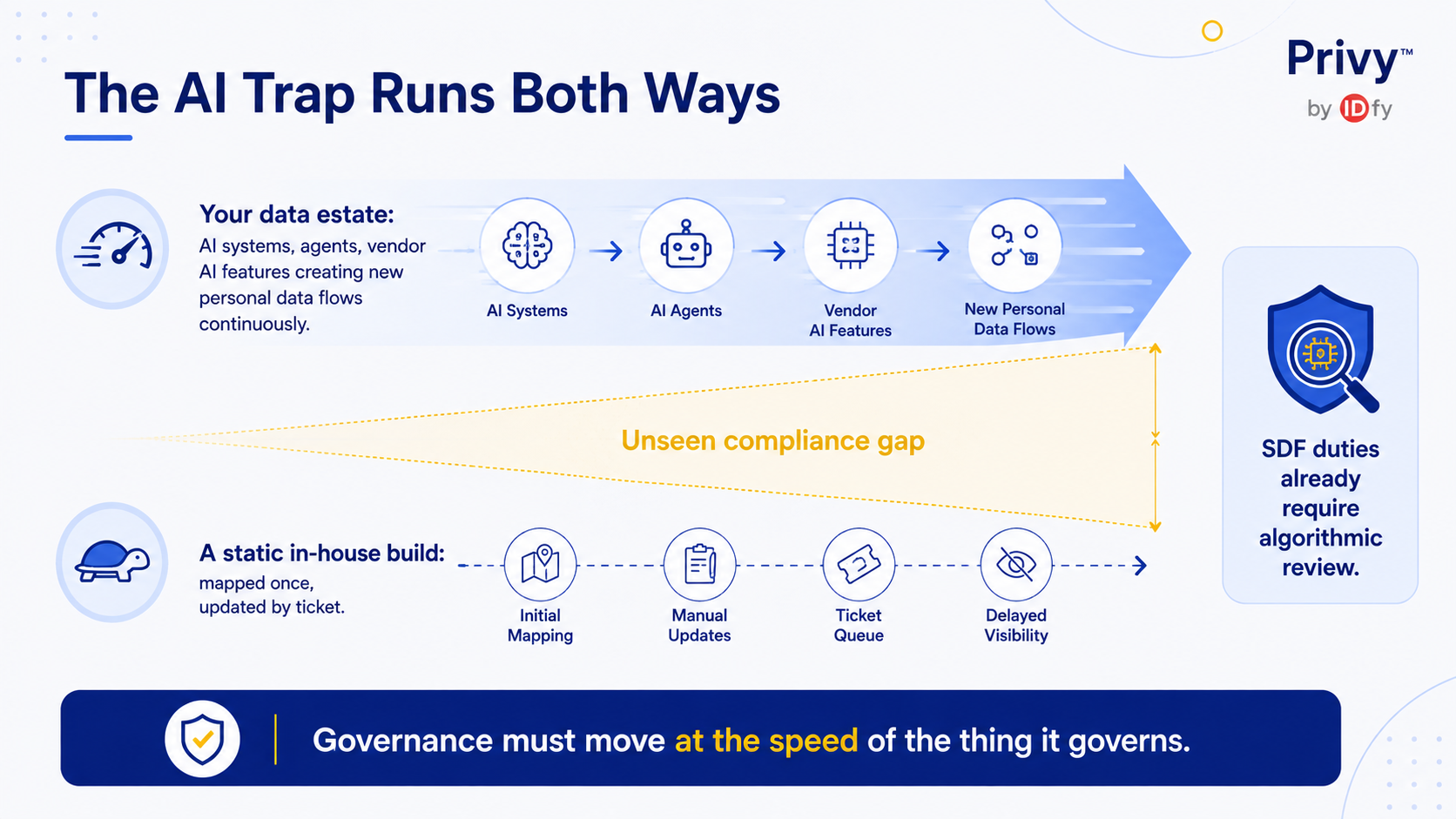
The first is inside the enterprise. Companies are deploying AI systems, copilots, and agent workflows that create personal data flows faster than any manual mapping exercise can track: models trained on customer records, agents calling internal APIs, and vendors quietly adding AI features that repurpose data. Significant Data Fiduciary obligations already reach this, requiring verification that algorithmic systems do not endanger data principals' rights, and DPIAs on high-risk processing pull model governance into the privacy programme. A compliance stack that cannot see machine-created data flows is blind to the fastest-growing part of the estate it governs, and AI-driven risk detection is the only approach that operates at the same speed as the thing it watches.
There is a one-question acid test for whether a stack is AI-ready: can it answer, "Which consented records may train this model?" Answering requires purpose-level consent stored as queryable provenance, joined to a live map of where those records sit, at the moment a data scientist asks. A consent database bolted to a spreadsheet, RoPA cannot produce that answer; it was never designed to be interrogated by machines about machines. Most in-house designs on the table today are consent databases bolted to spreadsheet RoPAs.
The second is in the tooling itself. Compliance operations are becoming AI-native: continuous, automated inspection of digital journeys, gap detection before go-live, and evidence assembled as a by-product of operations rather than a quarterly scramble. Building that capability is not a compliance side project; it is an AI product programme, with model development, training data, and evaluation infrastructure of its own. The honest 2026 build scope is therefore not the seven modules the cost estimates priced. It is seven modules plus an AI governance and inspection layer, which means the published build estimates are, if anything, floors. How AI is reshaping privacy governance is no longer a trend piece; it is the specification.
What the Numbers Say, Briefly
Independent estimates consistently show that building a DPDPA compliance platform in-house is a multi-crore investment. Large enterprises can expect one-time costs ranging from ₹2.5 crore to ₹18 crore, with annual maintenance costs between ₹50 lakh and ₹10 crore. The biggest expense is engineering: an eight-member team working for 18 months can cost around ₹5.4 crore before accounting for infrastructure, legal review, audits, or a dedicated Data Protection Officer.
Those costs also exclude the financial impact of non-compliance. IBM estimates the average data breach in India costs around ₹22 crore, while the DPDP Act allows penalties of up to ₹250 crore for security safeguard failures and up to ₹200 crore for breach notification failures arising from the same incident. In other words, the true cost of building is not just development; it is the risk of getting compliance wrong.
One counter-view deserves honest airing: some vendors argue the headline quotes are inflated and that disciplined architecture cuts compliance cost by more than half. Read closely, that argument supports buying smart, not building; its own conclusion is that consent infrastructure, withdrawal-triggered deletion, and auditable rights handling are punishingly hard to operate without dedicated platform infrastructure.
The Standard a Bought Platform Has to Meet
Buying only escapes the trap if the platform actually covers the surface, so the evaluation standard matters more than the decision. Demand the full obligation set in one connected system, not a consent point tool with six gaps: that means consent lifecycle, rights fulfilment, discovery and classification, PIA workflows, vendor governance, incident management built for the 72-hour clock, and evidence generated as a by-product of operation. Demand India-native design: DPDP terminology, Eighth Schedule languages, Aadhaar and PAN-aware classification, not a retrofitted global product. And demand the AI layer as a present capability rather than a roadmap slide.
Privy by IDfy is built to that standard. Its Consent Governance Platform runs the consent lifecycle with immutable artefacts at enterprise scale; Data Compass is DPDP-native discovery and classification across systems and endpoints, trained on Indian identity documents; and InspectAI is the AI inspection layer Trap 4 describes, scanning live digital journeys for compliance gaps continuously rather than by audit cycle. Our platform won MeitY's DPDP Innovation Challenge, evaluated on legal alignment, technical depth, and live demonstration, and runs in production at enterprises including Axis Bank, HSBC, Wakefit, and more.
Conclusion
The build-versus-buy question, asked properly in 2026, is not about software preference. It is about whether an enterprise wants to enter a project whose scope is discovered after commitment, whose deadline has already passed for new starts, whose maintenance never ends, and whose target specification now includes an AI layer the original estimates never priced. That is the build trap, and the way out is not a better project plan. It is declining the project and holding a bought platform to the full standard instead.
To see how Privy by IDfy covers the seven-module surface with the AI layer built in, write to shivani@idfy.com for a walkthrough. To know more about Build vs Buy, click here.
FAQs
Is building DPDP compliance in-house ever cheaper than buying?
On engineering arithmetic alone, rarely for the full obligation set: independent estimates put a large-enterprise build at ₹2.5 to 18 crore one-time plus ₹50 lakh to 10 crore recurring, and the from-scratch path trends to the upper half. Claims of dramatically cheaper compliance generally describe buying well-architected infrastructure, not building it.
What makes a build a "trap" rather than just expensive?
Four mechanisms: scope that reveals itself after investment is committed, a deadline that has already outrun the build timeline, maintenance that converts a project into a permanent product team, and an AI-shaped expansion of the compliance surface that makes the original build target obsolete. Each arrives after the natural exit points have passed.
Why does AI change the build-versus-buy calculation?
In both directions. Enterprise AI adoption creates personal data flows faster than manual mapping can track, while SDF obligations already require algorithmic review, and compliance tooling itself is becoming AI-native, so a credible build now includes an AI inspection layer, which is a product programme in its own right.
Does buying a platform transfer legal liability?
No. The Data Fiduciary remains accountable under the Act regardless of tooling. What a platform transfers is execution risk, the maintenance burden of regulatory change, and the evidence problem. Liability for outcomes stays with the enterprise, which is exactly why the reliability of the infrastructure matters.
Search Here
Explore More

Feb 16, 2026
DPDP Compliance at Scale: A 90-Day Implementation Guide for Indian Enterprises

Aug 11, 2026
DPDP for Board: A Leadership Framework
Jun 03, 2026
Aftermath of DPDP In 2027, What Happens After the Deadline
Share




 shivani@idfy.com
 Unit no. 801, Skyline Icon, 804, Andheri - Kurla Rd, Chimatpada, Marol, Andheri East, Mumbai, Maharashtra 400059
 1800 123 4339